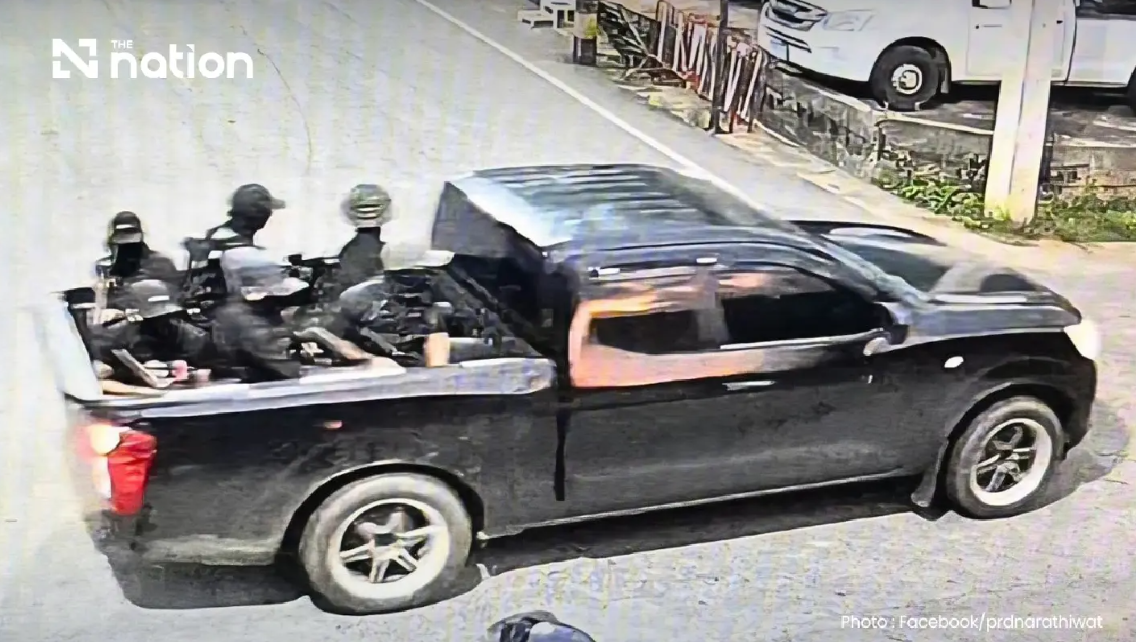
A meticulously planned military-style assault on a Thai ranger checkpoint in Narathiwat's Ra-ngae district on Wednesday evening has been captured on security cameras, providing authorities with detailed evidence of how nine attackers systematically overwhelmed the post in little more than a minute and a half. The Bukeh Sami checkpoint, located in Village 7 of Tanyong Mat subdistrict and staffed by members of the 4509th Ranger Company, came under attack at approximately 6:45pm on July 22, resulting in the deaths of all five rangers stationed there and injuries to six nearby civilians, including a young child.
The assault unfolded with military precision across two distinct operational teams working in coordinated fashion. Initial security assessments had suggested six attackers were responsible, but detailed analysis of footage from multiple external camera angles subsequently revealed the involvement of nine individuals. The primary strike force consisted of seven members travelling in a black Nissan pickup truck bearing Songkhla province registration number ผน 6866. These individuals wore dark clothing styled to resemble paramilitary uniforms and covered their heads with wide-brimmed hats that obscured much of their facial features. A single occupant controlled the vehicle while six additional assailants positioned themselves in the truck bed, a formation that would prove devastatingly effective during the initial assault phase.
Supporting this main element was a two-person rapid response team mounted on a red-and-white Honda Wave motorcycle, whose registration details remained obscured from camera view. The motorcyclist, dressed in a white shirt and wearing a helmet, was armed with an 11mm pistol and functioned as a secondary security element. His passenger, disguised in a black women's hijab in what appears to be a deliberate misdirection tactic, carried an AK-pattern rifle. This backup team followed the pickup as it approached the checkpoint from the direction of Tanyong Mat market, apparently providing covering fire and rear security as the main assault commenced.
The attack sequence itself unfolded with chilling efficiency. Three rangers were positioned at a roadside checkpoint entrance when the Nissan pickup began to decelerate in front of their position. The occupants of the truck bed immediately opened fire using M16 and AK-type rifles, rapidly neutralizing all three officers stationed at this forward position. The vehicle then halted, allowing several assailants to dismount and continue their barrage toward the checkpoint structure and its reinforced bunker, where two additional rangers sought cover. The bunker walls bore evidence of intense automatic weapons fire following the initial ambush.
Following their elimination of the ranger contingent, the attackers proceeded to methodically search the checkpoint post, gathering weapons and equipment before executing an organized withdrawal to their vehicles. As the assault group departed toward Dusongyo subdistrict, one member discharged a pipe bomb toward an elevated structure positioned near a bridge adjacent to the checkpoint, a final act of destruction that underscored the tactical sophistication of the operation. The entire sequence, from initial approach to complete withdrawal, consumed approximately 90 seconds. All five ranger casualties—Sergeant Major First Class Theerayut Somakerd, and ranger volunteers Sakiriya Jena, Wimon Dabthong, Nattasit Kaewsena, and Salahuding Pi—were pronounced dead at the scene.
The immediate aftermath brought responses from senior provincial and military leadership. Narathiwat Governor Boonchuay Homyamyen coordinated with Provincial Police Region 9 Commissioner Pol Lt Gen Piyawat Chalermsri, Narathiwat police chief Pol Maj Gen Prayong Khot Sakha, and Col Witthaya Sariya, commander of the 45th Ranger Regiment Task Force, in overseeing detailed forensic examination throughout the night. Specialized teams including bomb-disposal experts, tactical police units, and evidence collectors worked methodically through the hours following the assault. The intensity of the exchange became apparent through ballistic evidence: investigators recovered more than 100 spent cartridge cases scattered across the roadway, representing rounds from the M16 rifles, AK-pattern weapons, and 11mm pistol employed during the attack, along with ammunition apparently ejected when attackers cleared weapon malfunctions during sustained fire.
Weapons and equipment losses proved substantial. The attackers successfully departed with four folding-stock AK-type rifles, one 11mm pistol, four ammunition magazines, and four protective vests before initiating their escape. The precise inventory remained subject to ongoing verification, as initial accounts contained discrepancies regarding the quantity and specification of items taken. Evidence of the destruction of the Nissan pickup later recovered burned and abandoned—apparently a deliberate attempt to eliminate forensic evidence—further suggests the perpetrators had contingency plans for sanitizing their operational footprint.
The assault represents another chapter in the persistent low-intensity conflict affecting Thailand's southernmost provinces, where separatist and militant movements continue periodic attacks against security forces. The checkpoint raid demonstrates tactical evolution in planning and execution, with assailants employing coordinated multi-element tactics, disguise measures, and deliberate counter-forensics procedures. The involvement of civilians, particularly the 10-year-old boy among the injured, underscores how such violence inevitably claims broader community consequences beyond its intended military targets. Security forces rapidly established checkpoints and roadblocks throughout potential escape corridors, though the attackers' apparent success in initial withdrawal suggests preparation for exfiltration routes. For Malaysia and other Southeast Asian nations monitoring security developments in the region, the incident illustrates the sophistication increasingly demonstrated by militant actors operating across the broader subregion.

