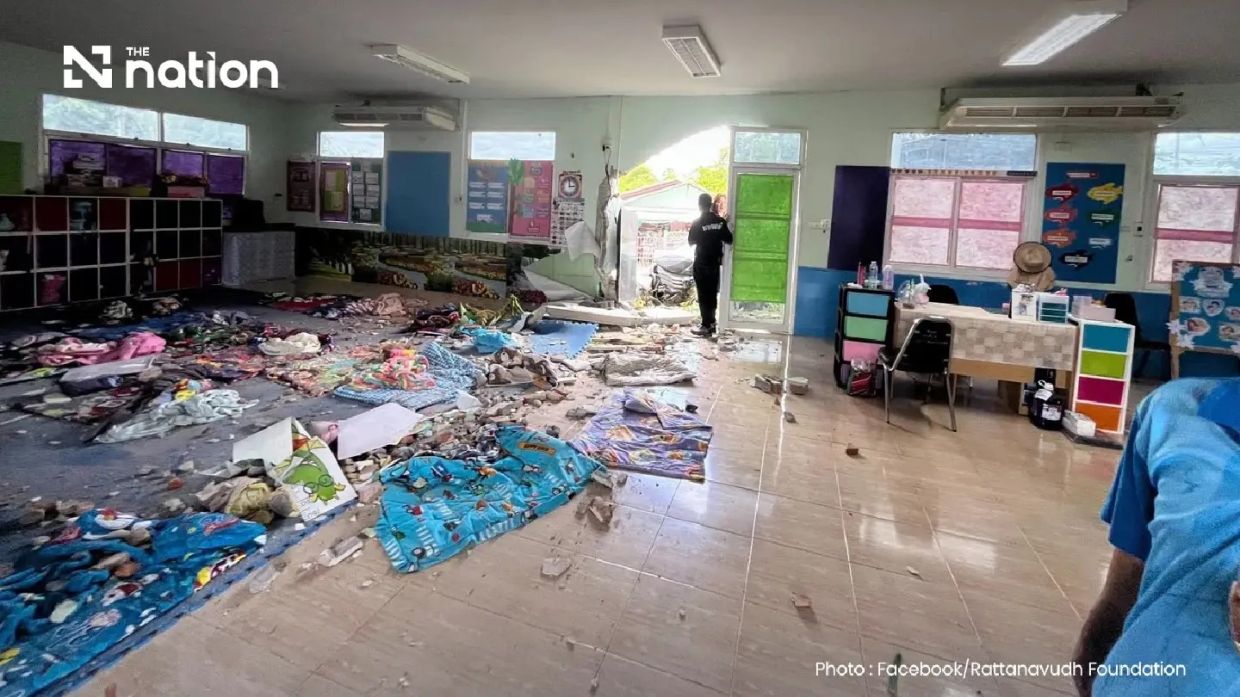
A terrifying accident unfolded in Thailand's Kanchanaburi Province when a private vehicle suddenly lost control and ploughed into the Ban Nong Song Ton Child Development Centre on Friday, August 7, 2026. The collision struck a classroom where young pupils were engaged in their afternoon rest period, leaving 15 of the facility's 34 children injured. The impact caused structural damage to the building and scattered debris throughout the classroom, creating a chaotic scene that alarmed emergency responders and the local community.
The injured children sustained a range of injuries stemming from the violent collision. Head wounds proved most common among the victims, while others suffered cuts and contusions from broken debris and structural fragments scattered across the classroom floor. Beyond the physical trauma, many of the young victims experienced emotional shock from the sudden and frightening nature of the incident. Staff at the facility immediately began providing basic care while emergency services were mobilised to respond to the crisis.
Emergency rescue personnel and representatives from the Rattanavudh Foundation and the Phithak Kan Foundation arrived swiftly at the scene. These responders provided critical first aid treatment to the injured children before coordinating their rapid transport to Phaholpolpayuhasaena Hospital. The decision to move all injured children to hospital reflected the seriousness with which authorities treated the incident, ensuring that even those with apparently minor injuries could receive thorough medical evaluation and monitoring. Road clearances were arranged along the route to Mueang Kanchanaburi district to facilitate the emergency response and prevent delays in medical treatment.
The timing of the accident contributed significantly to the scale of the incident. The collision occurred during the afternoon nap period when children at the facility were most vulnerable and concentrated in one location. Had the crash occurred during more dispersed activities or when children were better able to move away from danger, the number of injuries might have been substantially lower. This timing underscores how seemingly routine facility operations can be disrupted dramatically by unexpected incidents.
According to facility records reviewed by staff following the accident, a total of 34 children had attended the Ban Nong Song Ton Child Development Centre that day. The fact that only 15 sustained injuries meant that 19 children emerged completely unharmed from the incident. This distribution of injuries and the absence of fatalities represented a fortunate outcome given the violence of the collision and the vulnerability of the young victims. Teachers and caregivers at the facility worked to comfort frightened children and provide reassurance to those who had escaped physical harm.
All 15 injured children were transported to and admitted to Phaholpolpayuhasaena Hospital where medical professionals conducted comprehensive examinations. Hospital staff assessed each child for injuries beyond the obvious wounds, checking for internal injuries, neurological impacts, and other complications that might not be immediately apparent. The decision to hospitalise all injured children, rather than treating some at the scene or at minor injury clinics, reflected standard protocols for paediatric trauma cases and the need for careful observation of young children following significant accidents.
Following their admission to hospital, all 15 injured children were subsequently cleared as safe and stable by medical staff. This positive outcome would have brought considerable relief to families, caregivers, and the broader Kanchanaburi community who had been horrified by news of the accident. The absence of critical or life-threatening injuries represented a genuinely fortunate result given the severity of the crash and its impact on a classroom full of sleeping children.
The incident raises significant questions about safety protocols at childcare facilities across the region. While the ban Nong Song Ton Child Development Centre itself was not operating unsafely at the time of the crash, the vulnerability of young children to unexpected external incidents remains a broader concern. Childcare operators throughout Thailand and across Southeast Asia may need to review protective measures and emergency procedures in light of this accident. The question of whether barriers, bollards, or other physical safeguards could protect facilities from vehicle intrusions without creating security or safety hazards will likely generate discussion among facility managers and child welfare officials.
The response from rescue organisations and hospital staff demonstrated the effectiveness of coordinated emergency services in Thailand. The speed with which the Rattanavudh Foundation and Phithak Kan Foundation deployed personnel, the rapid medical assessment provided at the scene, and the swift transport of patients to a capable hospital facility all contributed to the positive outcome. This incident, while distressing, illustrated how well-trained emergency responders can mitigate potential disasters through rapid and professional response to crises.
For Malaysian observers, the incident serves as a reminder of the importance of comprehensive safety planning at childcare facilities and early education centres throughout the region. While vehicular crashes into buildings remain relatively rare incidents, their potential consequences for vulnerable young children demand that facility operators consider all reasonable protective measures. The incident also highlights the critical role that emergency services and coordinated rescue operations play in limiting harm when accidents do occur, underscoring the value of investment in paramedical training and emergency response infrastructure across Southeast Asia.

