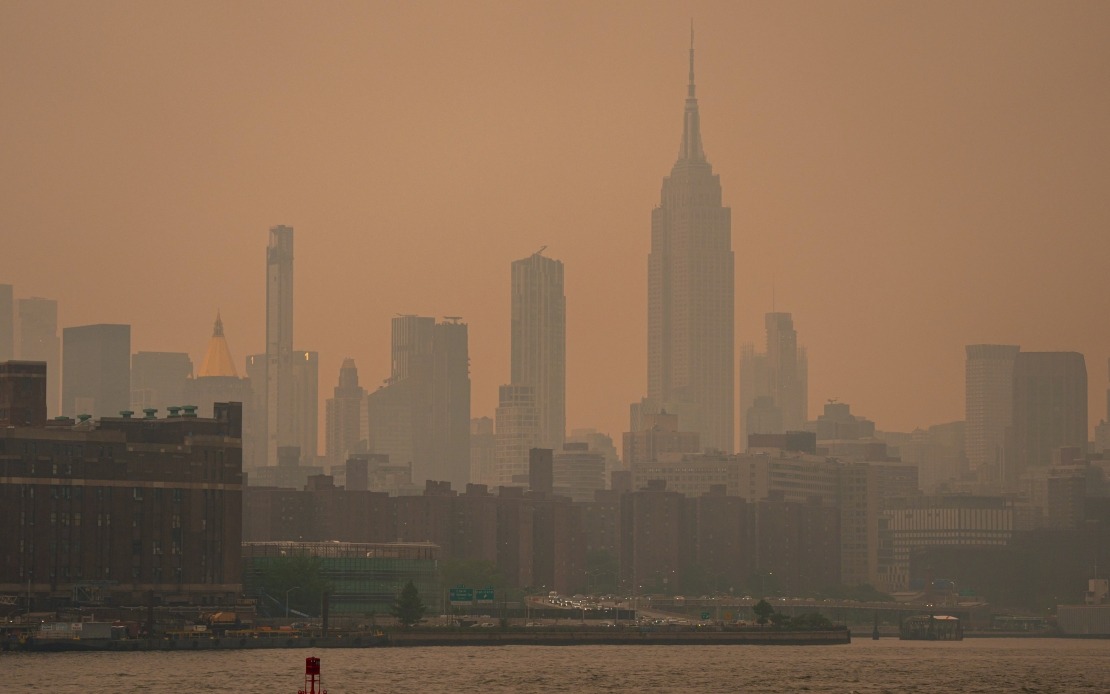
Mexican President Claudia Sheinbaum's journey to Sunday's Argentina-Spain World Cup final in East Rutherford, New Jersey, was thrown into disarray by smoke drifting across North America from Canadian wildfires, forcing organisers to arrange an alternative route to ensure her attendance at the high-profile sporting event. The disruption underscores how environmental crises can upend diplomatic schedules, even when state-level coordination is at play.
Sheinbaum's original flight from Cancún to New York faced cascading delays on Saturday as wildfire smoke blanketed the New York region, degrading air quality to hazardous levels. Her aircraft was first held back by two hours in anticipation that conditions would improve, but as the smoke persisted and meteorological forecasts showed no near-term relief, Mexican authorities made the difficult decision to cancel the scheduled flight entirely. The environmental emergency, driven by weeks of sustained wildfires burning across Canadian territories, had made commercial air operations untenable for the diplomatic journey.
Rather than abandon the visit, the Mexican government mobilised resources from its Defence Ministry to charter an alternative aircraft for Sheinbaum. She departed later that evening and arrived in New York overnight into Sunday morning, allowing her to make the final in time despite the setback. The improvised solution highlights the operational flexibility available to high-level state actors when standard channels become impassable, though it also reveals the vulnerability of even carefully planned diplomatic itineraries to climate-related disruptions.
The World Cup final itself had drawn significant diplomatic attention because it represented a rare trilateral engagement among the three host nations. Trump had extended a surprise invitation to Sheinbaum, signalling a measure of ceremonial cordiality despite considerable underlying tensions in the US-Mexico relationship. Sheinbaum would now attend alongside both Trump and Canadian Prime Minister Mark Carney, positioning the event as a moment for the three leaders to demonstrate public unity around continental cooperation in hosting the tournament.
However, the optics of such cooperation mask deeper bilateral strains, particularly between Washington and Mexico City. Trade disputes and divergent approaches to security and migration have created friction that extends well beyond sporting events. Sheinbaum and Trump had previously encountered each other only once before this World Cup final—during the draw ceremony in Washington in December—meaning their relationship remains relatively underdeveloped compared to the historical patterns of US-Mexico presidential engagement.
For Malaysia and other Southeast Asian nations, the incident offers a reminder of how transnational environmental crises can cascade into unexpected disruptions across borders and sectors. Wildfire smoke originating in Canada affected air travel into the United States, demonstrating that pollution and environmental hazards do not respect national boundaries. ASEAN member states, already grappling with recurring haze problems from forest fires in Indonesia and Malaysia, understand intimately how such atmospheric conditions create public health risks and operational challenges for airlines, businesses, and government services.
The Canadian wildfires themselves represent part of a broader climate pattern affecting North America. Successive years of intense fire seasons have forced governments and businesses to develop contingency protocols for air quality emergencies. The speed with which Mexican authorities pivoted to alternative arrangements—mobilising a defence ministry aircraft within hours—suggests that protocols for managing climate-induced travel disruptions are increasingly becoming standard practice among governments managing cross-border movement of high-level officials.
From a diplomatic standpoint, Sheinbaum's determination to attend despite the environmental obstacle sent its own message: the commitment to multilateral engagement and to honouring the World Cup partnership superseded the inconvenience posed by nature. That she arrived via an unscheduled alternative route, rather than simply postponing her attendance, underscores the political significance attached to her presence at the match alongside the leaders of the other two host nations.
The incident also illustrates the interplay between environmental governance and diplomatic logistics. Had Canada not been contending with such severe wildfire conditions, or had weather patterns shifted slightly to disperse the smoke, the entire disruption would have been avoided. Instead, the crisis forced a real-time test of coordination between Mexican government agencies, between Mexico and the United States in terms of airport operations, and between the diplomatic and defence establishments in Mexico City.
Looking forward, the episode may prompt multilateral discussions about reinforcing resilience in cross-border travel infrastructure during environmental emergencies. For Southeast Asia, where air quality issues periodically disrupt regional traffic, the Mexican experience provides a practical case study in how governments can maintain diplomatic commitments even when environmental conditions deteriorate sharply and unexpectedly. The World Cup final went ahead as scheduled, with all three host-nation leaders present despite the atmospheric interference, a small victory for diplomatic persistence in the face of climatic adversity.

