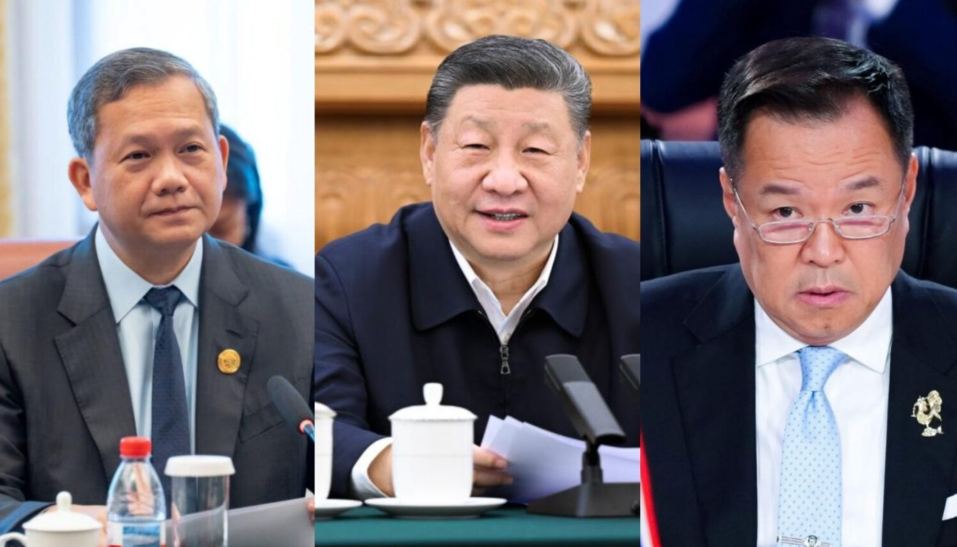
Cambodian Prime Minister Hun Manet and his Thai counterpart Anutin Chanvirakul are set to converge in Shanghai on July 17 for the opening of the World AI Conference 2026, having accepted invitations from Chinese President Xi Jinping. The high-profile gathering presents an unexpected diplomatic opportunity at a moment when tensions between the two Southeast Asian neighbours remain unresolved. While the ostensible purpose centres on artificial intelligence innovation and technological cooperation, observers are scrutinising whether China will seize the occasion to broker negotiations on the contentious border situation that has festered without substantive talks for over half a year.
Mamet's delegation represents a carefully calibrated show of state strength, including Foreign Minister Prak Sokhonn, Defence Minister Tea Seiha, and Sun Chanthol, the Council for the Development of Cambodia's first vice-chairman. Thailand's accompanying contingent will be led by Foreign Minister Sihasak Phuangketkeow. Both leaders are scheduled for separate audiences with Xi and Premier Li Qiang, a pairing that underscores Beijing's parallel relationships with each nation. Phnom Penh's foreign ministry framed the visit as an affirmation of deep bilateral ties and an opportunity to advance what it termed the Diamond Cooperation Framework and the all-weather Cambodia-China Community with a Shared Future. Bangkok issued similarly warm language, emphasising the strengthening of the Thailand-China Comprehensive Strategic Cooperative Partnership.
Yet beneath the diplomatic pleasantries lies a more complex reality. The two leaders last encountered one another in early June at the Asean Future Forum in Hanoi, where they exchanged handshakes for photographers but deliberately sidestepped substantive discussions about their land dispute. That choreographed cordiality masked the gravity of an impasse that has left tens of thousands of Cambodian civilians stranded in occupied territories, unable to reclaim their homes. The absence of meaningful dialogue since December signals neither side feels compelled by current circumstances to resume the hard diplomatic work that border resolution demands.
China's leverage as the dominant economic and strategic partner for both nations cannot be overstated. As a major trading partner and source of investment for Cambodia and Thailand alike, Beijing possesses considerable influence over their policy calculations. Analysts have suggested that the Shanghai summit could provide the appropriate setting for Chinese officials to use their economic and diplomatic weight to nudge both governments toward the negotiating table. Such intervention would align with Beijing's broader interest in regional stability and its role as a self-appointed mediator of regional disputes.
However, Kin Phea, director of the Royal Academy of Cambodia's International Relations Institute, identifies a structural impediment that transcends economic incentives or diplomatic pressure. According to Phea, the fundamental obstacle is not civilian political leadership but rather Thailand's military establishment, which has systematically ignored agreements negotiated between civilian governments. The Thai armed forces, he argues, retain effective autonomy over border operations and territorial actions, allowing them to encroach on Cambodian sovereign land despite official diplomatic commitments to restraint. This civil-military disconnect has enabled Thailand to maintain positions contrary to stated governmental policy, undermining any accords reached at the diplomatic level.
Phea advocates for a more assertive Chinese mediation strategy. Rather than confining its role to facilitating discussions, he contends that Beijing should explicitly champion peaceful resolution through diplomatic channels rooted in international law. He emphasises that China should assume a more active arbitration function, positioned to hold both nations accountable to their commitments and to ensure compliance with the principles enshrined in the Fuxian Consensus negotiated under Chinese auspices in December 2025. This framework theoretically provided a foundation for renewed engagement and conflict de-escalation.
The Fuxian Consensus represents the most recent serious attempt at establishing mutual understanding between Phnom Penh and Bangkok. Yet its provisions appear to have withered through non-implementation, particularly on Thailand's part. Phea explicitly calls for Bangkok to honour the agreement by withdrawing military forces from occupied territories and returning to substantive negotiations through the Joint Boundary Commission without further delay. The specificity of these demands underscores the concrete nature of the dispute—this is not a disagreement amenable to rhetorical compromise or symbolic gestures, but rather a territorial matter with immediate human consequences.
The scale of displacement resulting from Thai occupation cannot be minimised. Approximately 20,000 Cambodian civilians remain unable to return to their homes in contested areas, a humanitarian dimension that complicates any settlement. These displaced persons represent not merely a statistical footnote but a constituency whose suffering serves as a constant reminder of the dispute's intractability. Their situation demands resolution through genuine territorial restoration and security arrangements, not merely diplomatic niceties or conference room photographs.
For Malaysia and the broader ASEAN community, the Cambodia-Thailand impasse carries significant implications. Unresolved border disputes between member states undermine the Association's foundational commitment to peaceful conflict resolution and regional harmony. Malaysia, as an ASEAN member with its own border sensitivities, has a vested interest in seeing this dispute progress toward settlement. The failure of regional mechanisms to address the situation raises troubling questions about ASEAN's capacity to manage internal crises without external intervention, even as it reinforces the region's dependence on major powers like China to facilitate diplomatic breakthroughs.
The Shanghai summit will reveal much about Chinese intentions and capabilities. If Beijing uses the platform merely to orchestrate photo opportunities and ceremonial exchanges, it signals tacit acceptance of the status quo and suggests Chinese mediation possesses more rhetorical than practical force. Conversely, if Chinese leaders explicitly condition deeper economic and strategic engagement on meaningful progress toward border resolution, they would demonstrate willingness to leverage their considerable advantages for regional stabilisation. The coming weeks will show whether this July gathering represents a turning point or merely another diplomatic interlude in a dispute destined to persist through institutional paralysis and strategic ambiguity.

