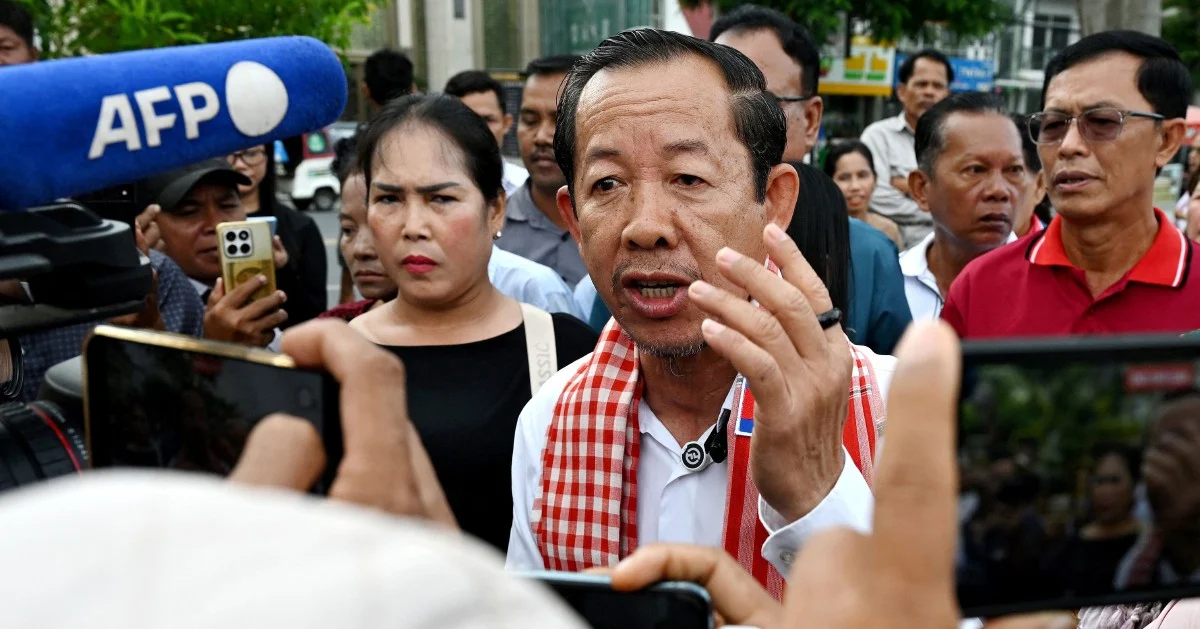
Cambodia's highest court delivered a mixed ruling on Friday regarding opposition politician Rong Chhun, suspending an earlier prison conviction while preserving restrictions that prevent him from contesting future elections. The decision, announced through his legal team, represents a partial concession to concerns about the severity of his original punishment, though it stops short of fully exonerating him or restoring his political rights.
The case highlights the precarious position of opposition figures in Cambodia, where constraints on electoral candidacy have become an increasingly common tool for limiting political competition. Rong Chhun's situation exemplifies broader patterns in the Kingdom's political landscape, where legal proceedings against members of the opposition have raised questions about judicial independence and the space available for genuine democratic participation.
The suspension of the prison sentence suggests some willingness within Cambodia's judiciary to recalibrate its approach to high-profile political cases, particularly when international scrutiny intensifies. By removing the custodial element, the court avoided the political complications that would accompany the imprisonment of a prominent opposition figure, while the maintenance of the electoral ban ensures that his political influence remains constrained within the current governing framework.
For Malaysian observers and policymakers, Cambodia's handling of opposition politicians carries implications for regional democratic standards. The pattern of using electoral restrictions rather than outright imprisonment reflects a more sophisticated approach to limiting dissent—one that maintains the appearance of judicial process while achieving substantive political objectives. Such mechanisms merit careful attention as they represent evolving strategies in how electoral systems can be shaped by incumbent powers.
The electoral ban constitutes the more consequential aspect of the court's ruling, as it directly prevents Rong Chhun from pursuing elected office regardless of his popularity or political standing. In many jurisdictions, such permanent restrictions on electoral rights would be viewed as extraordinarily severe, approaching the status of civic death. Within Cambodia's context, however, such measures have become normalised features of the political environment, applied selectively to weaken organised opposition movements.
Rong Chhun's case emerges against a backdrop of Cambodia's recent electoral history, characterised by restrictions on major opposition parties and constraints on political campaigning. The Cambodian National Rescue Party, which once posed a serious electoral challenge to Prime Minister Hun Sen's government, has operated under severe restrictions since 2017. Opposition activists and politicians have faced various legal challenges, creating an environment where political dissent carries substantial personal risk.
The lawyer's announcement of the court decision provides limited detail about the reasoning behind the Supreme Court's determination, a transparency deficit that itself reflects broader governance concerns in Cambodia. The absence of detailed judicial explanation for how the court weighed competing considerations—the suspension of imprisonment against the maintenance of electoral prohibition—leaves substantial room for speculation about the actual basis of the ruling.
For Cambodia's international partners and regional observers, rulings of this nature signal both continuity and subtle shifts in how the state manages political opposition. The suspension of imprisonment acknowledges external pressure and international human rights concerns, while the sustained electoral ban demonstrates the government's determination to prevent opposition challenges at the ballot box. This calibrated approach aims to balance competing pressures from domestic political objectives and international diplomatic concerns.
The implications for Cambodia's democratic trajectory remain concerning. Electoral systems function most effectively as mechanisms for democratic accountability when all major political parties and movements can compete freely. Restrictions on candidacy, whether absolute or time-limited, undermine this fundamental purpose. They create situations where electoral outcomes reflect legal frameworks designed to engineer particular political outcomes rather than authentic expressions of popular preference.
Rong Chhun's political stature and the attention his case has attracted suggest that the Supreme Court's ruling carries significance beyond his individual circumstances. His position as a recognised opposition figure means that his restricted electoral status has broader implications for how opposition movements can mobilise and contest for power. Other potential candidates may view his situation as cautionary evidence of the risks involved in emerging opposition leadership.
Regional governance experts have increasingly noted how electoral restrictions function as a subtler mechanism of political control compared to direct repression. By maintaining legal facades while achieving political objectives, such restrictions avoid the international reputational costs of obviously authoritarian actions. Yet they prove equally effective at preventing meaningful political competition, creating electoral systems that appear legitimate while operating in service of predetermined political outcomes.
The Supreme Court's decision reflects Cambodia's distinctive approach to managing political opposition in the contemporary period. Rather than pursuing confrontation through means that would generate maximum international attention, Cambodian authorities have developed frameworks that achieve substantive political control through what superficially appears as normal judicial process. Understanding these mechanisms remains essential for observers seeking to comprehend the actual functioning of Cambodia's political system.
As Cambodia continues its electoral cycle, cases such as Rong Chhun's will remain instructive for studying how opposition figures navigate legal systems shaped to constrain their effectiveness. The tension between the suspension of his prison sentence and the maintenance of his electoral ban encapsulates the larger challenge confronting Cambodian democracy: the coexistence of apparent legal protections with substantive limitations on political participation.
%22%2F%3E%3C%2Fpattern%3E%3C%2Fdefs%3E%3Crect%20width%3D%22100%25%22%20height%3D%22100%25%22%20fill%3D%22url(%23ph3evy7g)%22%2F%3E%3Crect%20width%3D%22100%25%22%20height%3D%22100%25%22%20fill%3D%22url(%23ph3evy7p)%22%2F%3E%3Ctext%20x%3D%2250%25%22%20y%3D%2250%25%22%20text-anchor%3D%22middle%22%20dominant-baseline%3D%22central%22%20fill%3D%22rgba(255%2C255%2C255%2C0.95)%22%20font-family%3D%22Georgia%2C%20'Times%20New%20Roman'%2C%20serif%22%20font-weight%3D%22700%22%20font-size%3D%22151%22%20letter-spacing%3D%22-0.02em%22%3ESingapore%3C%2Ftext%3E%3C%2Fsvg%3E)