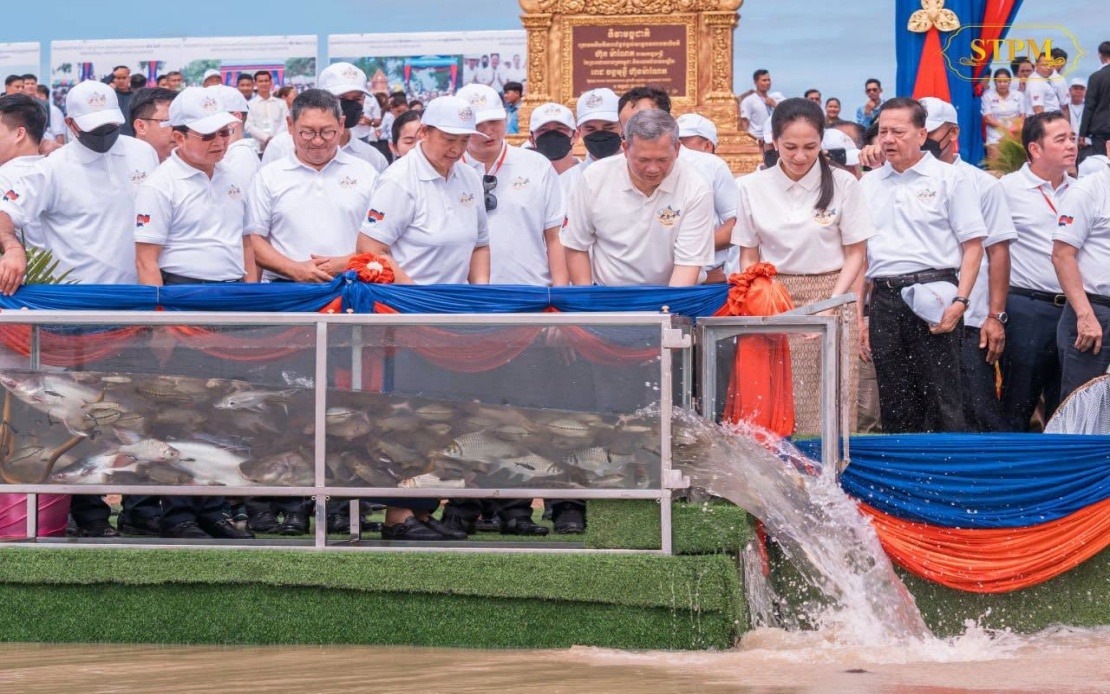
Cambodian Prime Minister Hun Manet has issued direct orders to regional authorities to intensify enforcement operations targeting illegal fishing operations in critical fish breeding zones, marking a significant escalation in the country's efforts to preserve its aquatic resources. Speaking during National Fish Day celebrations in Svay Rieng Province, Hun Manet underscored the critical importance of protecting spawning grounds where fish populations replenish themselves, emphasizing that such protections are essential to maintaining Cambodia's long-term environmental health and food security.
The directive comes as Cambodia grapples with mounting pressure on its marine and freshwater ecosystems from both commercial exploitation and subsistence fishing. Hun Manet revealed that military units positioned around Tonle Sap, Southeast Asia's largest freshwater lake and a vital ecosystem, have been mobilized to patrol these waters and detect illegal activities. This represents a continuation of a two-year military campaign against resource-related crimes that extends across both terrestrial and aquatic environments, though the Prime Minister acknowledged that such reliance on armed forces remains an imperfect solution.
Hun Manet's remarks highlight a fundamental challenge facing Cambodian resource management: the shortage of specialized enforcement personnel trained in environmental protection and fisheries law. The government has historically leaned on military resources because civilian law enforcement agencies lack the necessary expertise, equipment, and manpower to effectively combat sophisticated poaching operations. However, Hun Manet expressed a determination to reduce this dependency, signaling intentions to build a more dedicated civilian environmental enforcement capacity that would allow military units to focus on traditional border security responsibilities.
A particularly pressing concern addressed during the event involves large-scale clam dredging operations that have devastated local fishing communities. These mechanized operations extract shellfish and other organisms indiscriminately, destroying habitat structures and depleting breeding populations faster than natural reproduction can sustain them. Hun Manet's order for an immediate halt to such activities represents a direct confrontation with commercial interests, suggesting political will to prioritize ecological sustainability over short-term economic extraction.
The Prime Minister framed Cambodia's agricultural and fisheries sectors as foundational pillars of national resilience and food security. By describing agriculture as "the nation's stomach" and fisheries as its "source of protein," Hun Manet articulated a vision where resource protection serves not merely environmental objectives but fundamental human welfare. This framing carries particular weight in Southeast Asia, where millions of people depend directly on fish protein for nutrition and where fishing represents a primary livelihood for coastal and riverine communities.
For Malaysia and other ASEAN nations, Cambodia's struggle against illegal fishing offers both cautionary lessons and opportunities for regional cooperation. Cross-border fishing crimes, where vessels from one country operate illegally in another's waters, represent a persistent challenge throughout Southeast Asia. Cambodia's emphasis on military patrols and enforcement infrastructure suggests recognition that combating such activities requires sustained investment and visible deterrence, approaches that could inform regional maritime security discussions.
The release of 1.5 million fish and aquatic species into the Vai Ko River in Svay Rieng serves multiple purposes beyond symbolic gesture. Such restocking initiatives help replenish depleted populations and support breeding efforts, while the public ceremony demonstrates governmental commitment to aquatic resource preservation and potentially builds community awareness about ecosystem protection. For a country heavily dependent on fisheries revenue and food security, such tangible investments signal seriousness about long-term sustainability planning.
Cambodia's freshwater and marine resources face intensifying pressures from climate change, population growth, and economic development. The Tonle Sap system, which Hun Manet specifically referenced, experiences dramatic seasonal fluctuations that profoundly influence fish migration and breeding patterns. Climate variability threatens to exacerbate natural hydrological challenges, making proactive protection against human-induced pressures increasingly vital for maintaining productivity.
The directive also reflects evolving regional discussions about environmental governance and the role of military institutions in resource protection. While some conservation advocates question the appropriateness of militarized enforcement, others recognize that immediate threat suppression sometimes requires such capabilities. Hun Manet's apparent acknowledgment that military involvement is unsustainable long-term suggests openness to developing professional environmental enforcement structures, a trajectory that other Southeast Asian nations have pursued with varying degrees of success.
For Southeast Asian fishing communities and seafood-dependent economies, Cambodia's initiative carries broader relevance. Illegal fishing, whether domestic poaching or foreign vessel incursions, represents a transnational problem requiring coordinated responses. The region's complex maritime boundaries and the mobility of fishing fleets mean that protection in one nation's waters benefits neighboring states by helping sustain shared fish stocks and maintaining ecosystem integrity across larger aquatic systems.

