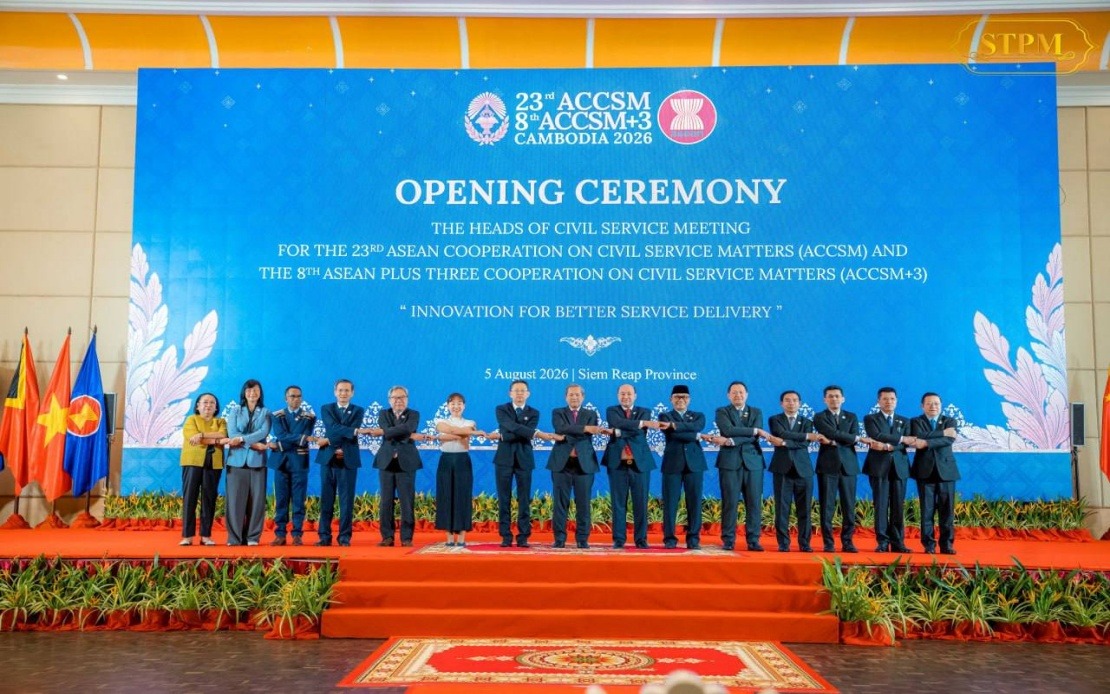
Cambodian Prime Minister Hun Manet has made a pressing case for Southeast Asian governments to harness artificial intelligence and digital innovation as tools for delivering superior public services and narrowing development inequalities that persist across the region. Speaking at a major gathering of ASEAN civil service leaders this week, Hun Manet articulated a vision where technology serves people rather than merely modernising bureaucratic systems for their own sake, signalling a shift in how regional policymakers are approaching the digital transformation agenda.
The remarks were delivered during the 23rd ASEAN Cooperation on Civil Service Matters and the 8th ASEAN Plus Three Cooperation on Civil Service Matters, a three-day forum held in Siem Reap from August 3 to 5. The conference, themed "Innovation for Better Service Delivery," brought together civil service officials from across the bloc and extended dialogue partners to discuss how governments can leverage emerging technologies more effectively. Hun Manet's intervention positioned Cambodia, which currently chairs various ASEAN mechanisms, as an advocate for a more inclusive and balanced approach to technological adoption that accounts for the region's pronounced disparities in economic development and institutional capacity.
Crucially, Hun Manet emphasised that innovation in ASEAN's public services sector cannot be divorced from the foundational elements required to sustain it. He stressed that institutional capacity and human resource development must precede and accompany any technological rollout. This observation reflects a pragmatic understanding of why technology adoption often falters in developing economies: the existence of cutting-edge systems means little if the personnel operating them lack adequate training, or if underlying institutions remain weak and fragmented. By highlighting this connection, Hun Manet implicitly cautioned against the tendency of governments to pursue headline-grabbing digital projects without attending to the harder, less visible work of institutional strengthening.
The Cambodian leader also acknowledged the reality of uneven development across ASEAN, where economies range from advanced industrialised nations to least-developed countries. Rather than advocating a one-size-fits-all approach to AI adoption, Hun Manet proposed that each member state should integrate new technologies at a sustainable pace suited to its particular circumstances. This position carries significant weight for countries like Cambodia, Laos, and Myanmar, which face genuine constraints in deploying and maintaining sophisticated systems. By framing sustainability and context-sensitivity as features rather than obstacles, Hun Manet potentially reassured less-developed nations that they need not rush into expensive technological investments they cannot afford to implement properly.
Beyond the domestic application of AI in streamlining government operations, Hun Manet broadened his argument to encompass regional collective action on shared challenges. He contended that innovation should serve as a vehicle for strengthening ASEAN's collective resilience in the face of interconnected crises that transcend national borders. Climate-related disasters, he noted, exemplify problems that individual nations cannot solve alone. Similarly, imbalanced economic development and persistent poverty require coordinated responses. By positioning AI and digital innovation as tools for enhanced regional cooperation, rather than purely national advantage-seeking, Hun Manet implicitly advocated for a more integrated approach to ASEAN's technological future.
The specific emphasis on knowledge sharing and policy harmonisation underscores an evolving conversation within ASEAN about the bloc's institutional future. The ACCSM platform, Hun Manet suggested, should become a crucible for mutual learning, enabling civil services across the region to exchange best practices, troubleshoot implementation challenges, and collectively address common obstacles. This vision implies a degree of openness and transparency that, in practice, can prove difficult for ASEAN governments to embrace, given persistent concerns about sovereignty and the bloc's traditional consensus-based decision-making culture. Nevertheless, the sentiment reflects a genuine recognition that fragmented national efforts to adopt AI will likely prove less effective than coordinated regional strategies.
The timing of these remarks matters considerably. ASEAN governments have indeed accelerated their digital transformation initiatives in recent years, with varying degrees of success. Some nations have invested heavily in e-government systems, digital identity platforms, and AI-driven applications in healthcare and public administration. Others have moved more cautiously. By convening this gathering and framing innovation in terms of citizen welfare and regional cooperation, Hun Manet has placed the spotlight on governance modernisation as a region-wide priority. This could influence budgetary allocations, policy priorities, and international partnerships across ASEAN in coming years.
For Malaysia and other mid-tier economies in the bloc, Hun Manet's framing offers both opportunities and cautions. The emphasis on people-centred innovation aligns with growing demands from citizens for more responsive, efficient government services, particularly in areas such as healthcare, education, and social welfare administration. Malaysian policymakers, already advanced in digital adoption relative to some neighbours, stand to benefit from participation in ACCSM platforms where successful experiments and lessons learned can be shared. Simultaneously, the cautionary note about sustainability and institutional capacity serves as a timely reminder that technological sophistication unsupported by adequate training and institutional reform can create new problems even as it solves old ones.
The broader implication of Hun Manet's intervention is that ASEAN is beginning to grapple seriously with the question of how to manage a technological transition that will reshape public administration across the region for decades to come. The framing emphasises inclusion, sustainability, and citizen benefit—values that resonate with international best practice in digital governance but which require genuine commitment to realise. Whether ASEAN's consensus-driven mechanisms can translate these aspirational statements into coordinated action remains an open question, one that will test the bloc's capacity for substantive regional cooperation on a matter that touches the daily lives of over 600 million people.

