Cambodia's Minister of Information Neth Pheaktra has pushed back against Thailand's dismissal of Cambodian territorial claims by underscoring a significant tactical shift: independent international observers are now witnessing and recording the physical conditions at the disputed frontier, transforming what was once a bilateral dispute fought through competing narratives into a matter with documented third-party verification. This response followed Air Chief Marshal Prapas Sornchaidee, director of Thailand's Joint Information Center, who rejected allegations that Bangkok's forces are encroaching on Cambodian territory through military construction and fortifications, insisting instead that Thailand maintains no policy of invading neighbouring states and that its activities serve legitimate security purposes.
The divergence between the two positions reflects a longstanding impasse, though both sides nominally agree on a fundamental principle: territorial boundaries should be determined through recognised legal mechanisms, historical documents, and technical processes rather than through military occupation or the creation of facts on the ground. Prapas acknowledged that the mere presence of troops and infrastructure cannot establish international boundaries, suggesting that the matter be resolved through maps, evidence, and the Joint Border Committee—a position that aligns with Cambodia's stated preference for institutional resolution. Yet this apparent convergence masks a deeper disagreement about what constitutes legitimate security activity and who has legitimate claims to disputed zones, disagreements that have proven intractable through formal channels.
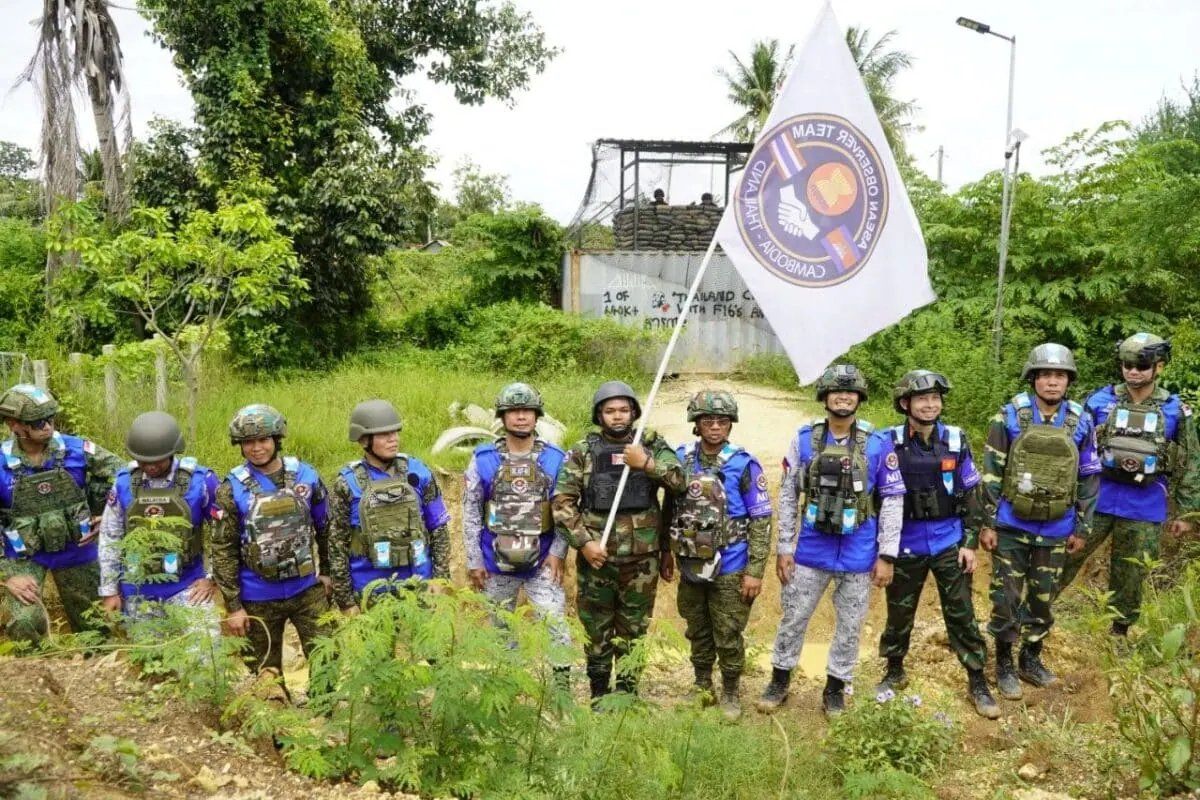
Where Pheaktra's argument diverges is in emphasising the evidentiary weight of international observation. He stressed that shipping containers, razor wire barriers, and other physical installations now cannot remain hidden from external scrutiny. The Asean Observer Team in Cambodia, headed by its Philippine mission director, has recently inspected three affected areas in Banteay Meanchey province, documenting 116 containers across 24 locations where approximately 13,259 people, including more than 3,400 children, remain unable to access their homes. At Boeung Trakuon in Thma Puok district alone, inspectors identified 44 containers at 14 separate locations blocking the return of over 7,800 residents from 1,869 families. These verifiable counts represent something Cambodia did not previously possess in abundance: concrete, independently documented evidence that corroborates its claims.
The introduction of third-party observers transforms the political landscape in important ways for Cambodia's diplomatic strategy. When disputes depend solely on official statements from each government, both sides can claim righteousness with equal rhetorical force, and international audiences struggle to discern truth from propaganda. Asean monitors, by contrast, provide neutral documentation that international media, civil society, and other governments can reference when evaluating competing claims. UN Special Rapporteur on human rights Tom Andrews, who visited the border region and displaced communities during his July mission, subsequently reported that roughly 650,000 Cambodians were displaced during the conflict and more than 20,000 remain unable to return—a finding grounded in direct observation and survivor testimony rather than administrative assertion.
For Southeast Asian observers, this shift carries significance beyond the immediate bilateral dispute. It reflects how international monitoring mechanisms, even those with limited mandates, increasingly serve as arbiters of factual reality in regional conflicts where verification is otherwise impossible. The Asean Observer Team's role, ostensibly limited to verifying ceasefire compliance, effectively becomes a source of documentation that extends beyond its formal authority. This expansion of observational function—where verifying one aspect of a ceasefire naturally entails documenting physical evidence that relates to underlying territorial questions—demonstrates how international presence can reshape the terms of a conflict even when observers lack explicit mandate to resolve sovereignty questions.
Thailand's countervailing argument rests on a different framing of legitimacy. Prapas maintained that Thailand would continue protecting what it considers its territory and would not halt security measures merely because Cambodia unilaterally demands it. The implication is that military activities, properly understood as defensive rather than encroaching, should not be constrained by international observation or pressure. This position reflects Thailand's conviction that the areas in question fall within its sovereignty and that security infrastructure represents lawful state action rather than usurpation. However, this argument, while internally coherent from Bangkok's perspective, lacks the empirical grounding that Pheaktra now possesses through international documentation. When third parties independently verify the presence of barriers, fortifications, and displaced populations, Thailand's invocation of sovereignty becomes primarily a legal claim rather than an observable reality that observers can independently validate.
Pheaktra's rhetorical strategy deployed a series of pithy formulations designed to isolate Thailand's position: shipping containers cannot serve as border markers, razor wire cannot substitute for treaties, trenches cannot replace boundary maps, and flags cannot constitute land titles. These assertions, while politically crafted, capture a genuine tension in international law between the formal mechanisms for territorial determination and the physical imposition of control. Thailand's predicament stems from the fact that it cannot easily square its invocation of legal processes with its simultaneous creation of on-the-ground physical facts that preempt those processes. If territorial questions should genuinely be resolved through the Franco-Siamese treaties, historical maps, the Cambodia-Thailand border Memorandum of Understanding from 2000, and the Joint Border Committee mechanism—frameworks that both sides nominally endorse—then current military activities that create new physical obstacles to civilian movement appear to prejudge those legal outcomes.
The humanitarian dimension adds complexity to this technical dispute. Cambodia links the territorial encroachment to Point 4 of the December 27 ceasefire agreement, which stipulates that affected civilians must be able to return to their homes on their respective sides without obstruction and in safety and dignity. For Pheaktra, the continuing inability of tens of thousands of Cambodians to return home constitutes prima facie evidence that the post-conflict arrangement remains violated. Thailand's security argument, however compelling from a military perspective, cannot easily reconcile with this humanitarian commitment. A ceasefire agreement that nominally permits civilian return while permitting military activities that prevent such return creates an internal contradiction that international observers can readily document.
For Malaysia and other Southeast Asian states, this dispute exemplifies the persistent challenges in border management and conflict resolution within the region. Despite decades of institutional development, including Asean mechanisms and bilateral agreements, neither Cambodia nor Thailand has found path to permanent resolution. The reliance on international observation reflects the exhaustion of bilateral negotiation channels and suggests that formal legal processes, such as International Court of Justice referral, might be necessary to break the deadlock. However, both countries appear reluctant to risk such external arbitration, preferring to maintain their positions and accumulate evidence for future negotiations. This stasis leaves border communities in limbo, unable to verify their status or recover their homes, while the dispute perpetuates.
What remains unclear is whether the multiplication of international observers will eventually generate sufficient political pressure for resolution or merely create a well-documented stalemate. Thailand's position that it will not alter security measures in response to unilateral Cambodian demands suggests that observation alone, without enforcement mechanisms or significant diplomatic consequences, may not compel behavioural change. Asean's tradition of non-interference and consensus-building provides limited tools for pressuring member states on sovereignty questions. Without either legal arbitration or escalated diplomatic sanctions, the situation could persist indefinitely—with growing international documentation of the problem but no mechanism to resolve it. For affected Cambodian civilians, this means continued displacement, while for the region, it represents an unhealed wound that periodically threatens to disrupt Asean cohesion and broader regional stability.

