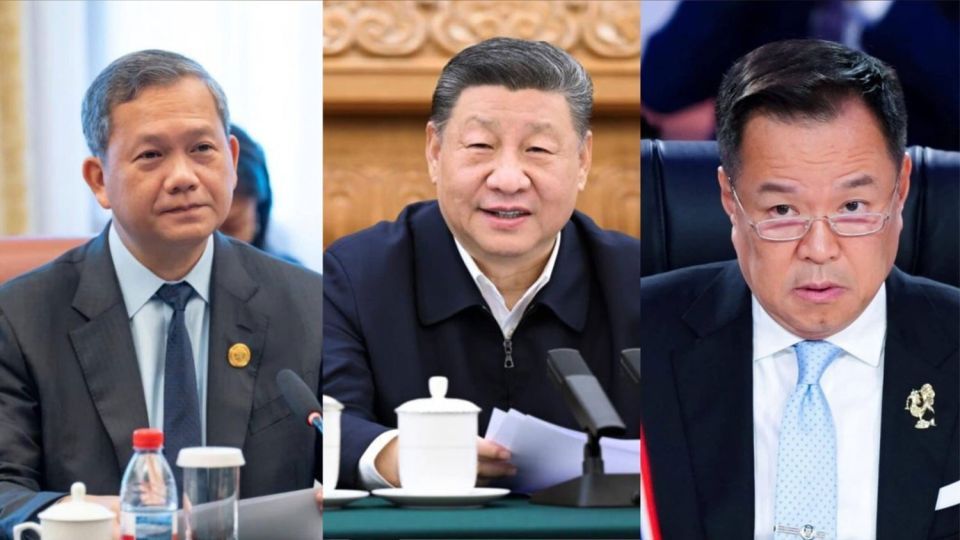
Prime Minister Hun Manet of Cambodia and his Thai counterpart Anutin Chanvirakul are preparing to travel to Shanghai later this month for the opening of the World AI Conference 2026, following an invitation extended by Chinese President Xi Jinping. The July 15-17 visit by Hun Manet and July 17 appearance by Anutin at the prestigious technology gathering present a rare opportunity for high-level engagement between the two Southeast Asian leaders, though observers remain uncertain whether Beijing will leverage the occasion to revive stalled negotiations over their contested maritime and terrestrial boundaries.
The Cambodian delegation is assembling a substantial team for the Shanghai journey, including Foreign Minister Prak Sokhonn, Defence Minister Tea Seiha, and Sun Chanthol, the first vice-chairman of the Council for the Development of Cambodia. Thailand's representation will be headed by Anutin alongside Foreign Minister Sihasak Phuangketkeow. Both delegations have been scheduled for separate sessions with Chinese President Xi Jinping and Premier Li Qiang, signalling Beijing's intention to conduct substantive bilateral discussions with each nation individually as well as potentially facilitating any multilateral dialogue.
The timing of this conference carries particular significance given that Cambodia and Thailand's prime ministers have not sat across a negotiating table since December 2025. Their last public interaction, at the ASEAN Future Forum in Hanoi during early June, amounted to little more than a handshake for photographers, with no substantive dialogue addressing the territorial tensions that continue to strain bilateral relations. The Shanghai venue thus represents an informal setting that might allow preliminary discussions to occur without the formality of dedicated border negotiations, which have become increasingly fraught and difficult to convene.
Cambodia's foreign ministry has framed the Shanghai visit as an opportunity to deepen ties with Beijing and advance several cooperative frameworks, including the Comprehensive Strategic Partnership of Cooperation and the Diamond Cooperation Framework. The diplomatic language emphasises an "all-weather Cambodia-China Community with a Shared Future," reflecting Phnom Penh's strategic alignment with China and its expectation that Beijing will support Cambodian interests in regional disputes. Thailand has similarly issued statements highlighting the importance of strengthening its Thailand-China Comprehensive Strategic Cooperative Partnership, suggesting both nations view China as a crucial partner whose favour and mediation they seek to cultivate.
Exclusively, the timing and composition of these delegations points to a broader pattern in Southeast Asian diplomacy where major powers increasingly serve as intermediaries in regional conflicts. China, as a dominant trading partner and investor in both Cambodia and Thailand, possesses considerable leverage to encourage productive dialogue. Analysts have suggested that Beijing may deploy this economic and political influence to push the two nations towards resolving their differences, particularly given that prolonged instability on China's periphery creates uncertainty that conflicts with Beijing's development ambitions.
However, expert observers caution that structural impediments may frustrate any Chinese mediation efforts. Kin Phea, director of the International Relations Institute at Cambodia's Royal Academy, has identified a fundamental disconnect between Thailand's civilian government and its military establishment as the primary obstacle to resolution. While civilian Thai leaders may agree to border settlements in diplomatic forums, the Thai military has consistently disregarded these commitments, continuing to occupy Cambodian territory and pursue unilateral actions that violate Cambodian sovereignty. This civil-military divide in Thailand's governance creates a situation where negotiated agreements lack enforceability, leaving Cambodia perpetually vulnerable to Thai military aggression regardless of what formal accords are reached.
The reference point for current negotiations is the Fuxian Consensus, a Chinese-brokered agreement reached in December 2025 that established a framework for peaceful resolution based on international law and diplomacy. Cambodia has maintained that Thailand must honour this consensus by withdrawing military forces from occupied territory and returning meaningfully to the Joint Boundary Commission to resume work on demarcating their shared border. The fact that Thailand has failed to implement its commitments under this Chinese-endorsed agreement underscores Phea's concern that Beijing may need to apply more forceful pressure to compel compliance, rather than simply facilitating dialogue between equals.
The human cost of the border dispute remains substantial and largely invisible in diplomatic proceedings. Approximately 20,000 Cambodian civilians remain displaced from their homes due to Thai occupation of Cambodian territory, representing a humanitarian dimension that extends far beyond the abstractions of border demarcation and bilateral relations. These displaced populations endure prolonged uncertainty about whether they will ever return to their ancestral communities, a situation that has persisted for years with minimal international attention or pressure for resolution.
For Malaysia and other ASEAN members, the Cambodia-Thailand border issue represents a concerning precedent. If a major regional power cannot effectively mediate between two relatively smaller Southeast Asian nations, or if agreements reached under great power auspices can be violated with impunity, it raises troubling questions about the stability and enforceability of multilateral frameworks that underpin regional security. The principle of inviolable borders and the peaceful settlement of disputes forms the foundation of the ASEAN Way, and any erosion of these norms through repeated violations threatens the broader architecture of regional cooperation that Malaysia and other nations rely upon.
The Shanghai conference will offer observers crucial signals about the trajectory of Cambodia-Thailand relations and the extent to which China will position itself as an active arbiter rather than a passive facilitator. Should the two prime ministers hold substantive discussions during the visit and announce progress toward renewed border talks, it would suggest that Chinese mediation remains effective and that even fractious disputes can be channelled toward peaceful resolution. Conversely, should the Shanghai gathering pass without meaningful engagement on the border question, it would indicate that the dispute has become intractable despite China's presence and influence, a sobering development for regional stability more broadly.
The coming weeks will reveal whether the Shanghai AI Conference becomes merely another venue for ceremonial exchanges between regional leaders or whether it catalyses genuine movement toward resolving one of Southeast Asia's most persistent bilateral disputes. For Cambodia and Thailand, the stakes are profound. For the broader region, the outcome will offer important insights into whether great power mediation remains a viable mechanism for managing interstate conflicts in the contemporary international system.

