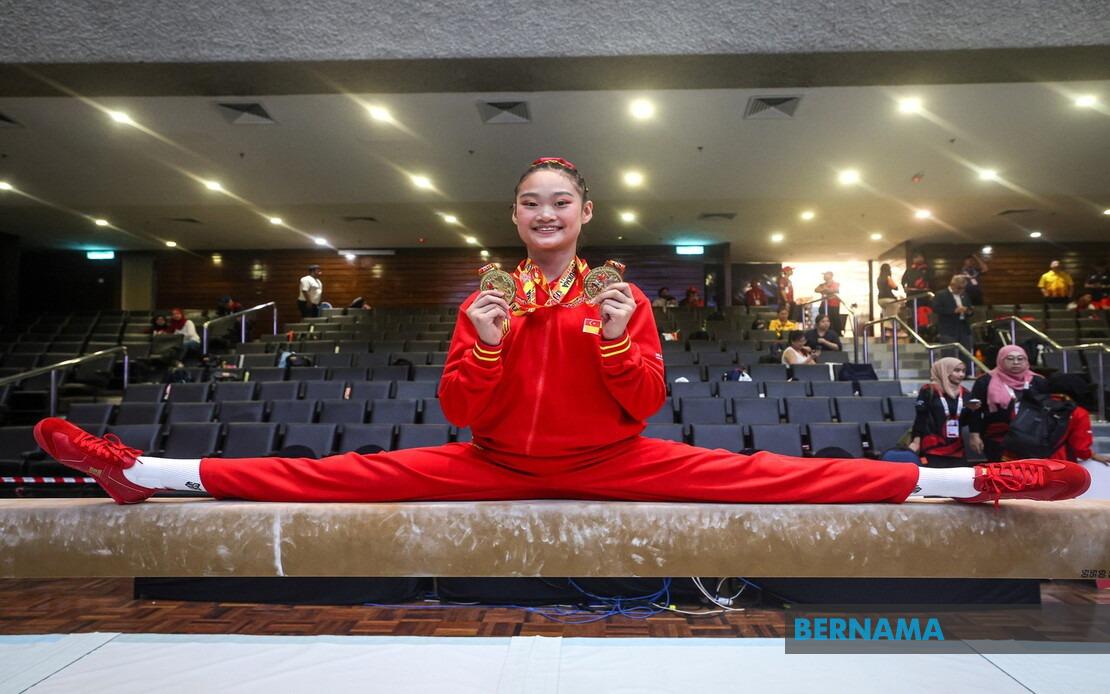
Selangor's rising gymnastics star Cadence Teh Zi Qi etched her name into the Malaysia Games record books on Wednesday by capturing two gold medals in artistic gymnastics, cementing her status as one of the nation's most promising young talents. Competing at Dewan Canselor Tun Abdul Razak on the Universiti Kebangsaan Malaysia campus, the 17-year-old successfully defended her women's individual all-around title whilst anchoring her state team to victory in the team competition, delivering a dominant performance that underscores Selangor's continued strength in the sport.
The defending champion posted a commanding score of 48.550 points across all four apparatus, demonstrating the technical proficiency and consistency demanded at the highest levels of artistic gymnastics. Her scores reflected formidable showings on vault with 12.050 points, uneven bars earning 11.400, balance beam where she posted an impressive 13.350, and floor exercise yielding 11.750 points. This well-rounded performance highlighted her versatility and training quality across disciplines that demand fundamentally different physical and mental attributes from competitors.
Teh's nearest rival, Sarawak's Aurin Zulkarnain, finished considerably adrift with 44.500 points, unable to mount a sustained challenge to the favourite. The bronze medal was contested between two gymnasts from competing regions—Federal Territories' Annabelle Ho Syin Yee and Penang's Amanda Ching Lee Wern each registered identical scores of 42.250 points, reflecting the competitive depth emerging across Malaysia's states in this discipline. The significant gap between gold and silver medals suggests a clear hierarchy in current competitive standards, with Teh operating at a distinctly higher technical level than her immediate challengers.
In the team competition, Teh combined forces with five clubmates—Nicole Wong Ziyi, Airisha Zuraidi, Wong Zi Qi, Leong Yee Shean, and Haifa Izzazi Mohd Faizul—to propel Selangor to the podium's top step with a combined total of 169.300 points. Federal Territories managed second place with 166.300 points, while Johor secured the bronze medal with 157.000 points. The performance demonstrates Selangor's systematic approach to nurturing talent across multiple gymnasts, rather than relying on any single individual, though Teh's contributions clearly provided significant ballast to her team's success.
Speaking candidly about her performance following the finals, Teh acknowledged the psychological and technical challenges she confronted during competition. She revealed that her early apparatus rotation proved problematic when she commenced on the uneven bars, admitting to a stumble that disrupted her rhythm at what should have been a settling routine. The fall appeared to have rattled her composure initially, an honest reflection that underscores the mental fortitude required to recover from mistakes and maintain focus through multiple apparatus routines within a single competition session.
However, the gymnast demonstrated the mental resilience characteristic of elite performers by rebounding strongly once she transitioned to the balance beam apparatus, where she produced her highest-scoring routine of the day. She attributed her struggle on bars partly to nervousness and a loss of body awareness, a common phenomenon experienced by competitors regardless of experience level when anxiety interferes with proprioceptive feedback. Her recovery on beam and subsequent solid performances on floor and vault illustrated her capacity to compartmentalise setbacks and refocus on the tasks ahead, a quality essential for sustaining excellence across a full all-around competition.
The strategic adjustment Teh made regarding her vault routine merits particular attention, as it reflects her coaching team's pragmatic approach to risk management. Rather than pushing maximum difficulty, she opted for a Tsukahara pike execution—a technically sound choice that prioritised secure execution and point accumulation over attempting riskier variations that could have resulted in costly deductions. This tactical maturity at such a young age suggests coaching influence that values consistency and championship mentality over unnecessary brinksmanship in competition settings.
More significantly, Teh disclosed that she elevated the technical difficulty of her balance beam routine to align with aspirations she harbours for the 2026 Asian Games, a continental championship scheduled to occur shortly after SUKMA. This forward-planning perspective indicates both her coaching staff's developmental vision and her own competitive ambition extending well beyond regional Malaysian competition. By treating SUKMA as a platform to test higher-difficulty combinations intended for Asian Games staging, she maximises the value of each competition whilst building towards more demanding international standards.
Reflecting on areas requiring further refinement, Teh identified nerves management and sustained focus as priorities for development, acknowledging that even during her medal-winning performance, psychological factors created technical interference on certain apparatus. This self-awareness and willingness to identify mental components of performance alongside physical execution marks her as an intellectually engaged athlete committed to holistic improvement. Rather than resting on the achievement of retaining her title, she appears focused on trajectory and the incremental gains necessary for Asian Games success.
The competitive schedule ahead remains demanding, with apparatus finals spanning Thursday and Sunday, providing Teh with additional opportunities to accumulate medals in uneven bars, balance beam, and floor exercise specialties. These competitions will afford her and fellow gymnasts further chances to showcase mastery of specific apparatus where they may have developed particular technical advantages. For Malaysian gymnastics enthusiasts and stakeholders, the emerging talent pool evident at SUKMA 2026, evidenced by the competitive margins and breadth of participants, signals encouraging prospects for regional representation at increasingly prestigious international platforms in coming years.

