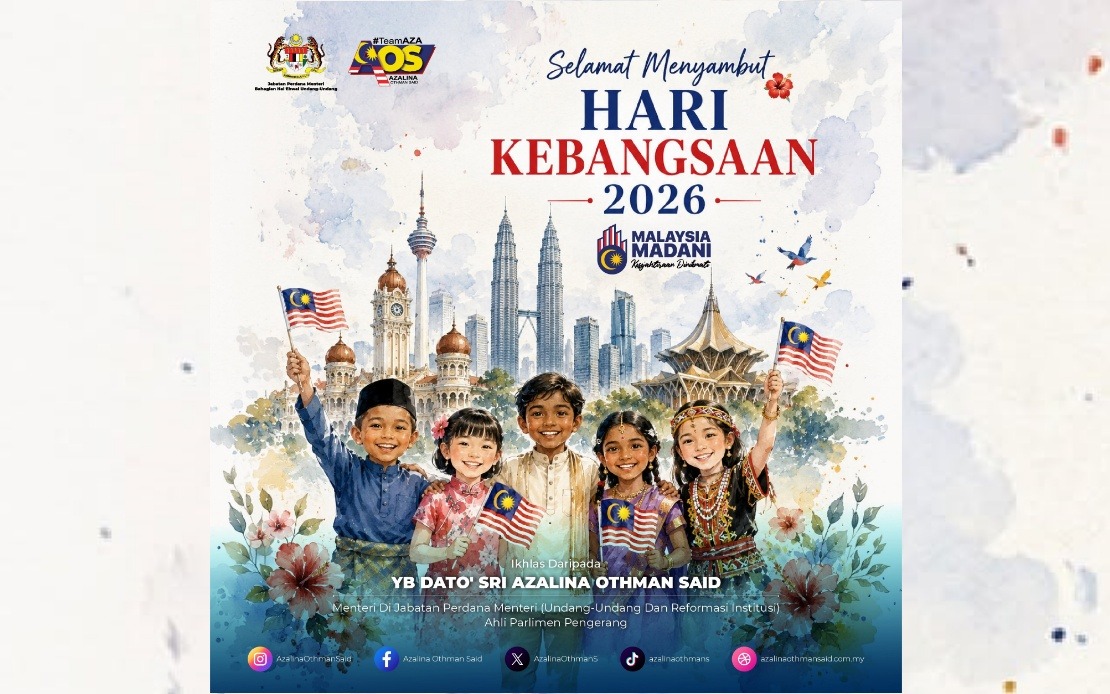
Malaysia's Cabinet has seized the occasion of the nation's 69th National Day to deliver a consistent message centred on unity, intercommunal harmony and the preservation of national independence. Speaking through social media channels on August 31, senior government figures have positioned the anniversary not merely as a historical commemoration but as a call to action for contemporary challenges facing the diverse Southeast Asian nation.
Datuk Seri Azalina Othman Said, who leads the Prime Minister's Department portfolio overseeing law and institutional reform, articulated a foundational principle underpinning the government's National Day rhetoric: that Malaysia's competitive advantage historically derives from the cohesion of its multiethnic populace. In framing independence as something requiring constant vigilance and collective effort rather than a fixed achievement, Azalina connected historical struggle with present-day responsibility. Her emphasis on "mutual respect and togetherness, regardless of race, religion or background" suggests official concern that the bonds holding Malaysia's plural society together require deliberate reinforcement, particularly given ongoing tensions around resource distribution and identity politics within the country.
Home Minister Datuk Seri Saifuddin Nasution Ismail adopted a reflective tone, characterising National Day as an opportunity for stock-taking regarding the nation's trajectory since independence nearly seven decades ago. By noting that the previous generation bore the burden of winning independence through struggle and sacrifice, Saifuddin implicitly established a responsibility framework for the current generation—one focused on stewardship rather than conquest. His framing of shared homeland against potential divisive forces signals governmental awareness that Malaysia's stability depends on consistently reaffirming common national interest over sectional identity.
Works Minister Datuk Seri Alexander Nanta Linggi expanded the geographical and conceptual scope of National Day observance by explicitly connecting urban and rural areas, as well as the peninsula and East Malaysian territories of Sabah and Sarawak. This inclusive geographic language reflects both the practical challenge of fostering national consciousness across vast distances and the political imperative of ensuring no constituent group feels marginalised from the national narrative. Alexander's emphasis on appreciating the "blessings" of living in a peaceful, multiracial setting reframes diversity as an asset rather than a liability—a messaging strategy increasingly important as Malaysia competes regionally for investment and talent.
Minister in the Prime Minister's Department (Religious Affairs) Senator Dr Zulkifli Hasan introduced a theological dimension to National Day discourse, defining independence as a "sacred trust from Allah" demanding "real justice for all people." By invoking founding Prime Minister Tunku Abdul Rahman Putra Al-Haj's assertion that independence was "not easily won," Zulkifli connected spiritual obligation with historical memory. His citation of independence fighter Dr Burhanuddin Al-Helmy and National Laureate Datuk Seri Dr A. Samad Said demonstrates how government messaging strategically deploys intellectual and spiritual authority figures to legitimise contemporary political narratives around unity and shared responsibility.
Crucially, Zulkifli operationalised the National Day message by linking independence commemoration to specific MADANI Government policy initiatives. By highlighting the expansion of BUDI MADANI subsidies, infrastructure allocations for inclusive education, free artificial intelligence subscriptions for youth, and healthcare efficiency improvements, he positioned the government's cost-of-living interventions as authentic expressions of independence values. This connection between patriotic rhetoric and tangible welfare measures attempts to address what has emerged as a significant vulnerability for Malaysian governments: the perception that national unity rhetoric rings hollow when citizens face genuine economic strain.
Federal Territories Minister Hannah Yeoh's contribution, while more economical in content, maintained symbolic consistency through the ceremonial triple invocation of "Merdeka" (freedom), reinforcing the emotive dimensions of National Day observance. The deployment of the founding independence cry across multiple ministerial communications suggests deliberate coordination to establish thematic coherence in government messaging.
Higher Education Minister Datuk Seri Dr Zambry Abd Kadir offered empirical observation regarding National Day observance, noting that Dataran Putrajaya filled to capacity with celebrants, whom he characterised as representing "all walks of life." This emphasis on spontaneous popular participation serves to validate government claims regarding genuine national unity rather than imposed conformity. Zambry's comment that "this is the spirit we want to cultivate" acknowledges that maintaining such unity requires continuous effort rather than occurring naturally.
National Unity Minister Datuk Aaron Ago Dagang explicitly connected the visual and emotional spectacle of National Day celebrations to the government's broader nation-building aspirations. By describing the unity on display as "remarkable" and as reflecting governmental ambitions for a "harmonious society," he translated ephemeral ceremonial moments into indicators of policy success. This framing risks oversimplifying complex social dynamics, yet serves the communication function of associating the government with desirable outcomes.
Digital Minister Gobind Singh Deo extended the national unity narrative to encompass international reputation management, characterising Malaysia's multicultural cohesion as a model that "the entire world looks at as a success." By positioning Malaysia's diversity as a competitive advantage in global contexts—relevant for attracting foreign investment, talent and tourism—Gobind connected intimate national concerns with international strategic positioning. His assertion that Malaysia governs "not just" its own country "but governs it well" contains an implicit comparative claim regarding performance relative to other developing nations navigating religious and ethnic plurality.
The 2026 National Day theme, "Malaysia MADANI: Kesejahteraan Dinikmati" (Wellbeing Enjoyed), crystallises the government's interpretive framework regarding the relationship between independence and contemporary governance. By emphasising wellbeing as the tangible outcome of both independence and effective administration, ministers attempt to collapse historical and present-day concerns into a unified narrative. This rhetorical strategy responds to what polling and political analysis suggest is a widespread Malaysian perception that while the nation successfully achieved political independence, translating that into widespread prosperity and social stability remains an incomplete project demanding sustained commitment and performance.
The Cabinet's coordinated National Day messaging reflects sophisticated understanding that maintaining Malaysia's multicultural equilibrium requires constant affirmation and connection between patriotic sentiment and material governmental delivery. The degree to which citizens perceive that the government delivers on such pledges will likely influence whether future National Day celebrations reinforce or undermine social cohesion in this complex, diverse nation.

