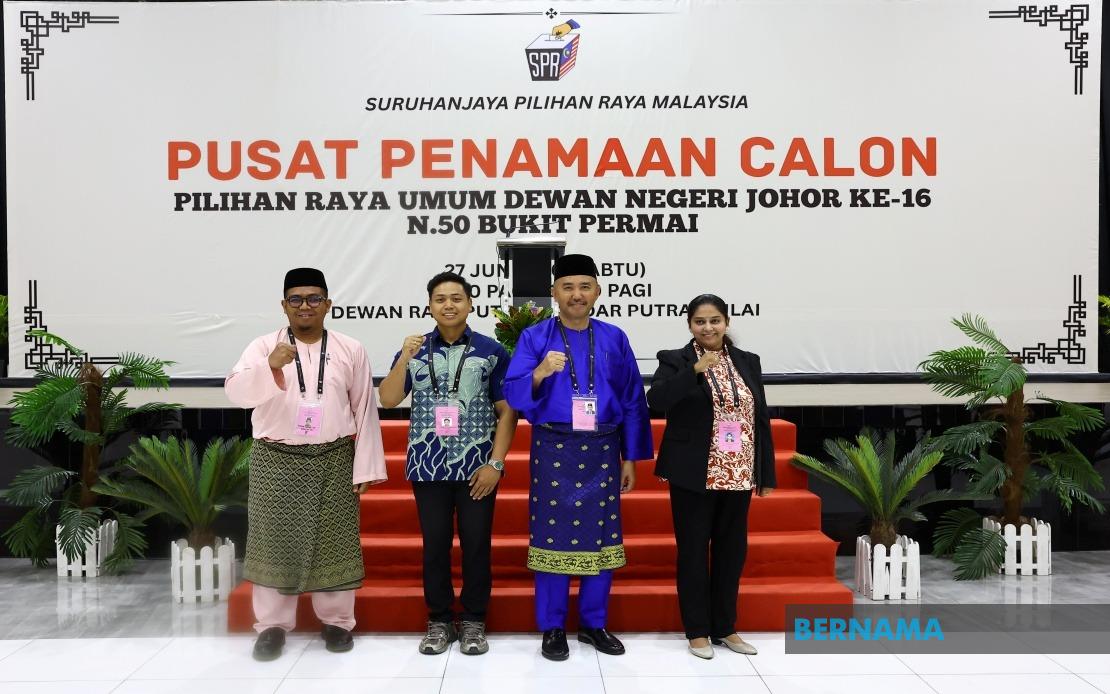
The Bukit Permai state assembly constituency in Batu Pahat has emerged as a multi-cornered battleground for the 16th Johor state election, with four candidates vying for control of the seat following the close of nominations on Thursday. Incumbent Datuk Mohd Jafni Md Shukor of Barisan Nasional is tasked with retaining his position against stiff competition from representatives of three separate political coalitions, marking a fragmented political landscape in this Johor heartland constituency.
Mohd Jafni's challengers reflect the complexity of Malaysia's contemporary political alignment. Mohamad Shafwan Ani carries the colours of Pakatan Harapan, the primary opposition coalition that has governed Selangor and Penang. M. Lina Manoh represents Perikatan Nasional, the newer political grouping that currently leads the Johor state government. Muhammad Aidil Riduan Mohd Yusof is the candidate for Parti Bersama Malaysia, the latest addition to the electoral arena. The returning officer Afzan Azhari formally announced all four names at the nomination centre located at Dewan Raya Putra in Bandar Putra following the conclusion of the nomination period.
The presence of PH's candidate was underscored by the arrival of Johor DAP chairman Teo Nie Ching at the nomination centre at 8:26 am to accompany Mohamad Shafwan. This personal endorsement highlights the national opposition's commitment to contesting Johor despite the coalition's mixed electoral fortunes in the state over recent years. PH's performance in Johor has been inconsistent, and this election represents another opportunity to rebuild its presence in a traditionally competitive state.
Mohd Jafni's record in the constituency provides context for this contest. In the 2022 Johor state election, he secured victory with a majority of 4,755 votes, also in a four-cornered fight. That comfortable margin suggested strong grassroots support, though the current election presents a different political environment with the inclusion of Parti Bersama Malaysia as a significant wild card. The splintering of the vote across four candidates introduces unpredictability that could benefit any camp capable of consolidating support or, conversely, could enable a well-organised challenger to emerge as victor through vote-splitting among opposition parties.
The election timeline has been set with precision by the Election Commission. Early voting is scheduled for July 7, providing opportunities for those unable to vote on the main election day. The general election will take place on July 11, giving the four candidates and their respective machinery approximately two weeks from nomination closure to mount their campaigns. This compressed timeframe demands swift organisation and strategic resource deployment from all camps.
The Bukit Permai contest exemplifies broader trends in Johor's political dynamics. The state, historically a BN stronghold, has increasingly become contested terrain. The emergence of PN as a serious contender in Johor has redrawn the electoral map, while PH continues to seek inroads despite previous disappointments. The participation of Bersama, though potentially marginal in vote share, adds another layer of complexity to an already fractured opposition landscape.
For BN and Mohd Jafni specifically, the challenge lies in maintaining the 2022 winning coalition while accounting for potential shifts in voter sentiment across the past two years. In that time, Malaysia has witnessed significant political realignments, changes in cost of living pressures, and adjustments to the political narrative. Whether these factors have strengthened or weakened the incumbent's position remains to be determined through the campaign period.
Pakatan Harapan's strategy in Bukit Permai must centre on consolidating opposition votes while differentiating itself from PN, which now governs Johor. For voters seeking change from the incumbent, the choice between PH and PN becomes crucial—a split opposition could easily hand victory back to BN. Perikatan Nasional, despite controlling Johor's state government, must demonstrate why its candidate deserves local support in what is technically a BN-held constituency, a nuanced message that requires careful articulation.
The inclusion of Parti Bersama Malaysia injects further unpredictability. As a newer political entity without extensive electoral track record in Johor, its likely impact remains speculative. However, even modest vote totals could mathematically alter outcomes in a close contest, making its presence impossible to dismiss outright despite initial assessments of its competitiveness.
From a broader Malaysian perspective, Bukit Permai represents one of many constituencies where traditional two-sided contests have given way to multi-polar competitions. This fragmentation of electoral politics, observable across numerous state and federal constituencies nationwide, fundamentally alters campaign dynamics and outcome calculations. Candidates who in previous eras could focus on building simple majority coalitions now must navigate more complex political terrain.
Voters in Bukit Permai will ultimately determine whether Mohd Jafni's governance record merits another term or whether this moment offers opportunity for fresh leadership under one of his three challengers. The constituency has demonstrated loyalty to BN in recent electoral cycles, yet the presence of serious opposition contenders indicates that support should not be assumed. What emerges from the July 11 poll will provide crucial insights into voter sentiment across this critical Johor battleground and potentially signal shifts in the state's broader political direction as it heads toward longer-term electoral reckoning.

