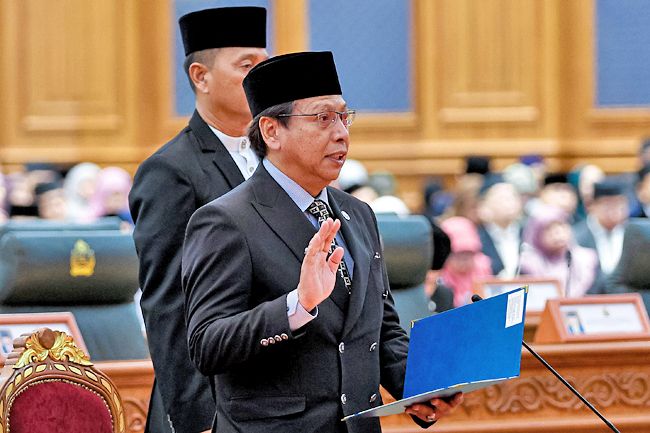
Brunei Darussalam marked the commencement of the second parliamentary meeting of its 22nd Legislative Council session with the formal swearing-in of four Cabinet ministers as ex-officio members on Monday, August 3rd. The ceremony, conducted at the Legislative Council chamber in Bandar Seri Begawan, reflects the constitutional framework that has governed ministerial representation in the sultanate's legislative body since independence.
The four ministers elevated to Legislative Council status include Datuk Seri Setia Awang Sufian Sabtu, who holds responsibility for security and legal matters within the Prime Minister's Office, and Datuk Seri Setia Awang Mohamad Azmi Mohd Hanifah, whose portfolio encompasses energy sectors including upstream and downstream petroleum operations. These two appointments underscore the continued centrality of energy policy and national security within Brunei's governance structure, reflecting the nation's dependence on hydrocarbon revenues and the strategic importance of internal stability.
The other two appointees brought broader sectoral representation to the council. Pengiran Datuk Seri Setia Mohammad Tashim Pengiran Hassan assumed his seat representing the Ministry of Religious Affairs, a particularly significant appointment in a country where Islamic governance plays a foundational constitutional role. Completing the quartet was Datuk Seri Setia Awang Mohammed Riza Datuk Paduka Mohammed Yunos, whose Transport and InfoCommunications Ministry addresses infrastructure and digital economy priorities facing the nation.
The induction process adhered strictly to the constitutional provisions established under the 1959 Brunei Constitution, the foundational legal document that has structured the sultanate's governance since its emergence as an independent nation in 1984. The ex-officio membership category ensures that senior Cabinet ministers maintain formal representation within the legislative chamber, creating a constitutional bridge between the executive and legislative branches. This arrangement differs markedly from Westminster systems where ministerial participation typically occurs through separate parliamentary processes.
For Malaysian observers, this constitutional arrangement offers instructive contrast. While Malaysia's Cabinet ministers also participate in parliamentary proceedings, the formal elevation through swearing-in ceremonies under specific constitutional provisions reflects Brunei's more hierarchical and ceremonial approach to governance structures. The attention to formal protocols and the explicit invocation of constitutional procedures signals the importance Brunei's government places on maintaining established legal frameworks and demonstrating respect for constitutional norms.
The presence of Pehin Orang Kaya Seri Lela Datuk Seri Setia Awang Abdul Rahman Datuk Setia Mohamed Taib, the Legislative Council Speaker, at the ceremony underscored the formal significance of the proceedings. The Speaker's attendance validated the constitutional propriety of the appointments and maintained continuity with parliamentary traditions. This ceremonial dimension reflects broader Southeast Asian governance practices, where formal rituals reinforce institutional legitimacy and respect for established procedures.
Brunei's Legislative Council has undergone significant transformation over recent decades, evolving from an advisory body toward greater deliberative capacity. The current 22nd session continues this trajectory, with the second meeting representing an opportunity to advance policy discussions on matters ranging from energy transition to digital infrastructure. The appointments of ministers specifically responsible for these sectors suggest that the government intends to prioritize substantive policy dialogue during this session.
The energy portfolio represents perhaps the most consequential ministerial presence in the chamber. Brunei, despite its oil and gas wealth, faces long-term economic diversification challenges as hydrocarbon reserves gradually deplete. The appointment of a dedicated minister for upstream and downstream operations signals continued commitment to maximizing returns from existing resources while potentially exploring downstream value-added opportunities and alternative revenue sources.
The inclusion of a transport and information communications minister reflects broader regional preoccupations with digital connectivity and physical infrastructure development. Southeast Asian economies increasingly recognize that these twin pillars undergird modern competitiveness. Brunei's relatively small population and geographic advantages position it uniquely within ASEAN to leverage digital innovation and strategic infrastructure placement.
The religious affairs minister's seat carries particular symbolic weight within Brunei's constitutional and social order. The nation has progressively emphasized Islamic governance frameworks, and maintaining robust ministerial representation on religious policy matters within the legislative chamber ensures that these concerns receive formal institutional attention. This reflects the sultan's role as defender of Islam and the integration of religious principles throughout Brunei's legal and governmental architecture.
These appointments occur within a broader context of parliamentary engagement in Southeast Asia. While Brunei's system operates distinctly from Malaysia's, Singapore's, or Indonesia's parliamentary models, all ASEAN legislatures grapple with balancing executive authority with meaningful deliberative capacity. The formal integration of senior ministers into Brunei's council reinforces the principle that governance legitimacy requires visible engagement with legislative processes, even where ultimate executive authority remains concentrated.
Looking forward, the presence of these four ministers within the Legislative Council during the second meeting may generate substantive debate on sectoral challenges and opportunities. Energy transition, infrastructure modernization, security considerations, and religious governance represent interconnected policy domains where ministerial presence can facilitate more nuanced legislative engagement than might occur through written reports or sporadic parliamentary questioning.

