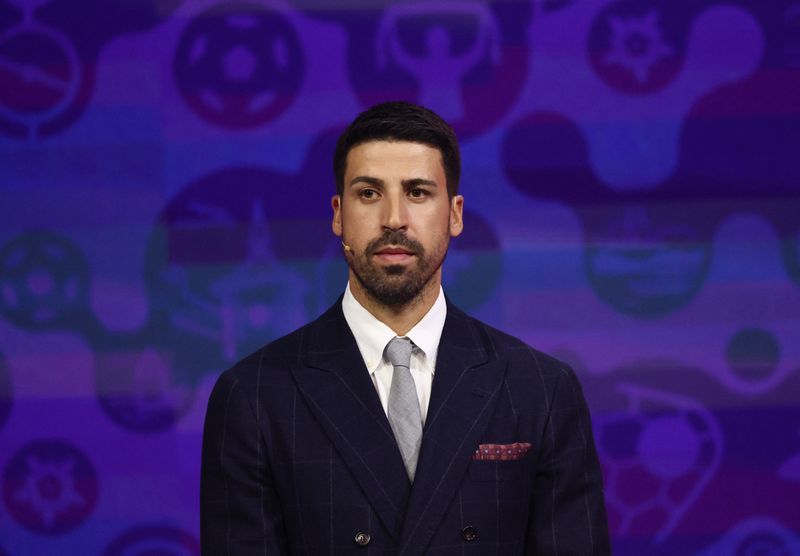
Sami Khedira carries dual heritage in his heart without conflict, and the German midfielder sees nothing problematic about brothers wearing opposing jerseys at the World Cup. Speaking at the Home of Football museum in New York, the 2014 World Cup winner articulated a vision of international football that embraces rather than questions the growing phenomenon of siblings representing different nations. His perspective carries particular weight given his personal experience navigating dual identity, with his brother Rani currently competing for Tunisia, their father's homeland, while Khedira himself earned 77 caps for Germany.
The modern football landscape increasingly reflects the complex realities of contemporary migration and family identity. Eight sets of brothers are participating in the current World Cup cycle, with half representing the same nation and half split across different federations. Athletic Bilbao teammates Inaki and Nico Williams exemplify this split, with Rani pursuing international football under Ghana's colours while Nico represents Spain. Similarly, Guela and Desire Doue find themselves on opposite sides when France confronts Ivory Coast, while Derrick Luckassen and Brian Brobbey, brothers through their mother but carrying their fathers' surnames, compete respectively for Ghana and the Netherlands. Harry and John Souttar navigate the Australia-Scotland divide, alongside three other sibling pairs distributed across Europe and the Caribbean.
For Khedira, these situations represent not fractured loyalties but rather the authentic expression of a globalised world where families transcend borders and cultures intertwine. Born to a German mother and Tunisian father, Khedira grew up navigating assumptions about his identity based on his name and physical appearance. He encountered Germans who questioned his authenticity whilst simultaneously being perceived as foreign in Tunisia despite his father's heritage. This lived experience informs his conviction that identity need not be zero-sum—that claiming both cultures simultaneously strengthens rather than weakens one's sense of belonging. His articulation reflects a generational shift in how football professionals understand nationality and allegiance.
The emotional power of this multicultural reality became vividly apparent to Khedira when he observed the Doue brothers singing both national anthems before a recent France versus Ivory Coast friendly. That moment crystallised for him something larger than sporting competition—the capacity of football to communicate profound messages about human connection and belonging. The image stayed with him precisely because it transcended the tactical dimensions of the match itself, instead illustrating how international sport provides a platform for expressing complex identities that nationalism alone cannot contain.
Khedira's observations gain significance within the context of football's structural evolution. The expansion to 48 teams at the World Cup has fundamentally altered which nations can credibly compete on football's grandest stage. Countries such as Cape Verde, Curacao, and Haiti now possess genuine pathways to tournament participation, whereas historical formats restricted opportunities to established footballing powers. This democratisation has profound implications for African and Asian federations that have increasingly narrowed Europe and South America's traditional competitive advantage. Behind this levelling lies decades of investment in coaching education, infrastructure development, and systematic talent identification in regions previously marginalised by football's institutional hierarchy.
Yet Khedira pointedly notes that European football carries responsibility beyond merely harvesting dual-nationality players to strengthen squad depth. The continent's developed football infrastructure and resources create ethical obligations to support football's growth in emerging nations at the source rather than simply benefiting from diaspora talent. This critique acknowledges an uncomfortable reality: wealthy federations have sometimes pursued young players from less resourced nations, creating pressure on promising athletes to make career-defining decisions before they possess sufficient maturity or understanding.
The psychological dimension troubles Khedira considerably. Young players representing multiple federations face intense pressure to declare national allegiance during formative years when they may not fully comprehend the permanence and emotional weight of such decisions. Khedira recalls his own experience at eighteen, needing to choose between identities whilst still developing as a person and player. That pressure, he emphasises, falls disproportionately on children scarcely old enough to make such consequential personal determinations. Political considerations, heritage arguments, and federation incentives can all cloud what ought to remain an intimate, individual choice.
Ultimately, Khedira argues that selecting one's national team must emerge from something ineffable—what he describes as a gut feeling that cannot be manufactured through external pressure, political calculation, or ancestral obligation. This perspective privileges the autonomy and emotional authenticity of individual athletes over institutional or familial demands. He recalls his own respectful conversations with Tunisian football authorities, decisions made from genuine regard for the nation's football community rather than compulsion. This balance—between individual agency and collective belonging—characterises the most ethically sound approaches to players navigating dual eligibility.
Khedira's commentary arrives at a moment when international football increasingly grapples with questions of identity, belonging, and representation. The phenomenon of brothers on opposite sides reflects broader demographic shifts reshaping world football. Globalised labour markets, educational migration, and family diaspora have created footballer populations whose identities resist neat categorisation. Rather than viewing this as problematic fragmentation, Khedira proposes understanding it as football's honest reflection of humanity's irreducible complexity. In his formulation, the beautiful game becomes beautiful precisely when it accommodates rather than erases the multifaceted identities that modern athletes authentically embody.
The expanding World Cup provides structural space for this diversity to flourish. Whereas previous formats might have squeezed players into either-or choices, the 48-team format permits more nations to develop competitive programmes capable of retaining promising dual-eligible talent. This expansion democratises not merely tournament access but also the range of identities that international football visibly represents. Khedira's vision suggests that football's future strength depends upon embracing rather than resolving the contradictions of multicultural belonging, allowing athletes to carry multiple allegiances with pride rather than shame.