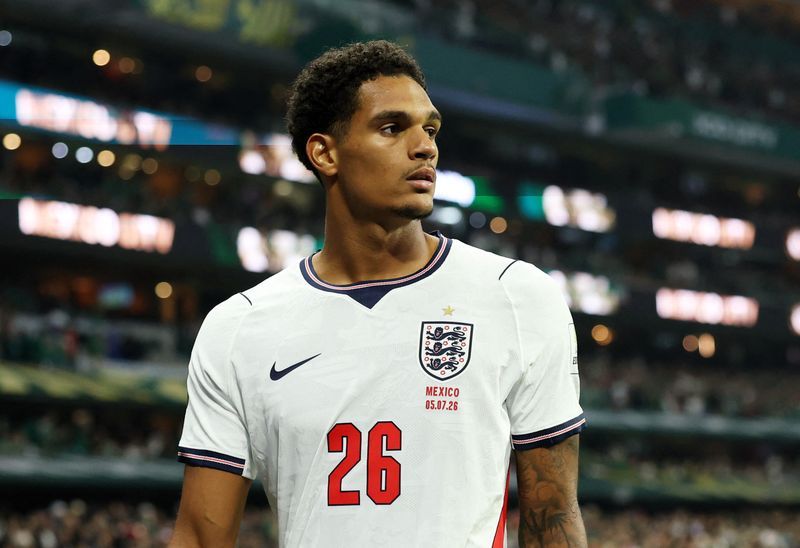
The fallout from FIFA's controversial decision to suspend Folarin Balogun's one-match ban has escalated dramatically, with British parliamentarians now demanding the world soccer body apply identical standards to England defender Jarell Quansah. The intervention represents a watershed moment in tournament politics, transforming what appeared to be a bilateral dispute into a broader challenge to FIFA's credibility and consistency in administering its own rules.
Quansah received a red card during England's 3-2 victory against Mexico at the Azteca Stadium on Sunday, triggering an automatic one-match suspension that would sideline him during the crucial quarter-final clash against Norway in Miami this Saturday. The English Football Association is actively exploring whether to lodge an appeal, according to sources briefed on the matter, while FIFA has remained conspicuously silent on whether it would consider Quansah's case under the same Article 27 provision that led to Balogun's reprieve.
The political dimension of the affair intensified when U.S. President Donald Trump publicly revealed that he had personally telephoned FIFA President Gianni Infantino to intervene in Balogun's case. Although Infantino maintained that FIFA's independent judicial bodies would make the final determination, the American president's direct engagement with soccer's governing body fuelled widespread speculation across European football authorities and political circles about whether political leverage had influenced what FIFA characterised as a purely sporting decision.
Labour MPs Noah Law and Melanie Onn dispatched separate letters to Infantino, articulated through social media, arguing that consistency demanded deferring Quansah's suspension until after the tournament concludes. Law acknowledged that Quansah's dismissal was warranted on the field, yet contended that the precedent established by Balogun's case created a compelling basis for similar treatment. Onn went further, emphasising that FIFA risked inflicting irreparable damage to its disciplinary architecture if one player received preferential treatment while another in materially identical circumstances faced immediate punishment.
The symmetry between the two cases has become central to the political argument. Both players received red cards during their respective victories, both face automatic one-match bans under FIFA's standard regulations, and both suspensions would eliminate them from critical knockout-stage matches. Yet the disparate treatment raises uncomfortable questions about whether tournament rules are applied uniformly or whether access to high-level political channels now constitutes an informal appeal mechanism within FIFA's system.
Caroline Dinenage, Chair of the House of Commons Culture, Media and Sport Committee, has demanded urgent clarification from FIFA regarding the intellectual basis for Balogun's suspension deferral. She framed the controversy as threatening to undermine the moral authority of international sport, arguing that a World Cup celebrating football's universal appeal cannot simultaneously tolerate the appearance of political interference in disciplinary matters. Her intervention carries particular weight, as it represents the formal judgment of parliament's dedicated sports oversight committee rather than individual MPs' positions.
Dinenage's statement pointedly referenced concerns that political pressure may have contaminated FIFA's decision-making process. By calling for explicit explanation of the reasoning behind Balogun's treatment, she implicitly challenged FIFA's assertion that its judicial bodies acted with complete independence. The demand for transparency addresses the tournament's credibility crisis, particularly among nations with less direct access to FIFA's leadership than the United States possesses.
The broader implications for FIFA extend beyond this specific tournament moment. The intervention by multiple British politicians and a parliamentary committee establishes a precedent whereby nation-states can mobilise their legislative apparatus to challenge FIFA's disciplinary determinations. If similar suspensions are not uniformly deferred in future cases, FIFA faces accusations of selective governance based on a player's or nation's political connections. Conversely, if FIFA grants Quansah's deferral, it effectively legitimises the principle that political representations merit consideration in disciplinary appeals.
For Malaysian and Southeast Asian observers, the episode illuminates deeper structural vulnerabilities within international sports governance. Smaller nations and players without direct political channels to FIFA's upper echelons lack equivalent capacity to seek intervention when suspension decisions affect their competitive prospects. The Balogun-Quansah disparity therefore represents not merely a technical inconsistency but a potential manifestation of power imbalances within global sports administration, where access to prominent political leadership may determine disciplinary outcomes.
England's upcoming quarter-final against Norway in Miami on Saturday will proceed with this controversy casting a shadow over the tournament. Quansah's potential unavailability due to suspension—or conversely, his continued participation through a deferred ban—will carry symbolic weight beyond the tactical implications for England's campaign. The match outcome may be remembered less for the quality of play than for its association with the tournament's most significant governance controversy.
FIFA's silence on these matters compounds the perception problem. By declining to explain its reasoning or comment on whether identical standards will apply to Quansah, the organisation invites reasonable scepticism about its decision-making transparency. The absence of proactive communication from FIFA President Infantino suggests institutional discomfort with scrutiny, reinforcing the impression that political factors rather than technical sporting judgment drove the original Balogun determination.
The coming days will reveal whether FIFA treats these interventions as legitimate governance concerns worthy of systematic response or attempts to shield its authority from democratic oversight. The consistency of its approach to Quansah's case will effectively determine whether FIFA accepts accountability to the political communities hosting its events or whether it reserves disciplinary determinations for opaque internal processes insulated from parliamentary scrutiny.

