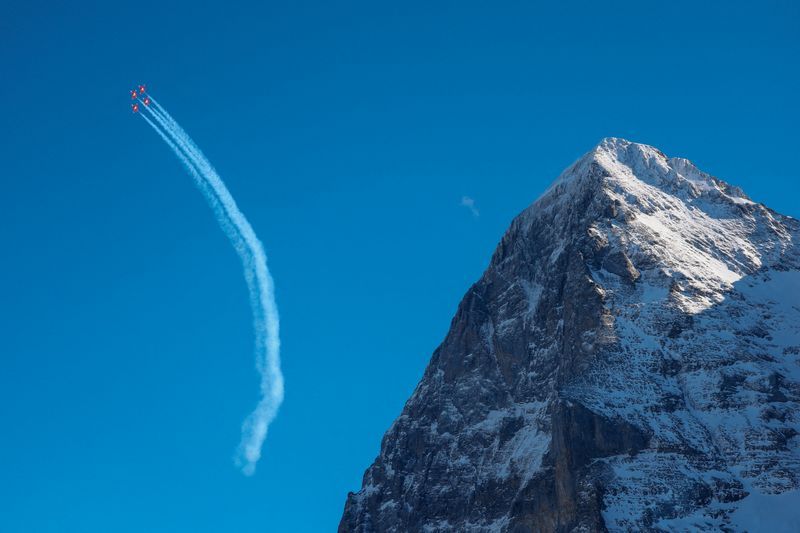
Fay Manners returned to Switzerland's Eiger this summer with a mission that extended far beyond merely conquering the legendary peak. The British alpinist, who had previously tackled the famous North Face using an established route, came back to the towering Alpine wall determined to do something no British woman had achieved before: chart an entirely new path across its vertical expanse. Over the course of 13 gruelling days, Manners and her Swiss climbing partner Roger Schaeli painstakingly mapped and ascended a previously unclimbed line, establishing what they named "Solar Eclipse," a 2,952-foot route spanning 33 pitches that now bears testament to their audacity and technical skill.
The Eiger North Face represents one of mountaineering's ultimate tests of courage and competence. Soaring nearly 1,800 metres above the Swiss Alps, this sprawling wall of rock and ice remains perpetually exposed to extreme weather systems and the constant threat of falling debris. The face earned its fearsome reputation through decades of tragedy before a German-Austrian team finally succeeded in reaching the summit in 1938, establishing a benchmark for what was possible on the wall. Since then, the North Face has attracted elite climbers from around the world, each seeking either to repeat known routes or to discover fresh lines through the unforgiving terrain.
Manners' own relationship with the Eiger began four years earlier when she completed the Heckmair Route, one of the well-known passages on the North Face. That experience, rather than satisfying her appetite for the peak, ignited something deeper. She found herself obsessively studying the wall's geography and architecture, mentally tracing alternative passages and envisioning possibilities where others perhaps saw only established pathways. The mountain had captivated her imagination, and she returned with clear intention to contribute her own creative vision to its climbing legacy.
The distinction between repeating an established route and pioneering a new one cannot be overstated. When climbers follow an existing path, they benefit from accumulated knowledge about what obstacles lie ahead, which equipment proves necessary, and whether success is genuinely attainable. Those undertaking a first ascent confront profound uncertainty at every step. Manners articulated this challenge candidly: the climber establishing a new route enters a realm of unknowns, unable to predict the technical difficulty, unable to anticipate what safety equipment the rock and ice will demand, and genuinely uncertain whether the chosen line will ultimately lead to the summit or prove to be a dead end. This uncertainty carries both physical and psychological weight.
Yet for Manners, the significance of establishing a new route transcends the personal accomplishment. She views it through a lens of representation and symbolic importance within mountaineering culture. Scanning through climbing guidebooks, she observed that virtually every person credited with opening a new route carried a male name. This pattern, she argues, carries a subtle but powerful message to aspiring climbers: men create the possibilities, women follow them. By stepping into the creative space traditionally occupied by men, Manners seeks to demonstrate that women belong not merely as participants in mountaineering but as architects and innovators shaping the sport's future. She emphasises that encouraging women to undertake the demanding work of establishing new routes—with all its physical and mental strain—matters as much as celebrating individual achievements.
Women have woven themselves into the Eiger's story for longer than many recognise. In 1964, Daisy Voog shattered a crucial barrier by becoming the first woman to successfully climb the North Face, despite historical accounts revealing that she had previously been rejected from a mountaineering club focused on extreme climbing purely because of her gender. Imai Michiko, a Japanese climber, became the sole female member of a six-person team that established the "Japanese Summer Direttissima" route just five years later. These pioneers operated within a context where their very presence on the mountain constituted rebellion against prevailing assumptions about women's capabilities.
Manners reflects critically on how subtle gender conditioning shapes what people—particularly women—believe they can accomplish. She pondered how differently her trajectory might have unfolded had she grown up in an environment where gendered assumptions about physical capacity never took root, where the division of labour and ability was simply never questioned. The stereotypes that limit women's aspirations, she notes, operate so quietly that people rarely notice their influence until examining their own self-doubt with deliberate scrutiny. These invisible barriers accumulate across a lifetime, each small suggestion that women are less capable settling into the subconscious and constraining ambition.
Manners' own path to professional mountaineering reflects precisely these constraints. Growing up in England, she possessed genuine athletic talent and harboured genuine ambitions to build a sporting career, yet the adults around her consistently communicated a dispiriting message: women could not make serious money or forge sustainable futures in sport. Rather than fight those narratives head-on, she complied with conventional wisdom, pursuing data science as a practical fallback. Even after relocating to Chamonix in France to be geographically closer to her climbing passion, she maintained her data consulting work, unsure whether climbing could genuinely sustain her. Only when The North Face approached her with sponsorship did the possibility of a full-time climbing career begin to seem real rather than fantastical.
Manners' sponsorship arrangement initially allowed her to straddle both worlds, continuing data consulting while gradually expanding her climbing commitments. Within a year, she made the leap to mountaineering full-time, though she describes a persistent sense of disbelief even as the transition occurred. The realisation that a woman could actually sustain a professional climbing career came almost as a surprise, so thoroughly had she internalised the earlier messaging about its impossibility. This delayed recognition of what was possible speaks to the cumulative power of gendered expectations in shaping not just individual choices but the very horizons of what people can imagine for themselves.
Looking forward, Manners envisions her contribution to the Eiger extending beyond her own ascent of the Solar Eclipse route. She articulates a specific ambition that reframes success in collective rather than individual terms: she hopes to see all-female teams return to the route and repeat her accomplishment. That vision represents something profound about her understanding of representation and legacy. A route opened by a woman that subsequent women choose to climb creates a feedback loop of possibility, gradually shifting the invisible landscape of what female climbers might attempt. Each subsequent all-female team that tackles the Solar Eclipse route writes their own names into a story that Manners initiated, building momentum toward the normalisation of women's creative participation in mountaineering.

