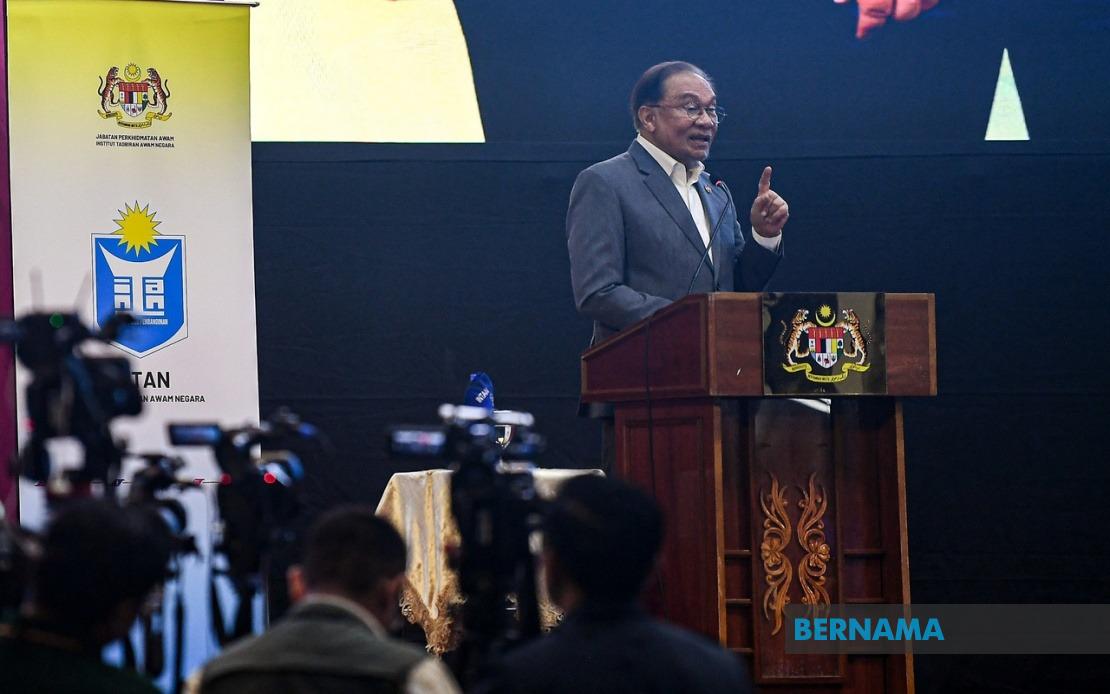
Prime Minister Datuk Seri Anwar Ibrahim has made an impassioned appeal to Malaysians to shed the psychological remnants of colonialism that continue to position Western models, institutions and cultural frameworks as inherently superior. Speaking during an engagement with civil servants from the Central Zone at Universiti Islam Selangor, Anwar framed this challenge as fundamental to the meaningful realisation of national independence, arguing that true sovereignty extends far beyond the formal end of colonial rule.
Anwar's remarks, delivered alongside Chief Secretary to the Government Tan Sri Shamsul Azri Abu Bakar and Director-General of the Public Service Tan Sri Wan Ahmad Dahlan Abdul Aziz, zeroed in on a persistent contradiction within Malaysian society: that nearly seven decades after independence, significant segments of the population continue to measure national progress and institutional quality against Western benchmarks. He observed that even Malaysians born in the post-independence era have internalised what he termed a mentally colonised outlook, where aspiration invariably gravitates toward emulating foreign systems rather than developing homegrown solutions.
The Prime Minister articulated his concern through a pointed observation about how this mindset manifests across multiple domains of national life. He highlighted that for a substantial portion of Malaysia's educated class and decision-makers, the default assumption remains that English-medium education represents intellectual superiority, that Western economic models provide the optimal development pathway, and that governance structures imported from Western democracies deserve unconditional adoption. This psychological orientation, Anwar suggested, represents a failure to genuinely internalise the independence that Malaysians struggled to attain.
Critically, Anwar positioned this challenge not as a mere matter of cultural preference or linguistic choice, but as fundamentally tied to national development strategy and institutional effectiveness. His argument carries particular weight given Malaysia's own track record of economic achievement and social development through policies adapted to local context. The Prime Minister's intervention signals growing concern within government circles that excessive deference to external models may constrain Malaysia's ability to innovate solutions tailored to its distinctive demographic composition, economic structure and regional position.
The timing of these remarks reflects broader regional and global currents. Across Southeast Asia, middle-income nations are increasingly questioning whether wholesale adoption of foreign institutional templates genuinely serves development objectives, or whether such approaches mask underlying power dynamics and create structural dependencies. Anwar's framing aligns with a emerging consensus among policymakers that sustainable development requires institutional and cultural authenticity, not merely technical transplantation from external sources.
Anwar further expanded his critique to encompass the generation born after Merdeka, observing that many harbour what he characterised as "half-English" thinking—a bifurcated consciousness where outward appearance and identity may be distinctly Malaysian, yet intellectual orientation, professional values and aspirational frameworks remain thoroughly Western-derived. This internal contradiction, he implied, undermines the coherence and authenticity of Malaysia's development trajectory.
The Prime Minister's invocation of values and national identity as counterweights to uncritical Western emulation carries deeper significance for the Malaysian civil service specifically. As the audience included senior public sector officials responsible for policy implementation, Anwar's remarks functioned as both diagnosis and directive: that government institutions should serve as anchors for Malaysian-rooted development approaches rather than conduits for external model implementation. This positioning suggests future policy discussions may increasingly emphasise adaptation and contextualisation over wholesale adoption of foreign frameworks.
Anwar's emphasis on building the nation upon Malaysia's own strengths and values represents a subtle but significant reorientation of development discourse. Rather than dismissing Western knowledge and systems outright, his framework advocates for a more discerning, selective engagement where external insights are filtered through Malaysian values and adapted to local circumstances. This approach potentially opens space for innovation that draws on Malaysia's multicultural character, Islamic principles, regional geographic positioning and accumulated institutional experience.
The implications extend beyond rhetorical flourish. If this philosophy becomes embedded in policy-making across government agencies and public sector institutions, it could catalyse meaningful differences in educational curriculum design, economic development strategy prioritisation, and governance structure evolution. For a nation that has successfully synthesised diverse influences throughout its modern history, such an approach might unlock institutional innovation that Western-centric templates have constrained.
For Malaysian civil servants gathered at the event, Anwar's message contained both validation and challenge: validation that their contributions to nation-building need not replicate external models, and challenge to develop alternatives grounded in Malaysian values. This positioning of the public sector as custodian of authentic national development rather than mere administrator of imported systems represents a noteworthy reframing of bureaucratic purpose and professional identity.
The remarks also carry implications for Malaysia's regional standing within Southeast Asia. As a middle-power nation navigating complex geopolitical dynamics, Malaysia's willingness to articulate development approaches rooted in its own values and institutional strengths strengthens its bargaining position in regional forums and reduces perceived vulnerability to external pressure. In this sense, Anwar's call transcends domestic discourse and engages questions of national agency and autonomy in the broader Asian context.

