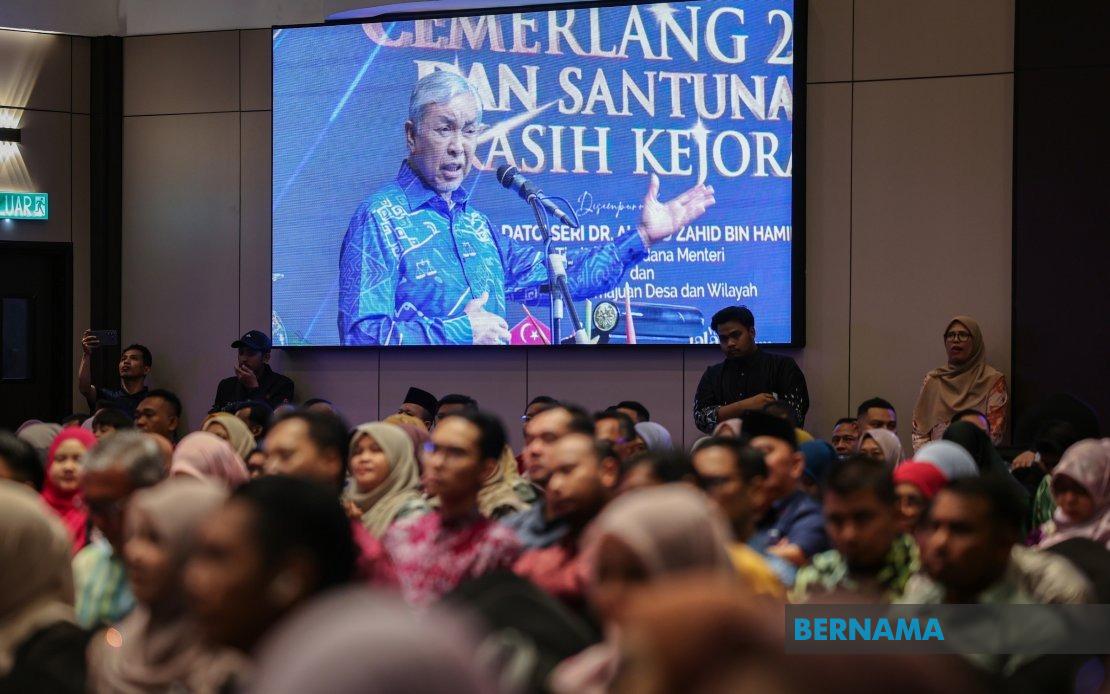
Barisan Nasional's campaign machinery in Johor is operating at full intensity, according to the coalition's chairman, who has pushed back against opposition suggestions that the election effort lacks vigour ahead of the July 11 state election. Datuk Seri Dr Ahmad Zahid Hamidi made the assertion while addressing media in Kota Tinggi, dismissing what he framed as baseless political rhetoric from rival coalitions. The timing of these remarks reflects broader anxieties within BN about perception management in a closely watched contest that could signal voter sentiment across the peninsula.
Ahmad Zahid's rebuttal addresses a narrative that has circulated in some political circles questioning the intensity and effectiveness of BN's ground operations compared to previous campaigns. The Deputy Prime Minister argued that such characterisations are mere political perception rather than observations grounded in verifiable campaign activity. He acknowledged that opposition coalitions are entitled to their own assessments, whether supportive or critical, but maintained that BN's internal evaluation shows robust engagement with voters across all 56 contested seats.
One complicating factor for BN's messaging involves the relationship between the state government and Pakatan Harapan at the federal level through the Unity Government arrangement. Some observers have speculated that this cooperation might confuse traditional BN voters in Johor, potentially diluting their support or causing them to question where political allegiances truly lie. Ahmad Zahid systematically addressed this concern, noting that Johor occupies a distinctive position because the state government under Menteri Besar Datuk Onn Hafiz Ghazi was already established before the federal Unity Government framework was created. This chronological reality, he suggested, means there is no structural conflict between state and federal cooperation, and both administrative layers are functioning harmoniously.
The Deputy Prime Minister emphasised that the professional working relationship between BN and PH at federal level need not translate into voter confusion at the state election. He portrayed this as evidence of mature governance rather than any ideological contradiction. For Malaysian voters accustomed to coalition politics, this distinction may be technically sound but could still generate uncertainty about how state-level performance will be evaluated under a federal framework that includes previous opposition parties. The framing appears designed to inoculate BN against criticism that it has compromised its traditional political identity.
BN is contesting all 56 seats in the Johor state assembly, seeking what Ahmad Zahid described as a resounding mandate to strengthen the state government's authority and accelerate its development agenda. This approach of contesting every seat contrasts with the more selective strategies some coalitions employ and signals BN's confidence in its ground position. The coalition is banking heavily on the track record of Onn Hafiz's administration, which Ahmad Zahid cited as evidence of effective governance worthy of renewed support.
Revenue generation under the current Johor government has become a key campaign metric. Ahmad Zahid highlighted that the state collected RM2.26 billion in revenue last year, the highest figure among Peninsular Malaysian states. This statistic frames Johor as a financially robust jurisdiction capable of funding development projects and state services. For Malaysian voters who increasingly evaluate governments on service delivery and economic vitality, such figures carry tangible weight. The Johor government is positioning this revenue achievement as justification for continuity and for voters to grant an expanded mandate.
With the stronger mandate in hand, Ahmad Zahid projected that BN would accelerate implementation of its development manifesto commitments over the next five years. This forward-looking pitch emphasises projects and investments rather than dwelling on past grievances or ideological disputes. It reflects a broader BN campaign strategy of making this election about future governance capacity rather than historical performance under the pre-2018 BN dominance. For a coalition seeking to restore or maintain voter confidence after years of turbulence, this constructive framing is strategically important.
The broader electoral landscape in Johor includes several other contenders. Perikatan Nasional is fielding 33 candidates, presenting itself as an alternative to BN's approach to Malay-Muslim politics. Pakatan Harapan is matching BN's commitment with 56 candidates of its own, indicating serious intent to capture the state government. Smaller parties and coalitions, including Bersama with 15 seats, MUDA with four seats, and single-seat efforts from Asli, PSM, and six independent candidates, add complexity to vote distribution. This fragmented field means BN cannot assume that traditional voter support will automatically translate into victories in three-way or multi-way contests.
Ahmad Zahid's response to PAS president Tan Sri Abdul Hadi Awang's call for voters to reject Pakatan Harapan outright, even in straight fights against BN, reveals tactical differences within Malay-Muslim political spheres. Whereas PAS is adopting a more adversarial posture toward PH, BN is maintaining what Ahmad Zahid characterised as a professional approach focused on its own candidates and messaging. He indicated openness to any additional support that materialises but is not aggressively campaigning for backing from outside BN's formal structure. This measured tone contrasts with more combative opposition rhetoric and may appeal to voters fatigued by political intensity.
Early voting is scheduled for July 7, with main polling on July 11. These dates were set to accommodate the timing required for a full state election process and allow sufficient campaigning time. The condensed timeframe compared to some other state elections means campaign messaging becomes more concentrated, and late-breaking developments can significantly influence outcome perceptions. For BN and other contenders, this compressed timeline increases the importance of front-loaded campaign activities and media presence.
The characterisation of the campaign as lacklustre or otherwise reflects deeper questions about voter enthusiasm and engagement levels in Malaysian electoral contests. In recent cycles, some constituencies have seen lower turnout, while others have mobilised voters intensely. Campaign intensity often correlates with perceived stakes and voter confidence in available options. Ahmad Zahid's insistence that BN's machinery is actively engaged can be read as an attempt to project confidence and momentum, countering any narrative suggesting complacency or loss of voter appeal.
For Southeast Asian observers and Malaysian analysts watching the Johor election, the state contest serves as a barometer of regional political sentiment. Johor's significance extends beyond its own governance questions; results will influence perceptions about BN's viability as a national force, PH's ability to expand beyond its current bases, and whether Perikatan Nasional can consolidate alternative Malay-Muslim support. The outcome may ripple through coalition calculations at other state levels and inform thinking about potential federal-level adjustments. In this context, BN's emphasis on campaign robustness and government performance becomes part of a broader national political narrative.

