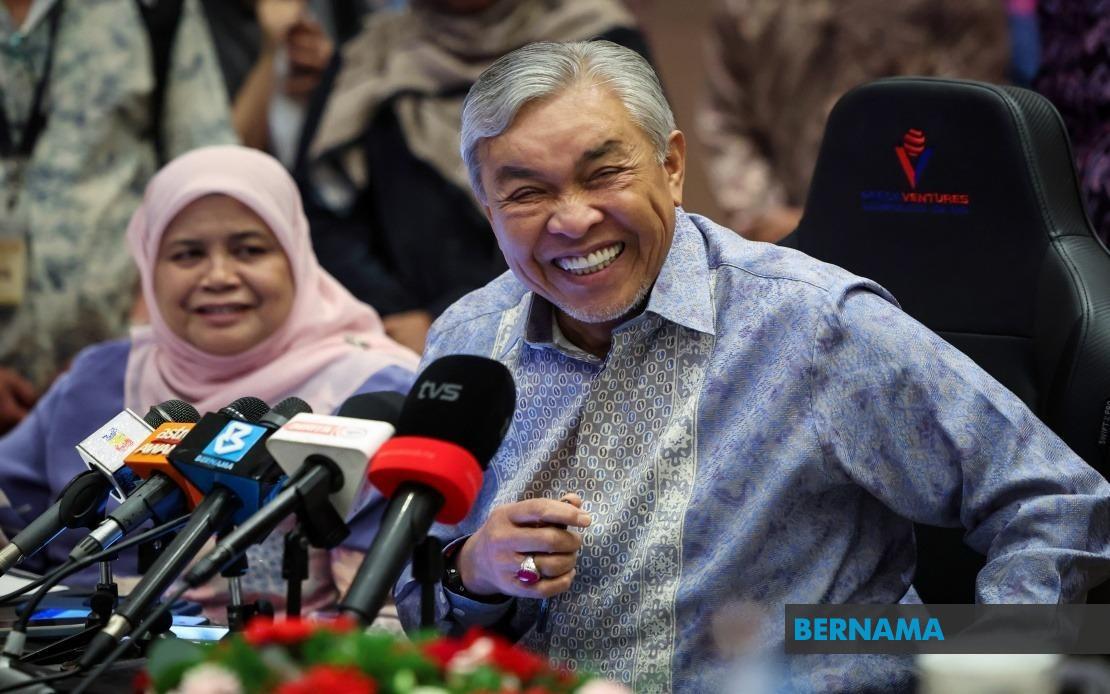
Barisan Nasional's leadership has moved to quash persistent speculation about the coalition's stability within Malaysia's Unity Government, with Deputy Prime Minister Datuk Seri Dr Ahmad Zahid Hamidi explicitly denying any intention to withdraw support from Prime Minister Datuk Seri Anwar Ibrahim's administration. Speaking in George Town during the 61st Coordination Meeting between the Minister of Rural and Regional Development and State Executive Councillors for Rural Development (MEXCLUB), Ahmad Zahid underscored that BN's position remains unshakeable despite ongoing rumours of potential political manoeuvres.
The BN chairman's forceful statement addresses mounting concerns within political circles about the durability of Malaysia's power-sharing arrangement, which has held since the 2022 General Election when the Yang di-Pertuan Agong decreed the formation of a unity coalition. Ahmad Zahid's categorical rejection of what he termed "Bangkok Move" or "Dubai Move" scenarios—references to alleged previous plots to topple governments—suggests the coalition is acutely aware of public and investor anxieties regarding political stability. For Malaysian business and international observers, such reassurances carry considerable weight given the nation's experience with political volatility.
The Deputy Prime Minister grounded BN's commitment in the foundational legitimacy of the Yang di-Pertuan Agong's directive, framing the coalition's continued participation as both a constitutional obligation and a strategic necessity. He stated unequivocally that once BN accepted the Agong's decree, the coalition pledged itself to serve through to the end of the 15th Parliament's term, scheduled for 2028. This framing appeals to both traditionalists who value monarchical authority and pragmatists concerned with governance continuity, positioning the coalition as constitutionally bound rather than merely opportunistically allied.
Ahmad Zahid's remarks carry particular significance given BN's historical dominance in Malaysian politics and its need to rebuild credibility following the 2018 electoral collapse that removed it from power. The coalition's formal integration into the Unity Government represented a significant shift in positioning, transitioning from erstwhile opposition partner to subordinate coalition member. His insistence that doubts should be dispelled speaks to the internal and external pressure BN faces to demonstrate reliability as a junior partner, particularly as it seeks to maintain relevance and negotiate future electoral arrangements.
The Deputy Prime Minister's comments also appeared designed to address fragmentation within BN's own ranks. His discussion of operational challenges affecting a Barisan polling district centre in Klawang during the Negeri Sembilan state election campaign revealed underlying tensions about candidate selection and resource allocation. Ahmad Zahid acknowledged that discontent had surfaced in response to BN's decision not to field a candidate for the Klawang state seat, a constituency within Negeri Sembilan UMNO chief Datuk Seri Jalaluddin Alias's Jelebu parliamentary constituency. Rather than dismissing such grievances, Ahmad Zahid indicated active engagement with state leadership to resolve the matter, suggesting that maintaining internal cohesion requires ongoing management and attention.
The three-way contest in Klawang—featuring Pakatan Harapan's Bakri Sawir, Perikatan Nasional's (PN) Danni Rais, and Bersatu's Muhammad Adib Musa—exemplifies the fragmented opposition landscape facing BN and its Unity Government partners. For Malaysian observers tracking the 2024 Negeri Sembilan state election campaign, the dynamics illustrate how opposition forces remain divided, potentially benefiting the Unity Government despite internal coalition friction. However, the dispute over BN's non-participation in certain constituencies also reveals the coalition's struggle to coordinate candidate deployment effectively across multiple parties with competing interests.
Ahmad Zahid's response to speculation about potential cooperation between BN and Perikatan Nasional under a proposed "Perikatan Barisan Nasional (PBN)" alliance represented another significant clarification. He dismissed such proposals as merely rhetorical flourishes heard during campaign speeches, emphasising that no formal discussions have taken place between the coalitions. This stance reassures Pakatan Harapan and other Unity Government partners that BN has not engaged in parallel negotiations that could undermine the current arrangement. For investors and international observers monitoring Malaysian political stability, such clarity about the absence of backroom discussions proves reassuring, even if campaign-trail rhetoric occasionally suggests otherwise.
The context of these statements assumes greater importance when viewed through the lens of Southeast Asian political developments more broadly. Malaysia's Unity Government represents a relatively rare example of a managed power-sharing arrangement within the region, contrasting with more volatile configurations elsewhere. The commitment to maintaining this structure until 2028 would effectively span two-thirds of a decade, providing continuity that could benefit long-term policy implementation and economic planning. However, achieving such longevity requires precisely the kind of sustained discipline and commitment that Ahmad Zahid sought to emphasise.
Ahmad Zahid's lighter moment—responding with his own pantun verse to Prime Minister Anwar's poetic meditation on unity and cooperation—signalled continued personal rapport between the two leaders despite their recent campaigning on opposite sides in Negeri Sembilan. The exchange of traditional Malay poetry on themes of political friendship and discipline underscores the cultural and personal dimensions underlying Malaysia's coalition arrangements. Such public displays of cordiality, while perhaps appearing cosmetic, serve an important function in reassuring the Malaysian public and international observers that personality conflicts are not driving political instability.
The timing of Ahmad Zahid's emphatic statements proved significant, coming as campaign activities intensified for the Negeri Sembilan state election. Competition between coalition partners at the state level, where different parties contest the same seats, creates inherent friction that risks spilling over into federal arrangements if not carefully managed. By articulating BN's federal commitment to the Unity Government even as individual coalition parties campaign against each other in state contests, Ahmad Zahid attempted to establish a clear distinction between tactical electoral competition and strategic political alignment. This compartmentalisation represents a delicate balancing act essential to coalition stability.
For Malaysian business interests and international investors, the Deputy Prime Minister's reassurances address fundamental questions about policy continuity and governance reliability. Political uncertainty directly impacts investment decisions, currency valuations, and the nation's international standing. BN's affirmation of commitment through 2028 theoretically provides a stable horizon for medium-term planning and capital allocation. However, whether such statements prove sufficient depends not merely on leadership declarations but on the coalition partners' ability to negotiate competing interests and resist the temptation to exploit their leverage for short-term advantage. The Negeri Sembilan state election campaign itself provides a microcosm of how effectively the coalition can manage such tensions.
Looking forward, Ahmad Zahid's position establishes a baseline against which BN's future behaviour can be measured. Should internal tensions escalate or external pressures mount, these statements would provide reference points for assessing whether the coalition remained true to its commitments. The Deputy Prime Minister's evident determination to foreclose discussion of alternative scenarios—his emphatic "Full stop" on the matter—suggests BN leadership recognises that any perceived wavering on commitment could invite destabilising speculation. In this sense, his categorical pronouncements function simultaneously as genuine policy declarations and as strategic positioning designed to preempt challenges from both within and without the coalition.

