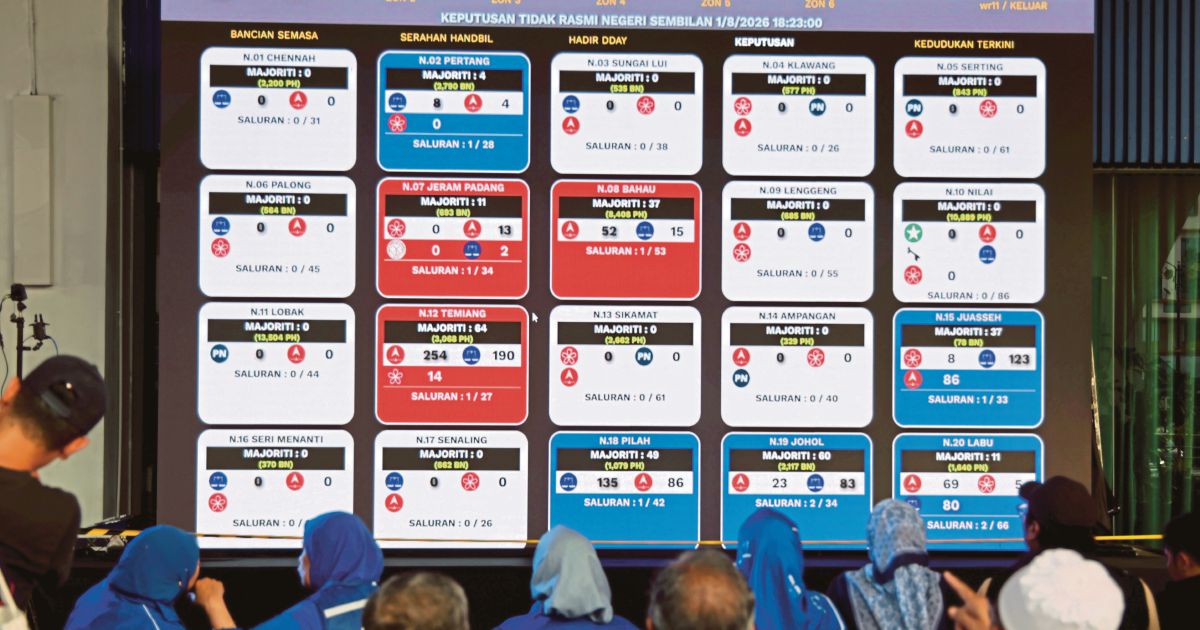
The Negri Sembilan political landscape shifted into focus when Umno's Datuk Dr Asyraf Wajdi Dusuki declared that the combined Barisan Nasional and Perikatan Nasional bloc had captured sufficient seats to establish the state's governing coalition. According to his statement in Seremban, the alliance had won 23 seats, crossing the threshold required to command a majority in the state assembly and secure the authority to form government.
The claim represents a critical development in what has been an intensely competitive electoral contest in one of Malaysia's central states. Negri Sembilan has historically been a swing territory where political fortunes shift according to regional dynamics and local voter sentiment. The formation of such a broad coalition between BN and PN signals strategic positioning across both major political blocs, indicating an attempt to consolidate power by bringing together traditionally distinct power structures.
The significance of this alliance cannot be understated within the Malaysian political context. Barisan Nasional, which long dominated Malaysian politics at federal and state levels, has found itself needing to forge partnerships with Perikatan Nasional, a coalition that emerged from internal disputes within the Umno-led establishment. The willingness of these groups to work together at the state level demonstrates pragmatic political calculation rather than ideological alignment, reflecting how Malaysian coalitional politics often prioritises immediate electoral victory.
Negri Sembilan occupies an important position within the Malaysian federation, both geographically and economically. The state lies between Selangor and Pahang, making it a crucial bridge between the developed Klang Valley region and the less developed east coast. Its government influences policies affecting manufacturing, agriculture, and services sectors that connect these regions. Control of state resources and development priorities therefore carries implications extending beyond the state's borders.
For Umno specifically, advancing such claims through party representatives underscores the party's continued efforts to reassert political relevance following losses in recent electoral cycles. Datuk Dr Asyraf Wajdi Dusuki's prominence in making this declaration places him at the forefront of Umno's state-level mobilisation efforts. His background and standing within the party machinery suggest the announcement carries official weight, though the informal nature of such claims before official electoral validation remains a feature of Malaysian political discourse.
The 23-seat claim warrants scrutiny against the actual number of seats available in the Negri Sembilan state assembly. The state assembly comprises 36 seats total, meaning 19 would constitute a simple majority. If the BN-PN figure of 23 seats is accurate, it would provide a comfortable buffer of four seats above the minimum requirement. This margin offers some protection against potential defections or abstentions that could undermine the coalition's stability during the crucial formation period.
The informal nature of Asyraf's announcement—described as an unofficial claim—reflects how Malaysian electoral politics often operates in a grey zone between official results and public assertions. Opposition parties typically contest such claims until official election authorities validate final counts. The timing and source of such declarations can shape early narrative control over government formation narratives, potentially influencing public perception and political momentum before formal processes conclude.
This development carries implications for Malaysian federalism and centre-state relations. The composition of Negri Sembilan's state government will influence how state authorities interact with federal structures, particularly given the nature of coalition partners involved. Relations between BN and PN coalitions at state level could affect broader federal political dynamics, especially regarding resource allocation and policy coordination between Putrajaya and state-level administrations.
The involvement of Perikatan Nasional in this coalition marks notable shifts in Negri Sembilan's political alignment. PN emerged as a significant political force following the 2020 general election and has since positioned itself as an alternative to BN. The decision to partner with BN in Negri Sembilan suggests that state-level considerations may override broader ideological positioning at the federal level. This flexibility in coalition-building demonstrates how Malaysian political parties prioritise local victories through pragmatic alliances rather than remaining rigidly wedded to national political positioning.
The claim of 23 seats also raises questions about which specific parties comprise the winning coalition and their respective contributions. Understanding whether BN's traditional components—Umno, MCA, and MIC—won substantially more seats than their PN partners, or whether the coalition benefited from relatively balanced contributions, would illuminate the power dynamics within this new governing arrangement. Such internal balance sheets determine who holds key ministerial portfolios and executive authority at the state level.
For Malaysian observers and investors, government formation in Negri Sembilan matters because stable state administrations facilitate consistent policy environments. A coalition with a workable majority and minimal internal tensions typically delivers more predictable governance than narrowly-formed governments vulnerable to sudden shifts. The 23-seat claim, if validated, would position the BN-PN coalition for a reasonably stable tenure, though no coalition in Malaysian politics operates entirely free from internal strains.
As formal results undergo official scrutiny and state assembly formation procedures commence, Asyraf's assertion will require validation through official channels. The Negri Sembilan State Election Commission will provide definitive seat allocations, and these will likely either confirm or necessitate revision of current claims. The coming days remain crucial as political actors jostle to establish government while official processes unfold, illustrating how Malaysia's electoral politics balances formal institutional procedures with informal power negotiations.

