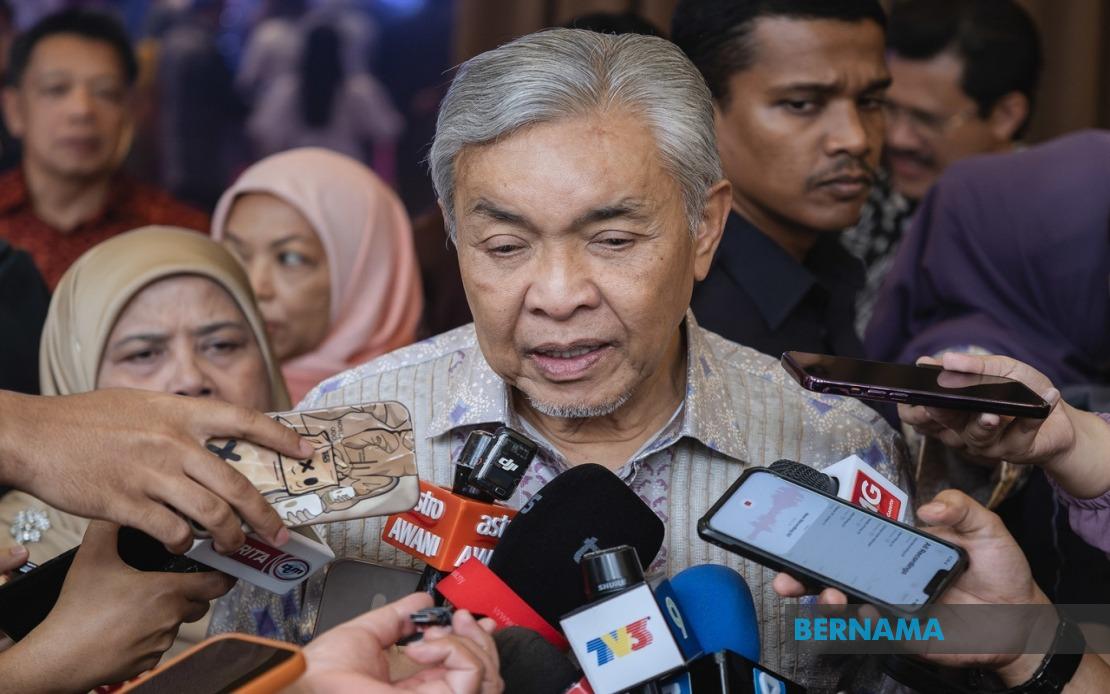
The Barisan Nasional coalition has drawn a clear line between its electoral campaign and the internal institutional machinery of Negeri Sembilan state, with Deputy Prime Minister Datuk Seri Dr Ahmad Zahid Hamidi declaring that the political alliance will maintain strict distance from matters involving the royal institution and the state's Council of Justice and Laws. The pledge came during a gathering in Kuala Lumpur following a session at the Ministry of Rural and Regional Development, where the UMNO president outlined his party's strategic approach to the looming state elections scheduled for August 1.
Ahmad Zahid's statement represents an attempt to frame BN's electoral positioning as one that respects institutional boundaries, particularly those surrounding the Negeri Sembilan Palace and the DKU, a body tasked with advising on matters of law and governance within the sultanate. In Malaysia's constitutional monarchy system, such reassurances carry significance, as they signal adherence to the separation between political contest and the sovereign authority of state rulers. The explicit commitment to avoid interference in DKU deliberations and royal prerogatives underscores the delicate nature of state-level politics in Negeri Sembilan, where the institution of the palace commands substantial symbolic and practical weight in governance structures.
The party leadership's emphasis on this boundary reflects broader concerns within Malaysian political discourse about maintaining institutional integrity during election cycles. By publicly committing to non-interference, Ahmad Zahid was signalling that BN's campaign for the 36 contested state seats would be conducted without leveraging royal or judicial institutions for political advantage. This approach differs markedly from past electoral episodes and suggests a deliberate strategy to insulate traditional power structures from the competitive pressures of democratic contests.
BN's internal focus, according to Ahmad Zahid, centres instead on consolidating party cohesion across all organizational levels in Negeri Sembilan. The deputy prime minister identified unity among party leaders and rank-and-file members as the coalition's principal concern ahead of August. This emphasis on internal solidarity points to potential fractures or coordination challenges within BN's structure at the state level, necessitating a concentrated effort to present a unified electoral front before voters head to polling stations.
The backdrop to this election differs substantially from Negeri Sembilan's 15th state election, when BN pursued a collaborative arrangement with Pakatan Harapan component parties. That cross-coalition approach, which reflected the broader political environment following the 2018 general election, has been abandoned for the upcoming contest. Ahmad Zahid made clear that the 16th state election would pit BN against its rivals without the strategic partnerships that characterized the previous electoral cycle. This shift necessitates a higher degree of internal party discipline and voter mobilization capacity, since BN cannot rely on vote-splitting arrangements with former temporary allies.
The decision to move away from the PH collaboration framework reflects the changing political landscape at both national and state levels. Since the 15th state election, Malaysian politics has undergone significant realignment, with BN recovering ground at the federal level and reconsolidating its organizational capabilities. In Negeri Sembilan specifically, the return to a more traditional competitive environment means that BN must execute a comprehensive campaign strategy relying principally on its own organizational machinery and voter appeal, rather than dividing the anti-incumbent vote with coalition partners.
Ahmad Zahid's comments also carry implications for how BN intends to navigate potential controversies or institutional complications that might arise during the campaign period. By preemptively committing to non-interference in palace and DKU matters, the coalition leadership has sought to deflect potential criticism about mixing electoral competition with institutional politics—a recurring concern in Malaysian state elections. This declarative approach serves to establish benchmarks against which BN's conduct during the campaign will be measured by observers, media, and the public.
For Negeri Sembilan voters and political observers across Southeast Asia, the August 1 election represents a significant test of BN's capacity to retain or expand its influence in one of Malaysia's important swing states. The coalition's strategic focus on internal unity rather than external institutional leverage suggests confidence in grassroots organizational strength, though it also acknowledges the constraints imposed by constitutional propriety and public expectations regarding the separation of political and royal spheres.
The timing of Ahmad Zahid's statement—approximately one month before polling—indicates that BN was actively mobilizing its campaign infrastructure and clarifying its operational boundaries for both internal party members and external stakeholders. By articulating what the coalition would not do, the leadership implicitly defined the scope of legitimate campaign activities, effectively communicating that BN's electoral strategy would rely on conventional political messaging, organizational outreach, and appeals to voter interests rather than institutional manipulation or controversial leverage points.
For Malaysian and regional political analysts, BN's repositioning in Negeri Sembilan offers insights into how Malaysia's dominant coalition is recalibrating after recent electoral reversals and recovery. The emphasis on respecting institutional boundaries aligns with broader trends toward democratic consolidation in Southeast Asia, where political parties increasingly recognize that long-term credibility and legitimacy depend on demonstrated respect for constitutional and institutional norms. Whether BN's commitment translates into actual electoral conduct will become clearer as the campaign intensifies through July and culminates on August 1.

