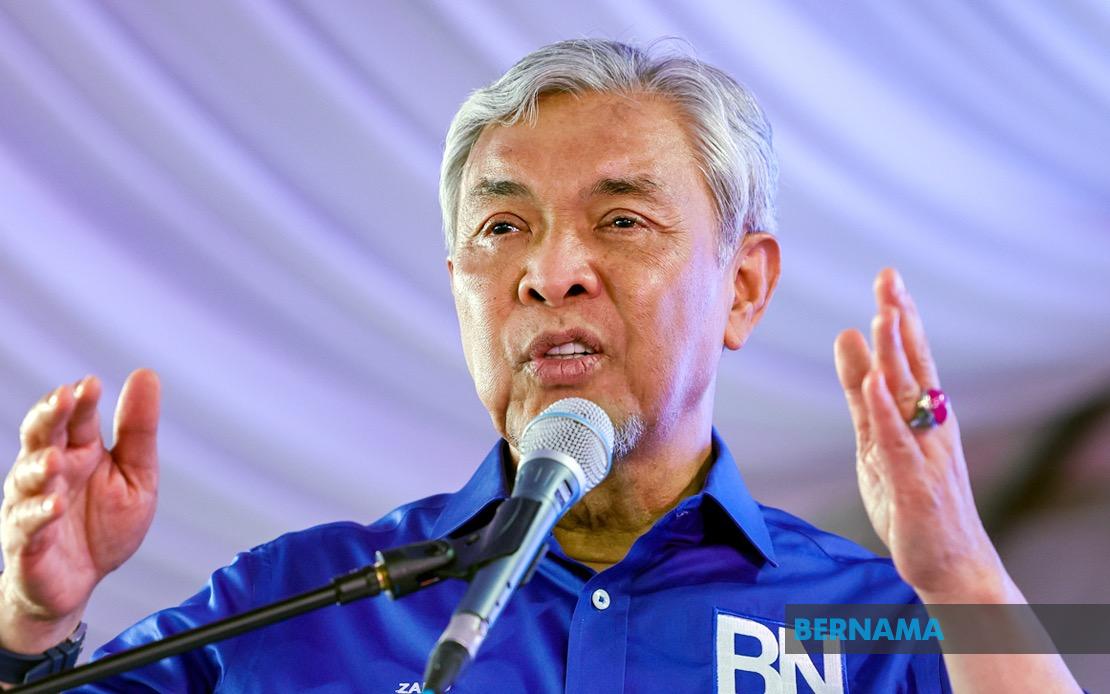
Barisan Nasional chairman Datuk Seri Dr Ahmad Zahid Hamidi has made a formal commitment to implement every pledge contained in the coalition's election manifesto if BN secures voter support in the Johor state election. Addressing supporters and party officials in Kluang during an engagement session with local village development committees, the Deputy Prime Minister sought to reassure voters that BN's campaign promises would translate into concrete action rather than empty rhetoric during the coalition's next term in office.
Ahmad Zahid framed the implementation of the manifesto as a foundational responsibility rather than a discretionary task, positioning it as essential to maintaining developmental momentum and safeguarding public welfare across the state. His statement came as BN intensifies its campaign messaging in the final days before Saturday's poll, attempting to consolidate voter confidence by emphasizing the distinction between electoral pledges and actual governance. The BN leadership has recognized that manifesto credibility remains a significant electoral concern, particularly following past instances where campaign commitments faced delayed or incomplete implementation at state and federal levels.
The party chairman emphasized that BN's administrative hierarchy would actively monitor progress on manifesto implementation rather than allowing pledges to languish on paper. Ahmad Zahid indicated that senior party leaders, working in coordination across different organizational levels, would take personal accountability for tracking whether promised initiatives were being delivered on schedule. This supervisory commitment suggests BN's awareness that voters increasingly demand transparency regarding how political promises translate into budgetary allocations and policy execution.
In a notable rhetorical pivot, Ahmad Zahid cautioned against interpreting electoral victory as validation for arrogance or complacency within BN's leadership structures. He framed winning the Johor mandate not as a triumphant endorsement but rather as a weighty obligation to strengthen unity among Johor's populace and maintain social cohesion during the new government's tenure. This messaging reflects broader anxieties within Malaysia's political establishment about public disengagement and declining faith in institutional governance, suggesting BN recognizes that maintaining voter support requires demonstrating humility and responsiveness to community concerns.
The concept of 'Bangsa Johor' invoked by Ahmad Zahid carries particular significance in contemporary Malaysian politics, where state-level identity movements have gained traction as alternatives to national party politics. By emphasizing that a BN victory should strengthen rather than exploit this collective identity, Ahmad Zahid was attempting to position the coalition as aligned with localized aspirations rather than as a vehicle for extracting resources to benefit party elites. This framing becomes important in Johor specifically, where opposition movements have increasingly mobilized around narratives of state autonomy and protecting local interests from perceived central encroachment.
The 16th Johor state election represents a significant battleground in Malaysia's contemporary political landscape, with 172 candidates competing across 56 state seats. The participation of 2.7 million registered voters indicates substantial public engagement with this electoral contest, suggesting that Johor voters view the election as consequential for determining the state's developmental trajectory and governance priorities. For BN, victory in Johor would constitute an important demonstration of retained strength in a peninsular state where the coalition has historically maintained dominance, though opposition parties have made incremental inroads during recent election cycles.
The timing of Ahmad Zahid's manifesto commitment, delivered just days before voting commenced, reflects standard electoral strategy whereby major parties attempt to solidify voter confidence through leadership statements during the campaign's concluding phase. However, his emphasis on preventing manifesto promises from becoming merely rhetorical signals recognition that public skepticism regarding political pledges represents a persistent challenge for BN's electoral appeal. Recent electoral cycles across Southeast Asia have demonstrated that voters increasingly penalize parties perceived as making hollow campaign commitments, making Ahmad Zahid's explicit acknowledgment of this concern strategically significant.
For Malaysian observers monitoring BN's governance capacity, Ahmad Zahid's statement carries implications extending beyond the immediate Johor electoral contest. The commitment to manifest accountability at both state and national levels indicates BN's attempt to address criticisms that federal-state coordination in policy implementation remains inconsistent. Ahmad Zahid's reference to monitoring manifestos across multiple administrative tiers suggests BN is positioning itself as capable of managing complex governance responsibilities across different territorial jurisdictions, a concern that has troubled previous coalitional governments.
The election itself occurs within a broader context of Malaysian politics characterized by dealignment and reduced voter loyalty to traditional party structures. Johor voters, like their counterparts nationally, have demonstrated increasing willingness to switch allegiances based on perceived performance and credibility. Ahmad Zahid's manifesto emphasis thus represents an attempt to rebuild trust through concrete commitments and transparent accountability mechanisms rather than relying on traditional party machinery and patronage networks that previously anchored BN's electoral dominance.
BN's competitive position in Johor reflects the coalition's broader challenge across Malaysia: maintaining electoral viability while adapting to voter demands for demonstrable governance outcomes. The deployment of the party chairman to make explicit manifesto implementation commitments reveals that BN recognizes electoral victory requires more than procedural compliance with democratic protocols; it demands visible evidence of responsive governance that directly improves constituent living standards. Ahmad Zahid's messaging suggests BN understands that the next Johor government will be evaluated stringently against the specific pledges contained in its campaign manifesto, with implementation shortfalls potentially damaging the coalition's credibility in future electoral contests.

