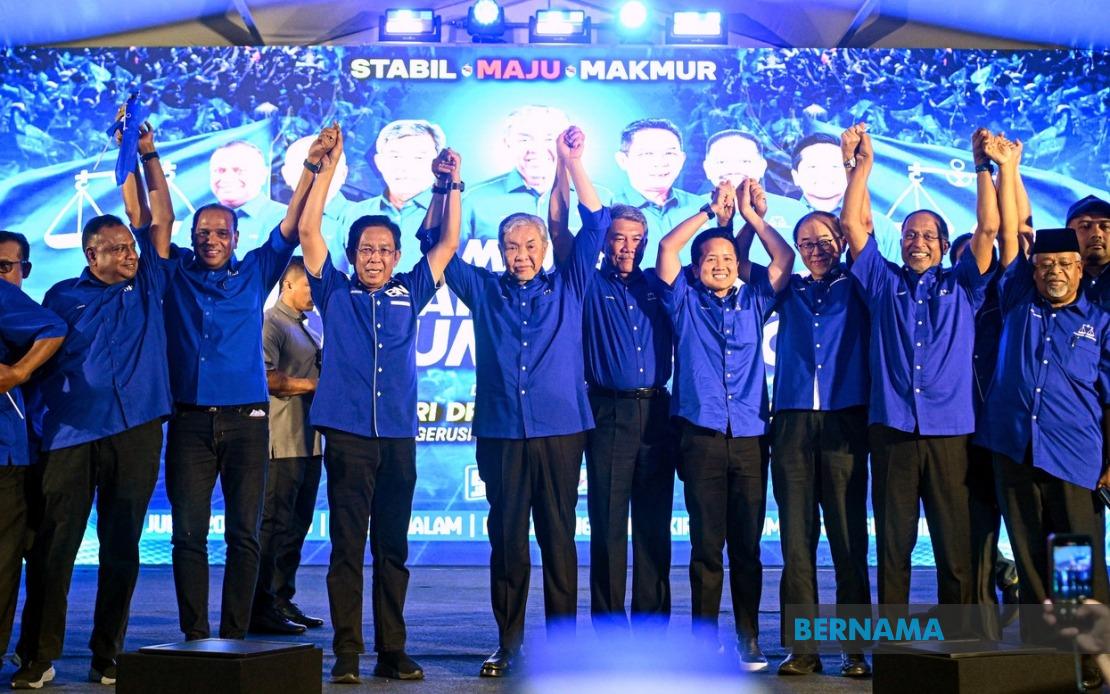
Barisan Nasional has formally unveiled its election machinery for the 16th Negeri Sembilan state election, presenting 25 candidates in a carefully balanced slate that combines proven incumbents with fresh political talent. The announcement took place at Tuanku Abdul Rahman Stadium in Paroi, signalling the coalition's readiness to contest what political analysts expect to be a closely fought state-level battle in one of Malaysia's traditionally competitive electoral battlegrounds.
Negeri Sembilan BN chairman Datuk Seri Mohamad Hasan will retain the Rantau seat, a position he has held continuously since 2004. His reselection underscores his standing within UMNO's leadership hierarchy and his continued relevance in the state's political architecture. Mohamad, who also holds the position of BN deputy chairman, publicly acknowledged the confidence placed in him by UMNO president Datuk Seri Dr Ahmad Zahid Hamidi, framing his renomination as a validation of two decades of constituency service.
Alongside Mohamad, Negeri Sembilan UMNO Liaison Committee chairman and Jelebu Member of Parliament Datuk Seri Jalaluddin Alias will contest the Pertang state assembly seat, which he has represented since 2013. The retention of both figures suggests BN's strategy centres on stability and name recognition in critical constituencies, particularly in areas where the coalition's organisational machinery remains robust. Jalaluddin's continuation represents continuity in a seat that has served as a reliable vote bank for the coalition.
The candidate list incorporates several other long-serving assembly members. Datuk Mohd Faizal Ramli will defend Linggi, whilst Datuk Mustapha Nagoor seeks another term representing Palong. These selections indicate BN's preference for candidates with established grassroots networks and demonstrated electoral success, a pragmatic approach in an environment where voter sentiment increasingly favours politicians perceived as effective community advocates rather than purely party apparatchiks.
However, the coalition's candidate finalisation process remains incomplete. BN has not yet settled on representatives for eleven state seats: Klawang, Serting, Lobak, Sikamat, Ampangan, Bukit Kepayang, Mambau, Paroi, Lukut, Bagan Pinang, and Gemas. This delay, whilst potentially indicating ongoing internal negotiations among coalition partners and UMNO factions, could work against BN if rival coalitions complete their candidate selections first and gain momentum through early campaigning activities.
Negeri Sembilan represents a microcosm of contemporary Malaysian electoral dynamics. The state has demonstrated susceptibility to political swings, with power alternating between different coalitions in recent decades. This volatility stems partly from its relatively compact electorate and the prevalence of closely marginal constituencies where voter mobilisation determines outcomes. BN's mixed approach—retaining established figures whilst deliberating on newer candidates—suggests recognition that the coalition cannot assume automatic victory despite its historical dominance in the state.
The timing of this announcement places additional pressure on opposition coalitions to expedite their own candidate declarations. In Malaysian state elections, early candidate announcements often generate momentum, allowing parties to coordinate grassroots activities and secure volunteers' commitment well in advance of the official campaign period. Delay in announcing the remaining eleven candidates could dissipate BN's initial announcement effect.
Within Negeri Sembilan's political context, the reselection of Mohamad Hasan carries symbolic weight beyond Rantau. His position as BN deputy chairman makes him emblematic of the coalition's state leadership, and his personal electoral performance will likely influence overall perception of BN's viability across the state. Similarly, Jalaluddin Alias's retention reflects confidence in a politician who has successfully navigated multiple election cycles and maintained crossover appeal among various demographic segments.
The outstanding candidacies represent strategic opportunities and potential vulnerabilities. Constituencies like Bagan Pinang, historically a BN stronghold but occasionally contested fiercely, require careful candidate selection to shore up base support. Other seats may involve competitive primary contests within UMNO or negotiations with coalition partners MCA and MIC, explaining the delay in finalisation. These internal deliberations, if protracted, risk creating perceptions of indecision or factional discord that opposition parties will undoubtedly exploit during campaigning.
For Malaysian and Southeast Asian observers, Negeri Sembilan's election assumes broader significance as a potential bellwether of Malay-Muslim voter sentiment regarding BN's governance record and policy direction. The state's relative economic diversity and mixed urban-rural character make electoral outcomes there reasonably predictive of performance in demographically similar constituencies nationwide. BN's final candidate slate, once complete, will offer further insights into the coalition's strategic priorities and confidence levels across different regional strongholds.
The announcement also reflects evolving expectations regarding candidate gender representation and generational balance. Observers will scrutinise the eventual full candidate list to assess whether BN has meaningfully increased female candidacies or reserved prominent positions for younger politicians, issues increasingly salient among urban, educated voters. These demographic considerations, whilst secondary to seat-winning calculations, increasingly influence broader coalition brand perception among crucial voter segments.

