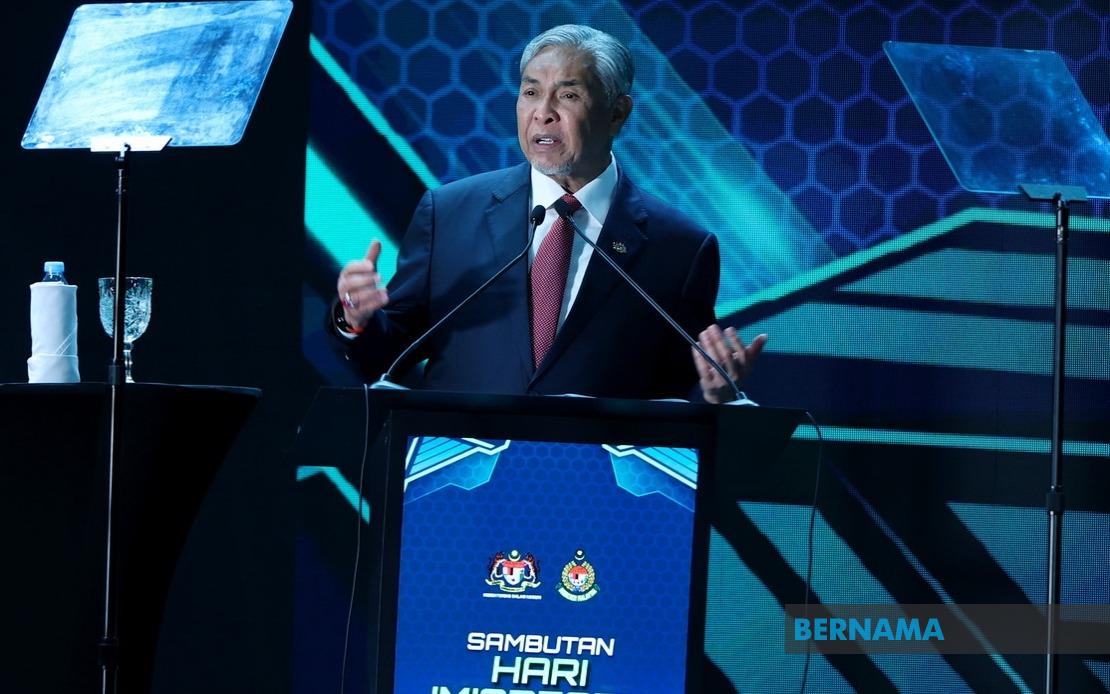
Barisan Nasional will maintain its participation in the Unity Government, adhering strictly to the position endorsed at UMNO's last General Assembly, according to coalition chairman Datuk Seri Dr Ahmad Zahid Hamidi. The announcement came during a press conference held in Cyberjaya on the sidelines of the 2026 Immigration Day celebrations, where Ahmad Zahid, who simultaneously holds the posts of UMNO president and Deputy Prime Minister, sought to dispel any uncertainty about the party's political direction. The reaffirmation represents a clear signal to party members and coalition partners that internal deliberations have concluded in favour of sustaining the current political arrangement that brought Prime Minister Datuk Seri Anwar Ibrahim to office in late 2022.
The timing of Ahmad Zahid's statement carries significance given the persistent speculation about potential fractures within the Unity Government framework. Since its inception, the coalition has weathered multiple rounds of pressure testing, with various political actors probing the limits of the arrangement. By anchoring BN's commitment to a formal assembly resolution rather than simply announcing party preference, Ahmad Zahid elevated the decision beyond the sphere of individual leadership whim, framing it instead as a collective mandate emanating from UMNO's highest deliberative body. This distinction matters considerably in Malaysian political culture, where General Assembly decisions carry considerable legitimacy among party grassroots.
Ahmad Zahid appealed to all stakeholders to respect the assembled will of the party, emphasising that no authority surpasses the General Assembly in UMNO's institutional hierarchy. By invoking this principle, he was simultaneously addressing potential dissidents within UMNO who might harbour reservations about the Unity Government arrangement, signalling that further agitation on the matter would constitute insubordination against a binding party decision. Such messaging proves essential for maintaining cohesion within BN itself, where Umno dominates but must balance the interests of coalition partners such as MCA and MIC, each with their own organisational dynamics and electoral considerations.
Separately, Ahmad Zahid addressed the scope of Prime Minister Anwar Ibrahim's executive authority, stating unequivocally that appointment and dismissal powers within the Cabinet remain the absolute prerogative of the Prime Minister. This declaration arrived in response to recent reports indicating that Anwar had issued warnings to Cabinet members and government office-holders against deploying their official positions to criticise Unity Government coalition partners during state-level election campaigns. The delineation of such executive powers underscores the hierarchical relationship within the government structure and clarifies the boundaries within which political actors must operate.
Anwar's reported warning specifically cautioned ministers and deputy ministers that any individual found attacking coalition partners while campaigning in state elections would face consequences, potentially including removal from their positions. Such directives reflect the Prime Minister's concern about maintaining coalition discipline at a time when constituent parties face electoral pressures that might incentivise competitive positioning against their supposed allies. State elections, by their nature, tend to generate localized political dynamics that can strain national coalition arrangements, particularly when federal ministers campaign in constituencies where their own parties compete against Unity Government partners for voter support.
The tension between maintaining coalition unity at the federal level while permitting competitive politics at the state level presents an enduring governance challenge in Malaysia's federal system. Ministers drawn from one coalition party must represent their constituents' interests while avoiding actions that fundamentally undermine the credibility or electoral viability of national coalition partners. The Prime Minister's intervention sought to establish clear parameters, ensuring that campaign rhetoric remains within acceptable bounds and does not cross into systematic attacks on coalition integrity or partner parties' core interests.
For Malaysian political observers, Ahmad Zahid's reaffirmation of BN's commitment to the Unity Government carries implications extending beyond immediate domestic coalition dynamics. The stability of the current federal government influences Malaysia's standing in regional economic and security frameworks, investor confidence in long-term policy continuity, and the government's capacity to execute substantial policy initiatives across multiple domains. Coalition instability historically produces governance disruption, administrative uncertainty, and policy inconsistency that reverberate through bureaucratic agencies and market participants alike.
The positioning also reflects calculations about electoral prospects and demographic trends. BN, having held federal power almost continuously from independence until 2018, faces the task of rebuilding credibility after the 1MDB crisis and related governance failures. Participation in the Unity Government provides BN with a pathway to demonstrate reformed governance while avoiding the severe electoral penalties that might accompany renewed exclusion from federal power. For UMNO particularly, the arrangement permits party members to occupy significant Cabinet portfolios and exercise executive authority, a consideration that undoubtedly influenced the General Assembly resolution.
Looking ahead, the durability of Ahmad Zahid's reaffirmation will likely depend on how effectively the coalition manages internal tensions during state election campaigns and whether the federal government delivers tangible policy outcomes that reinforce broader public confidence in the political arrangement. The willingness of BN—and specifically UMNO—to enforce discipline among its members regarding coalition partner treatment will substantially influence whether the Unity Government framework survives intact or gradually fragments under accumulated pressure from competing political interests and electoral cycles.

