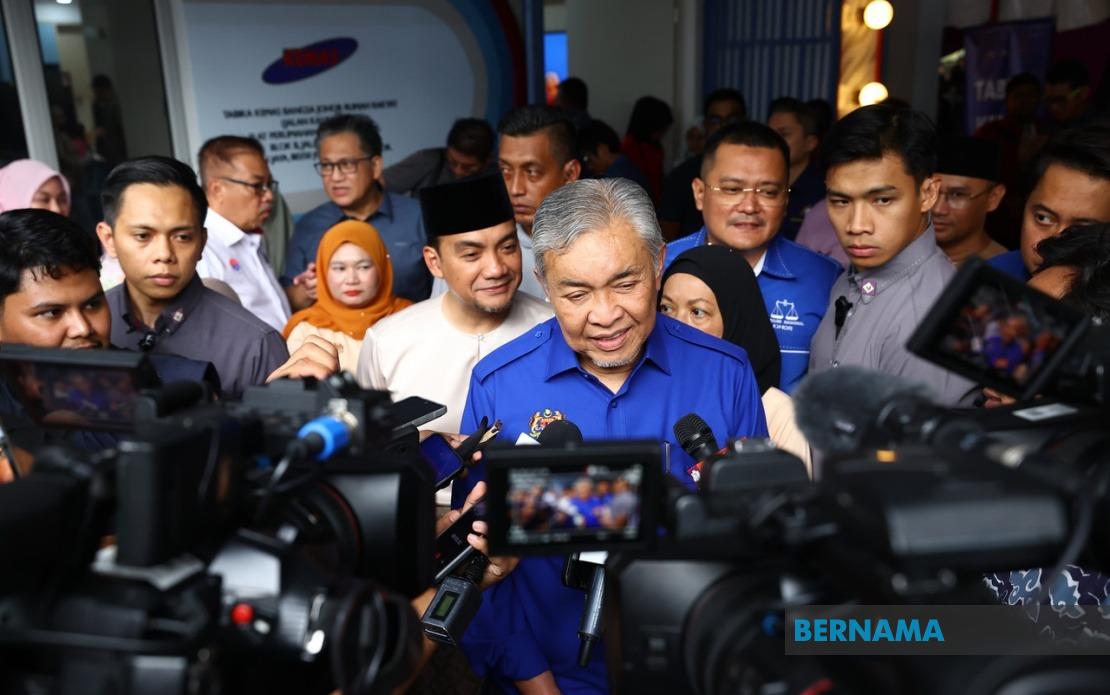
The Johor state election campaign entered a new phase of policy comparison on July 3 when Barisan Nasional Chairman Datuk Seri Dr Ahmad Zahid Hamidi publicly acknowledged Pakatan Harapan's campaign proposals, framing the electoral contest as a healthy democratic exercise where competing visions for the state's future are presented to voters.
Ahmad Zahid, who also serves as Deputy Prime Minister, made his remarks following a community engagement session at Larkin Court 1 flats in Johor Bahru, where he met with parents involved in Tabika Kemas Bangsa Johor. The setting underscored BN's focus on grassroots constituencies during the final stages of the campaign, with the state's Menteri Besar Datuk Onn Hafiz Ghazi and Larkin seat candidate Mohd Hairi Mad Shah accompanying the senior federal leader.
Pakatan Harapan's manifesto, unveiled that same day, outlined ten key commitments aimed at Johor residents. The opposition coalition's pledges encompassed the Johor Health Scheme to expand medical access, a deposit assistance programme targeting first-time homebuyers seeking to navigate the challenging property market, and a RM500 million youth development fund intended to address unemployment and skills gaps among younger Malaysians. Additional proposals focused on educational improvements across the state's school system, reflecting PH's emphasis on social welfare and quality-of-life enhancements.
Yet Ahmad Zahid's acknowledgement of PH's proposals came paired with BN's own performance narrative. The ruling coalition claimed credit for delivering on more than 90 per cent of its promises from the previous state government term, a metric designed to establish administrative credibility and suggest that BN translates electoral commitments into tangible outcomes. This emphasis on track record reflects a strategic calculation that incumbent performance provides a stronger foundation for voter confidence than campaign rhetoric alone.
The BN manifesto, according to Ahmad Zahid, represents a comprehensive policy framework addressing all life stages and demographic groups. His description encompassed provisions for expectant mothers during pregnancy and childbirth, developmental support for infants and young children, educational benefits for school-age populations, tertiary education assistance for university students, and targeted aid programmes for single-parent households. This lifecycle-based approach attempts to position BN as a party of inclusive governance, ensuring no community segment feels neglected or excluded from government benefits.
A particularly significant element of BN's messaging centres on the concept of "Bangsa Johor" — a state-based identity that transcends traditional racial and religious categories. Ahmad Zahid's assertion that anyone residing in Johor qualifies for equal benefits regardless of ethnic background represents an attempt to reframe electoral competition around territorial and civic loyalty rather than communal identity. This rhetorical strategy mirrors broader trends in Malaysian politics where parties increasingly emphasize shared state interest as a unifying principle.
As Rural and Regional Development Minister, Ahmad Zahid also leveraged his federal portfolio to signal continued commitment to Johor's infrastructure and development agenda. His promise of sustained ministerial support for the state's advancement serves multiple purposes: it associates BN's state-level campaign with federal resources and decision-making power, suggests that voting BN ensures access to higher-level patronage networks, and positions the coalition as capable of delivering both state and national benefits to local constituents.
The electoral mechanics of the Johor contest reflect the state's political significance within Malaysia's overall democratic system. With 172 candidates competing across 56 state seats, the election involves substantial voter choice and competitive contestation in most constituencies. The scheduling of early voting on July 7 and main polling on July 11 provides a compressed campaign timeline within which parties must mobilize supporters and persuade undecided voters. For Malaysian political observers, the Johor result carries implications beyond the state itself, often serving as a barometer for broader shifts in national electoral sentiment and coalition viability.
The respectful acknowledgement of opposition proposals by a senior BN figure, while simultaneously emphasizing the ruling coalition's superior execution record and comprehensive policy reach, reflects contemporary Malaysian electoral dynamics. Rather than dismissing PH's ideas outright, Ahmad Zahid's approach grants the opposition intellectual legitimacy while positioning BN as the more reliable custodian of voter interests. This comparative strategy assumes that voters weigh not merely policy proposals but perceived competence in implementation, administrative experience, and capacity to deliver promised benefits.
For Johor residents and Southeast Asian observers of Malaysian politics, this election represents a consequential choice between competing governance models. PH's manifesto emphasizes targeted interventions in healthcare access, housing affordability, and youth opportunity — issues resonating with middle and working-class constituencies navigating economic pressures. BN's counter-narrative stresses proven delivery capacity, inclusive state citizenship, and continuity in development partnerships. The July 11 polling will reveal which appeal proves more persuasive to voters in Malaysia's most populous state.

