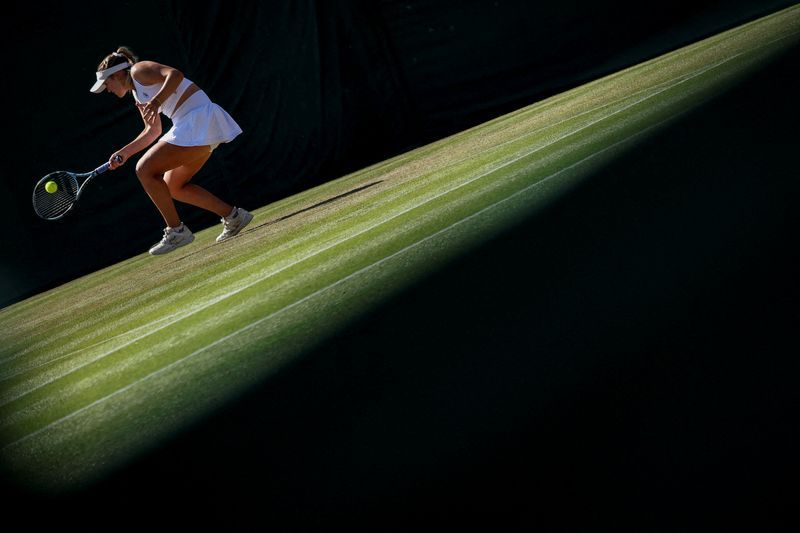
For 149 years, Wimbledon has curated an image as British sport's most fastidiously preserved institution. All England Club officials treat the perennial ryegrass on their courts with the same reverence that spectators bring to their cream teas and creative millinery. Players are obliged to dress entirely in white, from their shirts to their socks, creating a visual uniformity that reinforces the tournament's connection to Victorian sporting codes. The setting feels almost deliberately removed from the chaos of professional sport, a place where tradition matters as much as talent. Yet this carefully maintained facade masks something far more turbulent and consuming: a competition every bit as desperate and psychologically demanding as any football championship. The 675 matches staged across all categories during the two-week event represent countless battles where the world's best players risk reputation, ranking points, and their place in sporting history.
Where Wimbledon diverges most strikingly from the World Cup that coincided with this year's tournament is purely aesthetic. The football spectacle throbs with colour, noise, and unabashed celebration. Wimbledon insists on decorum, silence during play, and an almost meditative approach to victory. Yet the fundamental human stakes remain identical: athletes pursuing the sport's most coveted prize, enduring moments of crushing self-doubt, and experiencing the euphoria of unexpected triumph. The psychological warfare inherent in tennis, played out in the suffocating silence of a Grand Slam court, may actually intensify the emotional toll on competitors compared to team sports. There is nowhere to hide, no teammates to absorb pressure, no tactical adjustments that can mask individual shortcomings.
Photographers embedded throughout the tournament documented this underlying intensity with remarkable clarity. Their frames captured the exact moments when competitive masks slip, revealing the vulnerabilities that elite athletes usually conceal. These images resonate precisely because they contradict Wimbledon's polished surface narrative. In one telling moment, Alexandra Eala, the 21-year-old Filipino player, fell while attempting a forehand return against third seed Iga Swiatek, a six-time major champion with a vast experience advantage. The expression frozen in that instant—gritted teeth, physical strain visible in every muscle—told the story of an underdog refusing to surrender despite overwhelming odds. Photographer Toby Melville had positioned himself to capture a potential celebration but instead documented what became one of the tournament's most compelling human moments. The image works precisely because it captures the desperation beneath the white clothing and manicured courts.
Similarly, Otto Virtanen's first-round match produced an image that revealed the psychological toll of Grand Slam tennis. During a moment of frustration, Virtanen approached the courtside barrier with the apparent desire to simply vanish into the green surface, seeking refuge from the relentless pressure that professional tennis applies to competitors. These instances resonate with Malaysian and Southeast Asian audiences because they strip away the mystique surrounding elite athletes, revealing that even world-class competitors experience doubt and desperation. The weight of competing at sport's highest level transcends language and geography; the yearning for escape, however momentary, is universally comprehensible.
The tournament also produced moments of luminous confidence that contrasted sharply with the desperation elsewhere. Naomi Osaka, the two-time Grand Slam champion, strutted across Centre Court in a kimono-inspired dress as she pursued her campaign to the quarter-finals—her first appearance in the final stages for some time. The image captured a player reclaiming her fearlessness and competitive identity, having navigated personal and professional challenges that had previously limited her performances. Her presence at this level again represents a significant storyline for tennis globally, demonstrating that setbacks, even significant ones, need not define a career trajectory permanently.
Yet perhaps the tournament's most compelling photographic documentation emerged through the interplay of light and shadow across the grounds. Jannik Sinner, the men's champion, was captured mid-air during his final against Alexander Zverev, stretching desperately to return a forehand. His shadow, extending impossibly across the court, seemed to amplify his reach—a visual metaphor for the psychological extension required at the highest competitive levels. The shadow became more significant than the player himself, suggesting how margins separating success and failure at Grand Slams often involve intangible qualities like mental resilience and the will to pursue impossible returns.
Another striking image showed Guo Hanyu and Kristina Mladenovic embracing after their women's doubles victory, but the pair's shadow cast across the court formed a shape suggesting one figure raising her fist in triumph. These shadow studies reveal how photographers attempted to capture the emotional complexity beneath surface moments—victory photographs that simultaneously contained hints of struggle, joy tinged with the memory of previous disappointments, and celebrations acknowledging the substantial effort required to achieve them. For Southeast Asian audiences following the tournament, such images transcend sporting documentation, offering insight into how elite professionals internalize and process the extremes of competitive sport.
The physical toll on the legendary grass courts provided another compelling narrative thread. Over fourteen days, 675 matches wear visible patterns into the meticulously maintained surface. These scars represent concrete evidence of the competitive intensity that the tournament's tradition-focused presentation often obscures. When the spectator stands emptied and nets were removed, the worn grass patches captured by time-lapse photography tell a story that no amount of tradition can obscure: this tournament demands everything from its participants. The passage of players' shoes across Centre Court, compressed into accelerated footage, visualizes the relentless nature of championship-level tennis. Each worn patch represents hours of movement, decision-making, and psychological pressure concentrated into competitions lasting mere days.
Wimbledon's paradox lies in its simultaneous celebration and suppression of competitive intensity. The tournament's organizers preserve tradition and social custom with genuine reverence, yet the sporting soul underlying these traditions burns with a fierce intensity that rivals any athletic competition. Players must navigate this contradiction constantly: maintaining composure while experiencing internal turmoil, celebrating measured victories within rigid decorum requirements, and pursuing excellence within constraints designed to honour historical practice. This unique combination—tradition married to intensity—defines what makes Wimbledon distinct in professional sport's contemporary landscape.
For Malaysian and Southeast Asian sports enthusiasts, Wimbledon represents both an aspirational championship and a window into how elite athletes process pressure differently across varied sporting cultures. The tournament's physical location in London, its historical significance, and its traditionally British presentation might suggest a distant, exclusive competition. Yet the human emotions documented by photographers—desperation, determination, relief, joy, and the crushing weight of defeat—speak to universal experiences that resonate across regional and cultural boundaries. The tension between Wimbledon's carefully curated image and its underlying competitive ferocity mirrors challenges faced by athletes throughout Southeast Asia who must balance cultural expectations with the demands of international competition.

