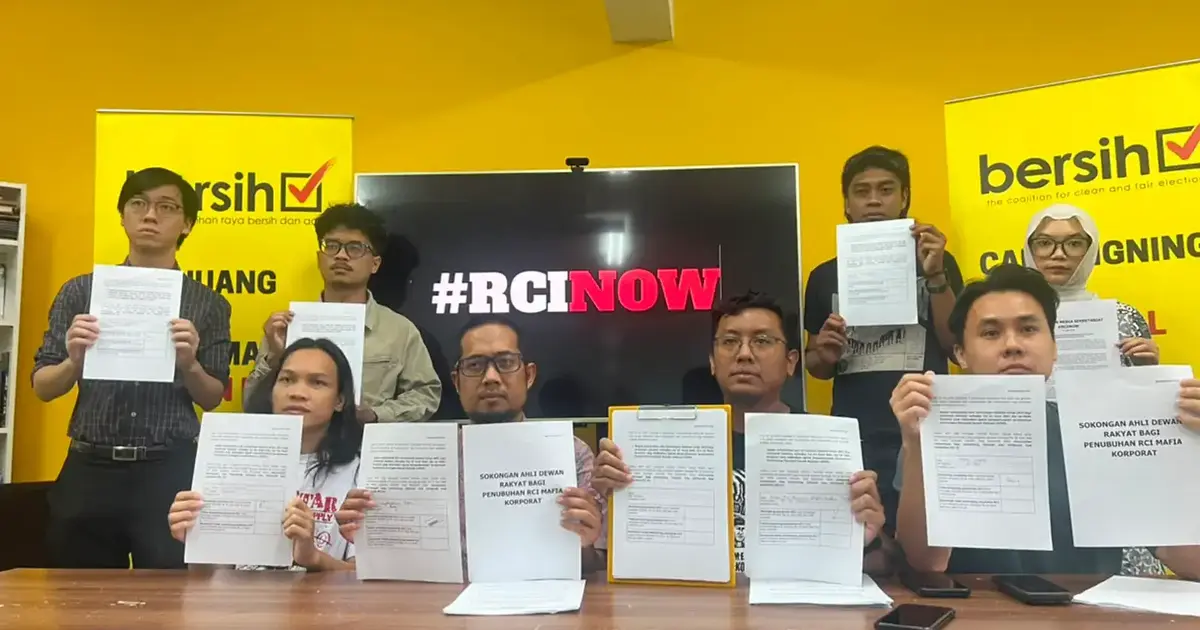
The Coalition for Clean and Fair Elections (Bersih) has announced that 34 members of parliament have signalled support for establishing a royal commission of inquiry to examine what the group describes as organised corporate criminal networks in Malaysia. The cross-party backing suggests that concern about systematic corporate misconduct transcends traditional political divisions in the legislature, with lawmakers from PKR, PAS, DAP and Umno reportedly among those willing to champion the proposal.
Bersih's assertion that multiple political factions recognise the need for such an investigation underscores growing recognition that corporate malfeasance represents a governance challenge requiring institutional solutions beyond existing enforcement mechanisms. The diversity of parties represented indicates that the issue resonates across ideological lines, from opposition-leaning PKR and DAP to government-aligned Umno and the Islamist PAS. This unusual alignment could strengthen the proposal's credibility in parliamentary discourse, even as the actual composition and motivations of the supportive MPs remain subject to scrutiny.
The electoral watchdog's framing of the issue as a "corporate mafia" problem reflects a particular diagnostic view of Malaysia's business environment. Rather than treating instances of corporate misconduct as isolated failures of individual companies or regulatory lapses, Bersih's language suggests systemic, organised networks operating with impunity across sectors. This characterisation has significant implications for how policymakers and the public should conceptualise accountability mechanisms. If corporate wrongdoing operates as a coordinated enterprise rather than scattered incidents, then conventional enforcement by sector regulators may prove insufficient.
A royal commission of inquiry represents a substantial institutional tool available to the Malaysian government for investigating matters of national concern. Such bodies possess broad powers to compel testimony, subpoena documents, and make recommendations for legislative or administrative action. The decision to pursue an RCI rather than strengthening existing regulatory agencies or creating ad hoc task forces signals confidence that thorough, independent investigation with legal authority is necessary to understand and address the alleged networks comprehensively.
The involvement of Umno MPs in supporting the proposal deserves particular attention given the party's historical governance role and continuing influence in Malaysian politics. Umno's willingness to back an inquiry into corporate networks could reflect several dynamics: genuine concern about business misconduct affecting the party's base, desire to demonstrate commitment to anti-corruption efforts during periods of reduced electoral influence, or positioning on specific corporate cases affecting party interests. Understanding which of these considerations predominates remains crucial for assessing the RCI proposal's political durability.
PAS's participation in this cross-party coalition similarly suggests that religious-based political representation sees merit in examining corporate conduct through an institutional lens. This convergence between secular watchdog groups and Islamist parliamentarians indicates that concerns about organised business wrongdoing bridge the divides that typically structure Malaysian political competition. Whether this unity proves deep enough to sustain the proposal through legislative processes and potential implementation remains to be determined.
For Malaysia's business community, the prospect of an RCI focused on corporate networks carries both transparent and implicit signals. The explicit message concerns heightened scrutiny of potentially unlawful conduct and the possibility of recommendations leading to stricter regulations or enforcement actions. The implicit message addresses corporate governance culture itself, signalling that networks engaged in systematic misconduct face material risk of exposure and sanction. These dynamics may encourage voluntary compliance improvements and heightened internal audit focus among companies concerned about RCI findings.
Southeast Asian regional observers will watch developments closely, as Malaysia's approach to investigating corporate governance challenges could influence discussions elsewhere in the region. Several neighbouring economies struggle with similar concerns about organised business misconduct and weak enforcement. A visible, credible Malaysian RCI process could either provide a model for institutional responses or, if ineffectual, suggest limitations of such mechanisms across the region's political contexts.
Bersih's claim requires verification regarding the specific parliamentarians who have indicated support and the nature of that support. Political backbench statements can represent genuine commitment or performative alignment with popular concerns without implying legislative action. The critical next phase involves determining whether the 34 MPs will formally petition the government or propose mechanisms for establishing the RCI, and whether the executive branch will view such a proposal as politically viable given its other priorities and the potential implications for corporate interests aligned with government coalitions.
The timing of Bersih's announcement also merits consideration within Malaysia's broader political calendar and ongoing governance debates. Government reshuffles, electoral cycles, and competing policy priorities all influence the legislative agenda and prospects for major institutional initiatives. Understanding when this RCI proposal might gain traction depends substantially on reading Malaysia's complex political dynamics and assessing whether addressing corporate networks through royal commission represents a genuine policy priority or a gesture toward anti-corruption sentiment.
If the proposal advances, fundamental questions will arise about the RCI's terms of reference, investigative scope, and how findings translate into accountability. Will the inquiry focus on specific sectors or the entire economy? Will it recommend criminal prosecution or regulatory enhancement? Should it examine enforcement failures by existing agencies or purely private-sector conduct? These definitional choices will substantially shape the investigation's ultimate impact and legitimacy among stakeholders across Malaysia's business, political and civil society landscapes.

