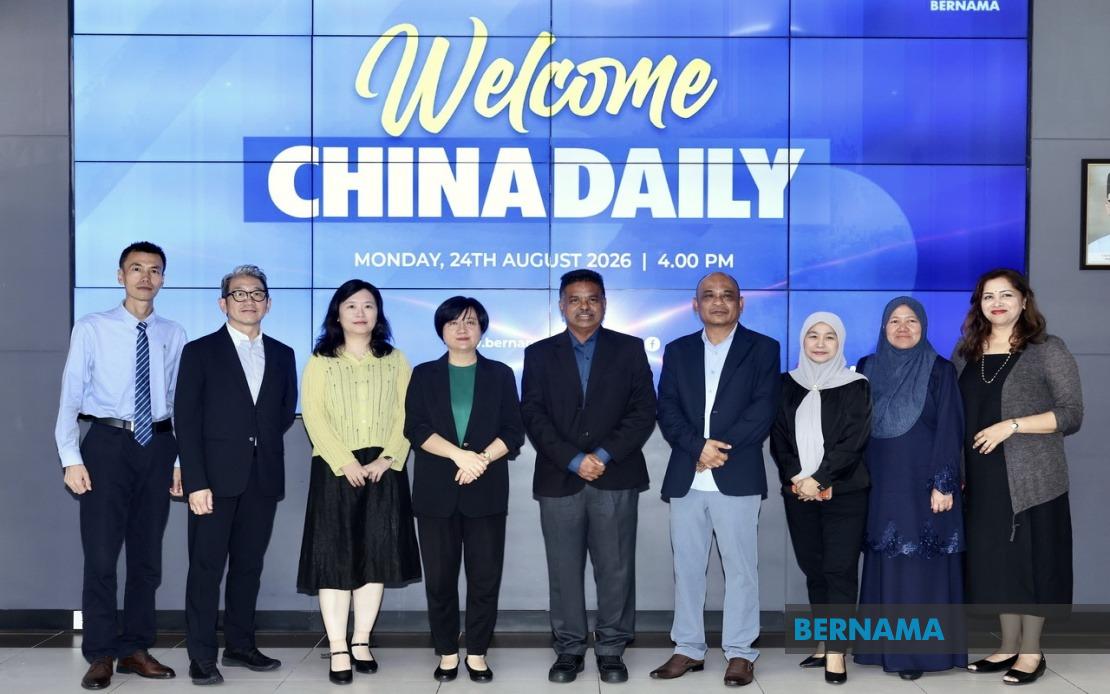
Malaysia's national news agency has opened discussions with China Daily about deepening their media relationship through a range of collaborative initiatives spanning content sharing, personnel development, and cultural programming. The conversation took place during a high-level courtesy visit by China Daily Asia-Pacific Editor-in-Chief Lu Haoting to Bernama's headquarters in Kuala Lumpur on Monday, signalling both organisations' commitment to strengthening the information ecosystem across the region.
Lu led a delegation that included China Daily Asia-Pacific Assistant Editor-in-Chief Sheila Shi, Business Development Director Kenrick Lee, and Kuala Lumpur Bureau Chief Peng Chao. Their counterparts at Bernama included Editor-in-Chief Arul Rajoo Durar Raj, Deputy Editor-in-Chief (News Service) Mohd Shukri Ishak, and Acting Deputy Editor-in-Chief (Economic News Service) Harlina Samson, reflecting the strategic importance placed on the discussions by both organisations.
During the meeting, Lu articulated a vision for cooperation that extends well beyond the conventional channels through which international media organisations typically interact. She emphasised that exchanges of journalists between the two agencies could provide valuable professional development opportunities, allowing reporters and editors to gain exposure to different editorial approaches, storytelling techniques, and regional perspectives. Such exchanges would enable media professionals from both organisations to enhance their skills while building personal networks that often prove instrumental in longer-term collaboration.
Formalised training programmes emerged as another priority area for potential partnership. By establishing structured capacity-building initiatives, Bernama and China Daily Asia-Pacific could develop standardised approaches to coverage of regional issues, create platforms for discussing best practices in digital journalism, and foster a generation of media professionals equipped to navigate the increasingly complex landscape of Asia-Pacific reporting. These programmes could address emerging challenges such as combating misinformation, adapting to changing audience preferences, and maintaining editorial integrity in the digital age.
Lu noted that the scope of cooperation could extend beyond traditional newsroom functions into the broader media and business ecosystem. Business forums and cultural activities represent untapped opportunities for collaboration, allowing the two organisations to serve as platforms for dialogue between Malaysian and Chinese stakeholders across multiple sectors. Such initiatives would position both Bernama and China Daily Asia-Pacific as facilitators of regional understanding rather than merely content producers, potentially enhancing their relevance to policymakers and business communities.
Bernama's leadership outlined the Malaysian agency's existing track record in working with Chinese media organisations, citing successful news and content exchanges as well as collaborative documentary productions. These existing arrangements provide a foundation upon which a more comprehensive partnership could be built. Arul Rajoo highlighted how the experience gained through these earlier initiatives could inform a new generation of collaborative projects, potentially creating templates for other regional media partnerships.
The potential expansion of cooperation with China Daily Asia-Pacific's regional bureau reflects broader trends in international media relations. As news organisations increasingly recognise that comprehensive coverage of Asia-Pacific affairs requires partnerships rather than purely autonomous operations, bilateral arrangements between national agencies and international news services have become more sophisticated and multifaceted. For Malaysian readers and media consumers, such partnerships can result in more nuanced coverage of regional developments, particularly regarding China's role in Southeast Asian economic, political, and cultural affairs.
China Daily's Asia-Pacific Bureau, which serves as the editorial hub for the publication's regional coverage, maintains broad purview over developments across the Asia-Pacific sphere. Its mandate encompasses political transitions, economic trends, social movements, and cultural exchanges, giving it considerable influence over how regional stories are framed for international audiences. A deepened relationship with Bernama could enhance Malaysia's voice in shaping these regional narratives, ensuring that Malaysian perspectives and priorities receive appropriate representation in China Daily's coverage.
For Bernama, such collaboration aligns with its mandate as Malaysia's premier news and information provider. By engaging with China Daily's regional apparatus, the Malaysian agency can tap into a vast distribution network and access expertise in serving diverse, multilingual audiences. Conversely, Bernama's deep understanding of Malaysian politics, economics, and society positions it as a valuable partner for China Daily, particularly as business and political ties between Malaysia and China continue to intensify across multiple sectors including infrastructure, technology, and trade.
The practical implications of expanded cooperation extend to Malaysian readers who increasingly seek authoritative information about regional developments. Enhanced journalist exchanges could result in more informed reporting on Chinese policy developments affecting Malaysia and Southeast Asia. Joint training programmes might produce a cadre of media professionals uniquely equipped to cover bilateral relations with nuance and contextual depth. Cultural activities organised jointly could foster greater mutual understanding between Malaysian and Chinese societies, contributing to the people-to-people exchanges that often underpin productive government-to-government relations.
Both organisations appear committed to moving beyond ceremonial gestures toward substantive operational engagement. The presence of senior editorial and business development staff from China Daily's delegation suggests that the discussions carried real decision-making authority. Similarly, Bernama's assembly of key departmental heads indicated that the Malaysian agency views this initiative as central to its strategic development.
As these discussions progress, the partnership's success will likely depend on clear delineation of respective editorial independence alongside collaborative benefits. Both organisations serve important roles in their respective media ecosystems, and audiences will expect that cooperation enhances rather than compromises editorial integrity. The framework that emerges from these preliminary talks will thus become a bellwether for how regional media partnerships can operate in ways that serve both institutional interests and broader public understanding of complex regional dynamics.

