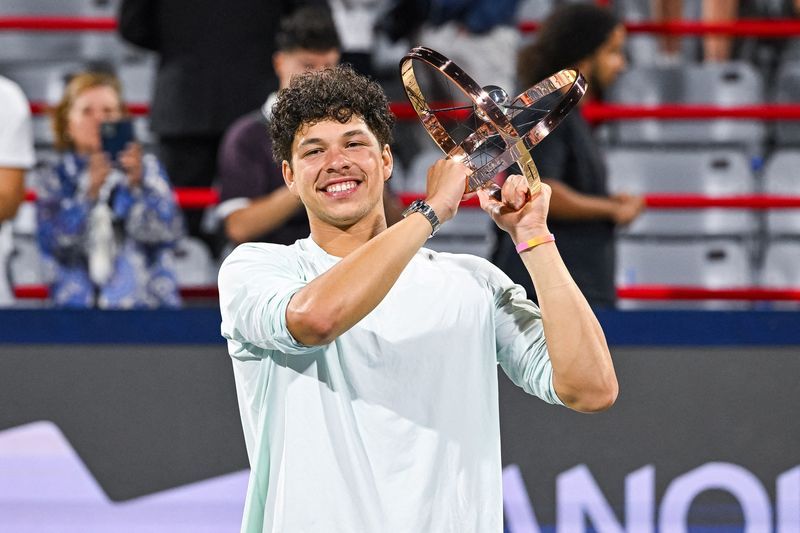
Ben Shelton arrives at the US Open with renewed momentum and purpose, determined to transform what he candidly describes as a tumultuous season into a breakthrough moment at Flushing Meadows. The 23-year-old American, ranked ninth globally, carries the weight of national expectation as he chases a title that has eluded American men since Andy Roddick's triumph over Juan Carlos Ferrero in 2003. His recent success at the Canadian Open, where he captured the crown for a second consecutive year without dropping a single set, has injected the confidence he needs after a string of underwhelming performances at tennis's most prestigious tournaments.
Shelton's 2024 campaign has been decidedly uneven, characterised by sharp peaks and concerning valleys across the Grand Slam circuit. At the Australian Open, he managed to reach the quarter-finals, a respectable showing that suggested the potential for deeper tournament runs. However, the momentum dissipated almost immediately thereafter. His French Open campaign ended prematurely in the second round, whilst his return to Wimbledon proved even more embarrassing, with the American eliminated in the opening match. These reversals tested his mental resilience and left observers questioning whether he possessed the consistency required to compete with the sport's elite players over best-of-five set encounters.
Yet the Canadian Open provides compelling evidence that Shelton possesses the tactical maturity and physical prowess to elevate his game when it matters most. His dominant fortnight in Montreal, where he dismantled fellow American Brandon Nakashima in the final, revealed a player operating with uncommon clarity and precision. Reflecting on his performance, Shelton articulated a vision of a more evolved competitor, one who has developed the returns, serving patterns, and defensive flexibility that separate champions from merely talented contenders. He emphasised his transformation into an elite returner and the clinical nature of his break-serve sequences, suggesting that the technical refinements he has pursued throughout the season are finally bearing fruit.
The trajectory of his hard court performances during the latter portion of the season demonstrates incremental but significant improvement. Shelton notes that each tournament appearance has yielded tangible gains, whether in serve placement, return aggression, or defensive positioning. This progressive development carries particular significance at the US Open, where hard court mastery separates champions from pretenders. Unlike clay or grass surfaces that reward specific stylistic strengths, the hard courts in New York favour well-rounded players who combine offensive firepower with consistent baseline construction. Shelton's recent dominance and continued refinement suggest he has assembled the necessary components to sustain deep tournament runs.
The broader context surrounding this year's US Open intensifies the narrative around Shelton's candidacy. Jannik Sinner, the world's top-ranked player, has withdrawn from the tournament, a significant development that reshapes the competitive landscape substantially. Similarly, Carlos Alcaraz of Spain enters with question marks surrounding his readiness following recent matches. Former champion Andy Roddick, reflecting on these circumstances during an August podcast appearance, acknowledged that Shelton represents a genuine contender for the title precisely because the traditional dominators face uncertainty heading into the fortnight. Roddick's assessment carries weight given his intimate understanding of American tennis and the specific demands of competing in home soil conditions.
Shelton's previous campaign at Flushing Meadows in 2023 demonstrated his capacity to perform at the sport's highest level when the occasion demands. His semi-final appearance marked a watershed moment in his young career, proving he could navigate the increased pressure and elevated quality of opposition inherent in deep Grand Slam runs. That performance established him as a player capable of sustained excellence rather than merely occasional brilliance. A return to that semi-final stage, or better yet, a progression to the final itself, would validate the considerable investment and development work undertaken during a season marked by volatility.
The psychological dimension of competitive tennis cannot be overlooked when assessing Shelton's prospects. The young American has demonstrated an admirable capacity for self-reflection and strategic adaptation, attributes often lacking in players at his developmental stage. His willingness to acknowledge both shortcomings and incremental improvements suggests maturity beyond his years. In a sport where momentum and confidence fluctuate dramatically across tournaments, Shelton enters the US Open riding the emotional and practical benefits of a dominant run at Montreal, where he proved his capacity to execute his best tennis against quality opposition without wavering.
Shannon expectations surrounding American tennis resonate throughout the commercial and cultural ecosystem of the sport within the United States. The absence of a men's singles champion for more than two decades represents both a drought and an opportunity. Shelton has positioned himself as potentially the vehicle through which American tennis emerges from this extended period of underperformance at the sport's premier championships. The convergence of personal momentum, circumstantial advantage, and national expectation creates a distinctive pressure environment, one that separates genuine contenders from those merely competing.
Looking ahead to his US Open campaign, Shelton's philosophy remains grounded in immediate execution rather than outcome fixation. He articulates a perspective that prizes the cumulative nature of professional tennis, understanding that the calendar's length presents endless opportunities for redemption and advancement. In this worldview, any single match possesses outsized significance precisely because it reshapes the trajectory of subsequent tournaments and seasons. This mental framework has proven invaluable for players navigating the psychological complexities of elite tennis competition, where past disappointment can metastasise into future anxiety or, conversely, motivate transformative performances. For Shelton, the Canadian Open represents the launching pad; the US Open represents the moment when his season's narrative will be fundamentally rewritten.

