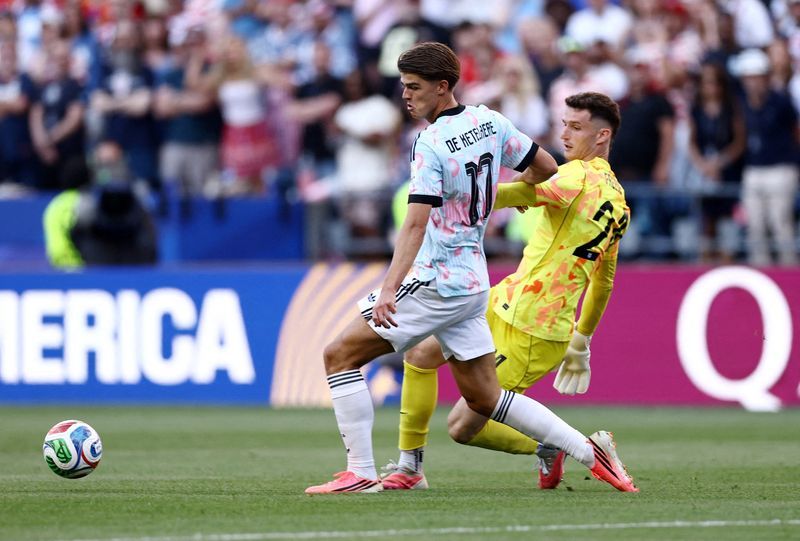
Belgium have discovered an unexpectedly potent formula at the World Cup by dramatically reshaping their starting lineup, with coach Rudi Garcia's willingness to drop several established stars yielding immediate and convincing rewards. The Belgians overwhelmed hosts the United States with a commanding 4-1 victory in their round of 16 encounter, displaying the most cohesive and dominant football they had produced throughout the tournament. The decision to leave Kevin De Bruyne, Jeremy Doku, and Romelu Lukaku on the bench—with De Bruyne not even appearing as a substitute in the Seattle clash—represents a radical departure from the squad's traditional approach and signals a fundamental recalibration of how Garcia intends to compete for the trophy.
Belgium's journey to this breakthrough moment had been fraught with tension and near-disaster. The European side flirted with premature elimination during their knockout round encounter against Senegal, where they found themselves two goals in arrears with merely five minutes remaining in regulation time. Their recovery from that precipice, completed through a penalty converted in extra time after a defensive miscue by their opponents, was less a testament to their superiority than a reflection of their opponents' vulnerability. This narrow escape appeared to crystallise Garcia's thinking about the direction the team needed to pursue, prompting him to implement sweeping changes rather than make incremental adjustments.
The tactical reorganisation Garcia introduced elevated Nicolas Raskin and Amadou Onana into the midfield, with Dodi Lukebakio joining the attacking contingent to replace the familiar trio. Charles De Ketelaere was repositioned into a centre-forward role that proved remarkably productive, yielding two goals during an dominant first-half performance. The restructured Belgian unit functioned with noticeably greater dynamism than the team that had struggled through the group stage, where two opening draws preceded a convincing 5-1 demolition of New Zealand that nonetheless saw Garcia endure considerable criticism domestically.
The tactical coherence that emerged during the American contest reflected a much higher-tempo midfield operation. With Youri Tielemans assuming greater responsibility in ball recovery, the Belgian press operated with increased intensity and effectiveness. The redesigned formation repeatedly won contested second-ball situations and seized possession with far greater consistency than earlier tournament performances had suggested possible. This aggressive approach, combined with calculated use of the flanks to expose the American defensive setup, created sustained pressure that left the hosts appearing disorganised and psychologically overwhelmed.
Garcia's strategic decisions extended beyond player selection to encompass in-game flexibility. When Amadou Onana departed with a knee injury during the opening period, rather than panic or attempt to restore the previous midfield configuration, the coach introduced Hans Vanaken to shield the three-defender unit. This adjustment maintained tactical discipline and collective structure, preventing the disruption that might otherwise have emerged from an unexpected personnel loss. Vanaken's contribution proved particularly symbolically significant when he converted a goal, a moment that Garcia emphasised carried special resonance given the 33-year-old's inconsistent previous selection history and the rarity of players at that career stage scoring on the World Cup stage.
Garcia's candour regarding his preparation process revealed the underlying confidence supporting these selections. He acknowledged that uncertainty persisted until hours before the match, yet his understanding of the tactical direction remained constant and unshaken. The coach articulated a clear strategic vision centred on controlling the tempo and territorial dominance from the opening whistle, indicating that his readiness to introduce De Bruyne represented a contingency rather than a core component of his footballing intention. Once Belgium achieved their early scoring advantage, implementing this contingency became unnecessary, allowing Garcia to execute his preferred approach throughout the contest.
The psychological dimensions of Belgium's performance against the United States carried significance extending beyond the specific result. The Belgians had endured mounting pressure and scrutiny throughout their group-stage campaign, with Garcia's position seemingly precarious following performances that neither convinced domestically nor inspired confidence internationally. The dramatic improvement witnessed in the knockout round suggested that either the coach's tactical philosophy required time to crystallise or that the elimination of established personalities and hierarchies unlocked greater collective cohesion than the squad possessed under traditional structures. This distinction carries implications for how modern national football teams balance experience with flexibility and innovation.
Looking ahead to their quarter-final encounter against Spain in Los Angeles, Belgium now occupy a fundamentally different psychological position than they occupied before this transformative encounter. The European representatives have transitioned from favourites teetering on elimination to revitalised competitors demonstrating genuine competitive capability. Spain themselves have not demonstrated the imperious form that might have intimidated opponents, suggesting that Belgium's confidence and tactical clarity could prove decisive in determining progression toward the semi-finals. The Belgians' willingness to disrupt established patterns and embrace personnel changes that prioritise functional fit over individual reputation has repositioned them as serious tournament contenders.
The broader implications of Belgium's tactical evolution merit consideration within Southeast Asian and regional footballing contexts. Across Malaysia and the wider region, national team coaches often struggle with balancing the selection of established stars—frequently performing at elite European clubs—against the imperative to build cohesive team structures that function effectively within specific tactical frameworks. Garcia's approach demonstrates that star power and individual excellence, while valuable, need not constitute the foundation of competitive national team performance. The Belgian experience suggests that coaches willing to prioritise tactical coherence and in-match functionality over the mere accumulation of premium talent may unlock superior results than more conservative approaches that default toward established hierarchies and familiar configurations.

