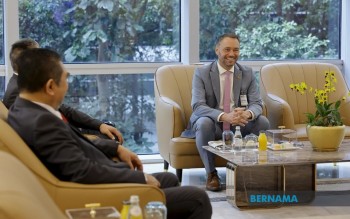
Belgium's Deputy Prime Minister and Minister of Foreign Affairs Maxime Prévot has articulated an ambitious vision for the Malaysia-European Union Free Trade Agreement, positioning it as a catalyst for expanded commerce and shared prosperity between the two trading blocs. Speaking during a working visit to Kuala Lumpur, Prévot underscored Brussels' commitment to bringing the long-negotiated accord across the finish line, framing it as critical for unlocking pathways that neither Malaysia nor the EU can fully realise independently. The Belgian official stressed that completing this landmark agreement remains a genuine priority for both the European Union as an institution and for Belgium specifically, signalling that the momentum for finalisation has intensified despite the complexities that multilateral trade negotiations typically entail.
The deputy prime minister's remarks reflect the strategic importance Belgium places on the Malaysian market and broader Southeast Asian engagement. Rather than viewing the transaction purely as a technical customs arrangement, Prévot contextualised it as a transformative partnership designed to stimulate bilateral trade flows, fortify economic resilience across sectors, and generate meaningful employment opportunities for citizens on both sides of the Eurasian divide. He characterised the forthcoming agreement as a mechanism to facilitate deeper commercial exchanges and cultivate novel business avenues that current trade frameworks constrain. This positioning appears designed to build political momentum domestically within Belgium and across the EU, where constituencies ranging from exporters to labour unions harbour diverse views on trade liberalisation.
Belgium's own economic profile illuminates why the deputy prime minister prioritises such agreements with singular focus. As a nation of just 11.77 million people, Belgium has engineered an extraordinarily export-dependent economy in which overseas sales constitute approximately 85 per cent of gross domestic product. This structural reliance on foreign markets means that even modest incremental access improvements—such as those that modern trade agreements typically furnish through tariff elimination and regulatory harmonisation—translate into measurable macroeconomic consequences for Belgian companies and workers. For a small, densely populated country lacking substantial natural resources, trading relationships are not peripheral to prosperity but foundational to it.
The timeline for concluding negotiations has begun to crystallise, with both parties apparently aiming to seal a deal within the next few months or by the end of the coming year. Such an accelerated schedule, while still permitting substantive technical work, suggests that the major sticking points have either been resolved or are close to resolution. Trade agreements of this magnitude—covering goods, services, investment protections, intellectual property, and regulatory cooperation—typically require extended deliberation. The stated intention to wrap up discussions by year's end indicates serious political will on both the Malaysian and European sides, though implementation of any finalised text would itself require ratification by national parliaments and the European Parliament, which could extend the timeline considerably.
During his inaugural visit to Malaysia since taking office in February last year, Prévot scheduled bilateral meetings with Deputy Prime Minister Datuk Seri Fadillah Yusof, who holds responsibility for energy matters and water management. The agenda extends well beyond traditional trade mechanics, encompassing collaboration on renewable energy infrastructure—a sector where both Belgium and Malaysia recognise mutual interests in decarbonising their economies. Rare earth elements have emerged as a focus area too, reflecting global supply chain vulnerabilities that Malaysia's significant mineral reserves could help address for European manufacturers. Additionally, the halal industry represents a domain where Malaysian expertise and certification standards command international respect, offering opportunities for Belgian food processors and exporters seeking to penetrate Muslim-majority markets across Asia and the Middle East.
Malaysia-Belgium bilateral commerce already demonstrates substantial vitality despite the absence of a dedicated free trade agreement. Total two-way trade reached RM9.74 billion in 2025, with Malaysian exports comprising RM6.85 billion and Belgian imports accounting for RM2.89 billion of this figure. The asymmetry in this trade balance—Malaysia sells considerably more to Belgium than it purchases—reflects both Malaysia's role as a resource and manufacturing exporter and the structure of European economies more broadly, where services and intellectual property command premium valuations often absent from bilateral merchandise trade figures. This imbalance, while favouring Malaysia in conventional accounting terms, also illustrates room for deepened integration, particularly as both economies diversify and services trade gains prominence.
Investment flows paint an equally encouraging picture of bilateral economic integration. Through 2025, Belgian companies had secured approval for 67 separate projects across Malaysia, representing accumulated committed capital of RM5.1 billion and projecting the creation of 4,605 jobs once these ventures reach full operation. These investment figures, whilst not earth-shattering compared to flows from major Asian investors, indicate genuine corporate confidence in Malaysia's business environment, stability, and skilled labour availability. Belgian firms span diverse sectors—chemicals, engineering, renewable energy, and food processing among them—suggesting a portfolio approach rather than dependence on single industries.
From a Malaysian perspective, the MEUFTA negotiation carries significance extending beyond immediate commerce. The European Union remains one of the world's most substantial trading blocs and a critical market for Malaysian products ranging from palm oil derivatives to electrical equipment and semiconductors. A formal trade agreement would lower barriers for Malaysian exporters seeking to expand beyond traditional sectors, while simultaneously offering Malaysian consumers and manufacturers access to advanced European technologies and capital goods at reduced cost. For an economy navigating energy transitions and seeking to diversify sources of foreign investment away from traditional regional partners, Belgium and the broader EU represent valuable counterweights to market concentration elsewhere in Asia.
The regional implications merit consideration as well. Southeast Asia has increasingly pursued bilateral and regional trade agreements as a means of strengthening economic interdependence and counterbalancing great-power competition. An EU-Malaysia agreement would sit comfortably within this architecture, complementing initiatives like the Regional Comprehensive Economic Partnership and established ASEAN ties with individual European states. The agreement would also signal European commitment to the Indo-Pacific as a region warranting sustained commercial and strategic engagement, at a moment when such commitment requires deliberate reinforcement amid global geopolitical tensions.
Looking ahead, the successful conclusion of the MEUFTA would likely catalyse subsequent engagement, with other ASEAN members potentially seeking parallel arrangements with the EU. Both Malaysia and Belgium recognise that the current geopolitical environment—marked by deglobalisation rhetoric in some quarters and persistent supply chain fragmentation—creates urgency around cementing trade relationships before protectionist sentiment further constrains options. Prévot's visit, whilst diplomatic in tone, thus represents something more substantive: a concrete effort by one EU member state to accelerate and cement a strategic partnership with a key Southeast Asian economy during a critical moment for global trade governance.

