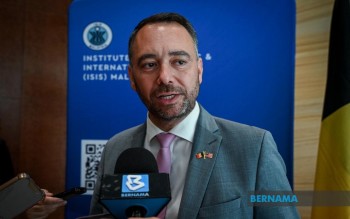
Belgium is positioning itself as a strategic partner for Malaysia's renewable energy ambitions, with Deputy Prime Minister Maxime Prévot proposing collaborative projects in offshore wind generation during his inaugural visit to the country. Prévot, who also holds the Foreign Affairs and Development Cooperation portfolio, used the 39th Asia-Pacific Roundtable in Kuala Lumpur to underscore the substantial potential for cooperation between the two nations in offshore energy technology and implementation, marking a shift toward concrete European engagement with Southeast Asian sustainability goals.
The Belgian official's enthusiasm for offshore energy collaboration reflects a pragmatic recognition of both countries' complementary interests and capabilities. While Belgium possesses only 60 kilometres of coastline, a geographical constraint that might seem prohibitive for offshore energy development, the nation has cultivated world-class expertise through aggressive investment and technological advancement. The country currently operates offshore wind farms capable of producing two gigawatts of electricity, a significant achievement that demonstrates the viability of offshore generation even in resource-constrained settings. This track record positions Belgium as a credible knowledge partner for Malaysia, which possesses substantially longer maritime boundaries and considerable untapped offshore wind potential, particularly in the Straits of Malacca and the South China Sea.
Belgium's expansion roadmap reveals the scale of ambition driving its offshore sector development. Prévot outlined plans to scale capacity from the current two gigawatts to between six and seven gigawatts within the coming years, an expansion equivalent to the output of five to seven nuclear power plants. This trajectory underscores Belgium's serious commitment to decarbonisation and energy security—twin concerns that have intensified across Europe following recent energy crises and climate pledges. For Malaysian policymakers observing these developments, the implication is clear: Belgian authorities have invested heavily in building supply chains, regulatory frameworks, and technical expertise that could be readily transferred or adapted to Southeast Asian contexts, potentially accelerating Malaysia's own renewable capacity buildout.
The broader European dimension of this engagement extends beyond bilateral cooperation. The European Union, through its Global Gateway Strategy, has committed €10 billion to support the ASEAN Power Grid and facilitate regional energy transition initiatives. This substantial funding commitment signals a strategic recalibration of EU-ASEAN relations, moving beyond traditional trade partnerships toward infrastructure and technology cooperation in critical sectors. The ASEAN Power Grid represents an ambitious long-term project aimed at integrating regional electricity systems and enabling cross-border renewable energy trading—capabilities essential for efficient green energy distribution across Southeast Asia. Belgium's initiative thus sits within this larger geopolitical and economic context, where European actors seek to position themselves as development partners in Asia's transition away from coal and fossil fuels.
Prévot's framing of offshore wind cooperation emphasises complementary benefits for both Malaysia and Belgium. Energy security concerns—whether in Europe or Asia—have created powerful incentives for nations to diversify their generation sources and reduce dependence on volatile international fossil fuel markets. Offshore wind offers the advantage of stable, predictable generation with minimal environmental disruption compared to terrestrial alternatives, though it does require significant upfront capital investment and specialised technical knowledge. Belgium's willingness to share operational experience, training programmes, and potentially equipment or financing mechanisms could substantially lower the barrier to entry for Malaysian developers exploring offshore projects. Conversely, Malaysia's larger coastline and more favourable wind resources in certain regions could allow Belgian companies and investors to participate in larger-scale offshore developments than are feasible in the North Sea.
The proposed partnership aligns strategically with Malaysia's stated commitment to achieving 31 percent renewable energy capacity by 2025 and expanding this further toward net-zero commitments by 2050. Offshore wind remains an underutilised resource in Malaysia's renewable portfolio, which has historically concentrated on solar generation. Diversification into offshore wind would not only increase total renewable capacity but also improve grid reliability by providing generation during monsoon seasons and nighttime hours when solar output diminishes. Belgian technical assistance in site assessment, turbine installation, grid integration, and maintenance protocols could accelerate Malaysia's learning curve and reduce costly early-stage development errors common in countries without established offshore expertise.
Beyond offshore energy, Prévot identified semiconductors, logistics, clinical trials, biotechnology research, and pharmaceuticals as additional sectors warranting bilateral exploration. These sectors reveal Belgium's broader strategic interests in Malaysia's economy and position the country as seeking diversified commercial engagement rather than single-sector investment. The semiconductor designation carries particular significance given ongoing global supply chain tensions and Europe's efforts to reduce dependence on Asian suppliers through domestic capacity building. Malaysia, as a major semiconductor manufacturing hub, represents both a partner for European technology transfer and a potential source of components for European industries. Similarly, biotechnology and pharmaceutical collaboration could leverage Malaysia's emerging capacity in life sciences while connecting local researchers and companies to European markets and regulatory standards.
Commercial ties between the countries reflect this multi-sectoral approach. Malaysia-Belgium bilateral trade reached RM9.74 billion in 2025, with Malaysian exports comprising RM6.85 billion of this total, indicating Malaysia's role as a net exporter to the Belgian market. Crucially, Belgian investment projects approved as of 2025 totalled 67 ventures worth RM5.1 billion with potential to generate 4,605 jobs, demonstrating meaningful economic participation beyond mere trade. This investment footprint suggests that Belgian businesses already perceive opportunities in Malaysia across manufacturing, services, and technology sectors, creating a foundation upon which deeper energy cooperation could build.
Prévot's visit, his first since assuming the Foreign Affairs portfolio in February 2025, signifies Belgium's intention to elevate bilateral relations and assert European presence in regional energy and economic discussions. The timing coincides with accelerating ASEAN momentum on renewable energy targets and growing competition among developed nations to position themselves as preferred partners in Asia's green transition. China, Japan, and South Korea have all made substantial renewable energy commitments to Southeast Asian nations in recent years; Belgium's entry into this space through both technical cooperation and EU-backed financing represents a calculated effort to maintain European relevance in Asian development priorities. The €10 billion EU commitment to the ASEAN Power Grid, therefore, should be understood not merely as development assistance but as strategic investment in regional stability, European market access, and influence over emerging Asian energy infrastructure standards.
The convergence of bilateral ambition and multilateral strategy evident in Prévot's visit reflects a maturing recognition in European capitals that Asia's energy transition will largely determine global climate outcomes. Malaysia, as a major Southeast Asian economy with significant maritime resources and industrial capacity, represents a strategic focal point for such engagement. Belgian expertise in offshore wind, combined with EU financing mechanisms and broader European commitment to the ASEAN Power Grid, creates a compelling package of support for Malaysian policymakers evaluating renewable energy investments. The success of these initial cooperative discussions will likely influence not only Malaysia's offshore energy trajectory but also serve as a model for how other smaller European nations can meaningfully participate in Asia's green economy expansion.

