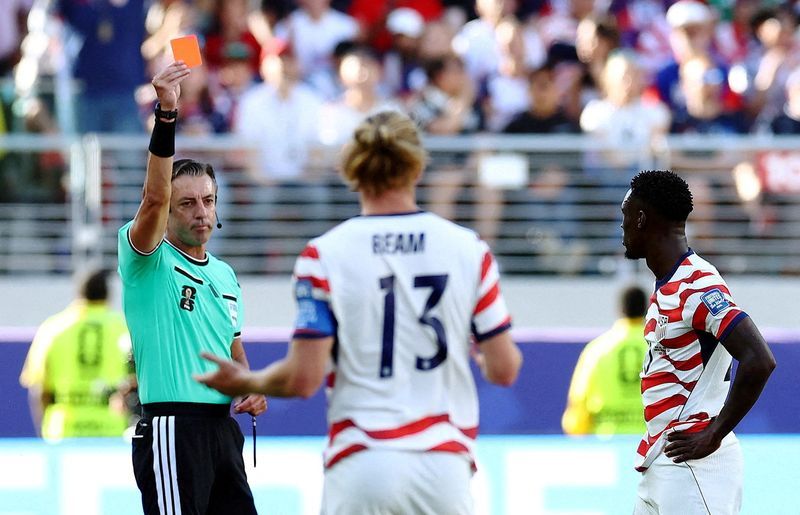
The Belgian government and public have erupted in outrage over what they perceive as FIFA's capitulation to political pressure from Washington, after the world football governing body moved to overturn a disciplinary suspension affecting a key American player just days before a crucial knockout-stage encounter. The controversy has exposed troubling questions about the independence of international sports administration and the ability of political figures to circumvent established disciplinary protocols, raising concerns that resonate across sporting bodies in Southeast Asia and beyond.
At the centre of the dispute lies FIFA's reversal of a red-card suspension that had initially barred a prominent United States striker from competing in Monday's last-16 fixture against Belgium in Seattle. The original sanction appeared to be a straightforward application of the sport's rulebook following a serious on-field transgression. However, after President Donald Trump directly petitioned FIFA President Gianni Infantino to reconsider the matter, the international federation swiftly annulled the ban, permitting the player to participate. The timing and manner of this reversal—coming on the heels of presidential lobbying rather than through standard appeals procedures—has prompted Belgian officials and ordinary citizens alike to question whether sports law remains impartial or has become susceptible to executive influence.
Thérese Kpooubie, a Brussels resident, articulated the bewilderment felt by many Belgians when she questioned the fundamental purpose of disciplinary measures in football. She pointed out that a red card represents a referee's documented judgment that a player has committed a serious infraction warranting suspension from future matches. The decision to erase this punishment, she suggested, inadvertently casts doubt on whether the referee's original assessment was correct or whether external political considerations had overridden sporting merit. Her comments reflect a broader anxiety that if a nation's leader can successfully lobby for the reversal of disciplinary decisions affecting their team's opponents, the entire framework of competitive fairness collapses.
Bastien Noel, another Bruxellois interviewed in the Belgian capital, took a more pragmatic stance while still acknowledging the troubling precedent. He argued that Belgium's national team, affectionately known as the Red Devils, should channel any frustration arising from the decision into motivation on the pitch itself. Rather than dwelling on what he characterized as an incomprehensible administrative outcome, Noel suggested the squad should demonstrate through performance that such external interference cannot undermine their competitive spirit or their commitment to advancing through the tournament. His perspective captures a tension many Belgian supporters face: accepting that the decision cannot be reversed while simultaneously refusing to let it demoralise the squad.
Belgium's Deputy Prime Minister Maxime Prevot lodged a formal objection to what he saw as a flagrant violation of sporting principles. In a statement circulated to the press, Prevot suggested that if Trump's telephone call to Infantino was indeed the decisive factor behind FIFA's decision, the reversal would constitute a direct affront to the foundational rules governing football and sport more broadly. His intervention signals that this row has transcended the realm of sports commentary to become a matter of national political concern, with government ministers viewing the episode as symptomatic of broader threats to institutional independence and the rule of law in international governance.
The United States government moved swiftly to deny any improper pressure had been exerted. Bill White, America's diplomatic representative in Brussels, posted a statement on Instagram categorically rejecting suggestions that President Trump had sought to manipulate FIFA's disciplinary machinery. White's formulation—that Trump merely expressed gratitude to FIFA following their decision—attempts to reframe the presidential intervention as post-hoc acknowledgment rather than active lobbying. Yet this denial largely rings hollow in the context of contemporaneous reporting suggesting the call occurred precisely when the disciplinary question remained unresolved, implying a causal rather than merely correlative relationship.
The episode raises uncomfortable questions about FIFA's vulnerability to political pressure from powerful nations, particularly those whose governments maintain significant economic or diplomatic leverage. FIFA, despite its nominally independent status as a non-governmental organization, operates within a geopolitical ecosystem where the preferences of major sporting nations cannot easily be ignored. A president commanding the resources and influence of the United States possesses tools—diplomatic, economic, and reputational—that can incentivize compliance with his wishes, even when doing so contradicts an organization's established procedures and publicly stated principles.
For Malaysian and Southeast Asian observers, the incident carries instructive lessons about institutional capture and the fragility of supposedly neutral international bodies. The region has experienced its own frustrations with FIFA decision-making, and this episode demonstrates that even prestigious global organizations can bend under pressure from powerful political actors. The precedent set—that a direct presidential appeal can overturn a sporting discipline decision—potentially emboldens other nations to attempt similar interventions, eroding the impartial application of rules that theoretically governs all member federations equally.
The timing of the reversal, announced immediately before a match where the decision materially affects competitive balance, amplifies perceptions of bias and favoritism. Had FIFA genuinely believed the original suspension to be erroneous, normal procedures would have allowed time for a full, transparent review through established appeals channels. The speed and the proximity to the match instead suggest reactive capitulation to external pressure rather than principled reconsideration of sporting facts.
Belgian supporters, meanwhile, have channeled their indignation into backing their team with renewed determination. Therese Kpooubie, wearing Belgian flag-colored earrings, called upon her nation's squad to pursue victory with undimmed focus, framing potential triumph not merely as sporting success but as an assertion of integrity against perceived injustice. This emotional investment reflects how such controversies transcend technical arguments about rule interpretation and become symbolic struggles over whether sporting institutions will remain faithful to principles of fairness or will succumb to the gravitational pull of political power.
The confrontation between Belgium and the United States now carries baggage beyond the ninety minutes of football that will be played in Seattle. For Belgian players and officials, every decision made by referees during that match will be scrutinized through the lens of whether FIFA's earlier decision signaled a broader bias toward the American team. This contamination of the sporting environment—where trust in institutional impartiality has been undermined—represents perhaps the most corrosive consequence of Trump's intervention and FIFA's capitulation, extending damage far beyond the immediate disciplinary question into the integrity of competition itself.

