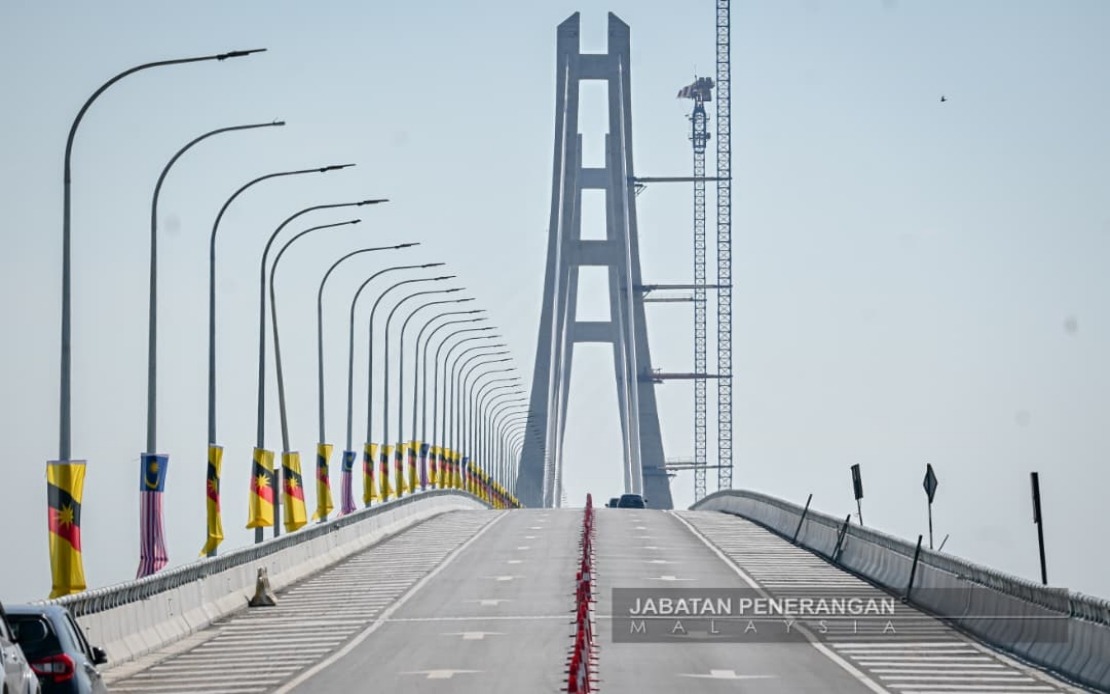
Sarawak Premier Tan Sri Abang Johari Tun Openg has proclaimed the opening of the Batang Lupar 1 Bridge as a watershed moment in the state's infrastructure journey, positioned to unlock economic potential across the coastal communities of Sebuyau, Betong, Sri Aman and Samarahan. The 4.844-kilometre crossing, which cost RM848.75 million to construct, represents the culmination of persistent local advocacy and addresses longstanding connectivity challenges that have constrained development and mobility in these regions.
The bridge fundamentally reshapes transportation dynamics along Sarawak's coastal corridor by providing the first permanent link across Malaysia's longest river. Previously, residents and commercial operators relied entirely on the Sebuyau-Triso ferry service, which remained subject to the unpredictability of weather and tidal conditions. Premier Abang Johari emphasized that this infrastructure gap was not merely inconvenient but occasionally tragic, with maritime incidents caused by rough seas at the river mouth serving as stark reminders of the risks inherent in ferry-dependent travel. The persistent community pressure for a fixed crossing, articulated through successive generations of elected representatives, ultimately drove the state government to prioritize this project.
The bridge functions as a critical artery within the broader Sarawak Second Trunk Road network, a RM3.21 billion coastal development initiative designed to fundamentally reconfigure regional logistics. Deputy Premier Datuk Amar Douglas Uggah Embas, who oversees infrastructure and port development, highlighted the dramatic compression in travel distances this network will achieve. The route between Kuching and Sibu, currently requiring 396 kilometres of travel, will be cut to just 252 kilometres—a reduction of 144 kilometres that translates into substantially lower transport costs, reduced fuel consumption, and faster goods movement across the state. This efficiency gain holds particular significance for agricultural producers and commodity traders who have historically absorbed substantial logistics expenses.
The completion timeline for full coastal road development extends to 2030, meaning the Batang Lupar 1 Bridge represents an early and highly visible victory in a multi-year transformation project. The phased approach allows communities along the route to experience immediate benefits while subsequent segments are constructed, potentially generating momentum and political support for continued infrastructure investment. For Malaysian and Southeast Asian observers, this project exemplifies the scale of infrastructure ambition now underway in East Malaysia, where geographic constraints and dispersed settlement patterns have traditionally limited road connectivity compared to peninsular regions.
The bridge's economic implications extend beyond mere transportation efficiency. Improved connectivity to previously isolated agricultural areas should stimulate production expansion and enable farmers to access wider markets with fresher produce and reduced spoilage. Sectors dependent on just-in-time supply chains, including palm oil processing and aquaculture operations, gain operational flexibility when travel times shrink and reliability improves. Real estate development patterns may also shift as properties along the new corridor become more accessible to Kuching's commercial and residential markets, potentially triggering land value appreciation and construction activity in currently peripheral areas.
Investment flows represent another dimension transformed by this infrastructure. Businesses have traditionally hesitated to establish operations in remote coastal districts where supply chains and customer access remained constrained by ferry schedules and weather disruptions. The bridge removes these structural barriers, making locations like Sebuyau and Betong more attractive to manufacturers, service providers, and distribution facilities serving broader Sarawak and beyond. Government incentives for regional development may prove more effective when paired with genuine connectivity improvements that address investor concerns about logistics reliability.
The Malaysia Book of Records recognition of the Batang Lupar 1 Bridge as the nation's longest river-spanning bridge adds symbolic weight to the project beyond its functional value. Engineering credentials matter in infrastructure narratives, providing visual proof of technical ambition and execution capability. For Sarawak's development narrative, this recognition positions the state as a jurisdiction capable of delivering megaprojects to international standards, potentially influencing investor perceptions and supporting the Premier's broader vision of state modernization. The certificate presentation during the opening ceremony transformed a technical achievement into a celebrated milestone with media resonance.
The ferry service's retirement marks a social transition as significant as the engineering one. For generations, the Sebuyau-Triso crossing represented a chokepoint in regional mobility, a place where residents experienced extended waiting times and genuine safety anxieties during adverse weather. Operators of the ferry service, while providing essential connectivity, also embodied the limitations and frustrations of pre-modern transportation infrastructure. The bridge's opening provides a concrete demonstration of government responsiveness to community needs, particularly valuable in a context where rural areas have historically felt marginalized in development narratives dominated by urban centers.
For Southeast Asian regional dynamics, Sarawak's coastal road development reflects broader infrastructure competition within ASEAN, where countries compete to attract investment through superior connectivity and logistics efficiency. Malaysia's positioning as a regional hub depends partly on internal integration, ensuring that peripheral states like Sarawak are sufficiently connected to support seamless cross-border trade and supply chain operations. The Batang Lupar 1 Bridge, while primarily serving local needs, contributes to this larger equation by confirming Malaysia's commitment to pan-state connectivity investment.
The project's financing model—substantial state government funding for major infrastructure—offers lessons about development strategy in resource-rich states. Sarawak has historically leveraged hydrocarbon revenues to fund transformative projects, though evolving global energy dynamics complicate this model's long-term sustainability. Demonstrating the economic multiplier effects of major infrastructure projects becomes increasingly important for justifying continued capital expenditure, particularly if state revenues eventually decline. The bridge's anticipated impact on agricultural productivity, investment attraction, and regional competitiveness will be scrutinized as a template for evaluating future infrastructure investments.
Premier Abang Johari's framing of the bridge as historical progress carries political significance beyond infrastructure discussion. By emphasizing the fulfillment of community requests repeatedly articulated through elected representatives, the Premier anchors the project in democratic responsiveness rather than top-down government initiative. This narrative proves valuable for legitimizing major public expenditure and maintaining political support across diverse constituencies. The bridge becomes evidence of government accessibility and responsiveness to grassroots concerns, particularly important in dispersed rural communities where infrastructure gaps create palpable frustration.
The Batang Lupar 1 Bridge ultimately represents more than engineering achievement or transportation infrastructure. It symbolizes Sarawak's determination to overcome geographic fragmentation through sustained investment, promises concrete economic benefits to previously isolated communities, and demonstrates infrastructure ambition matching the scale of the state's development aspirations. As the first major component of a multi-year coastal transformation program, it sets expectations for subsequent phases and establishes momentum for the broader Sarawak Second Trunk Road vision that extends to 2030. For Malaysian observers nationwide, the project exemplifies how strategic infrastructure investment addresses both practical mobility challenges and broader regional development objectives.

