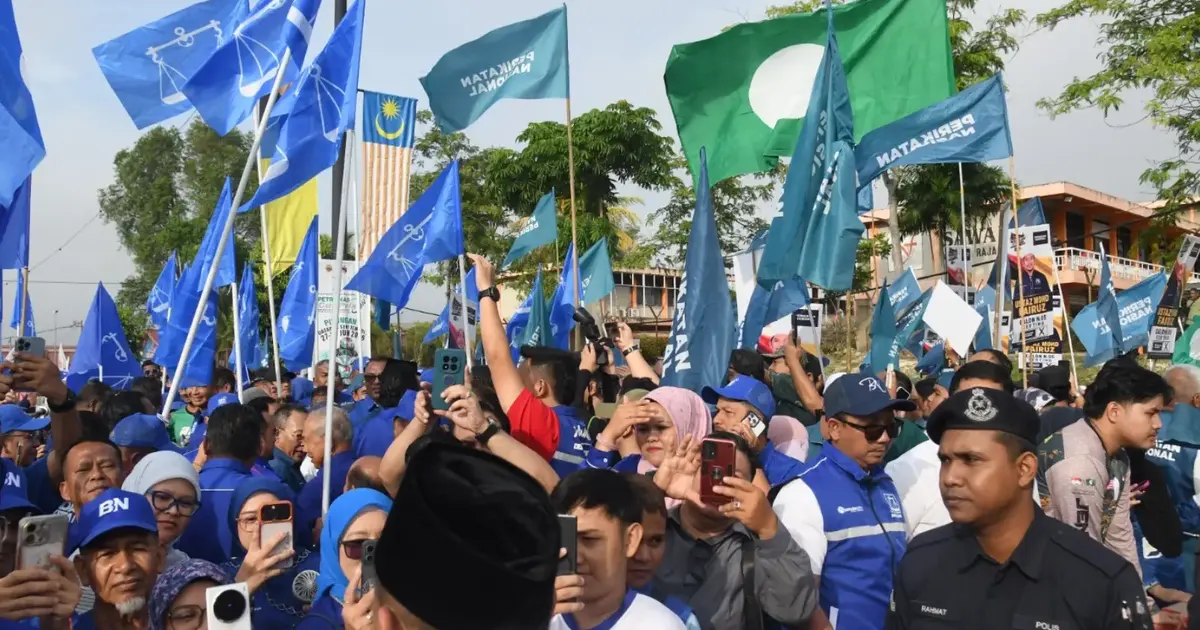
Political analyst Azmi Hassan has dismissed suggestions that Barisan Nasional could effectively replace Bersatu in advancing Perikatan Nasional's ambitions to capture Selangor, arguing that the coalition lacks the organisational capacity and grassroots penetration that the smaller party provided during the last state election. The assessment highlights a critical vulnerability in the opposition's electoral machinery as it gears up for the challenging task of unseating Pakatan Harapan in Malaysia's richest and most urbanised state.
Bersatu, under the leadership of former Prime Minister Mahathir Mohamad, played an instrumental role in channelling votes and mobilising supporters for Perikatan Nasional during the 2022 Selangor state elections. The party functioned as a crucial bridge between the Islamic-focused PAS and Barisan Nasional's more moderate political base, allowing the opposition coalition to appeal to a broader spectrum of voters. Bersatu's presence created a middle ground that enabled the PN alliance to make significant inroads in a state where sophisticated urban voters traditionally favour Pakatan Harapan's centrist positioning.
The dynamics have shifted considerably since that election. Bersatu has since undergone internal turbulence, with Mahathir stepping back from active leadership in key states and the party experiencing fluctuations in internal cohesion. This fragmentation has left a substantial political vacuum within Perikatan Nasional's structure. For Selangor specifically, where Bersatu maintained respectable organisational capabilities and a faction of dedicated loyalists, the loss of its contribution poses a substantial challenge to opposition efforts to break Pakatan Harapan's hold on the state government.
Barisan Nasional, comprising UMNO, MCA, and MIC, operates according to a fundamentally different organisational culture and voter engagement strategy. These parties prioritise maintaining traditional support bases and consolidating established strongholds rather than pioneering new electoral territory. In Selangor's case, where BN's support has been severely eroded over successive elections, the coalition lacks the demonstrated capacity to rebuild voter confidence or execute sophisticated ground operations at scale. UMNO's presence in urban Selangor particularly has deteriorated, with younger voters gravitating toward other political offerings and the party struggling to articulate a compelling vision distinct from Pakatan Harapan's governance record.
Azmi Hassan's analysis suggests that BN cannot replicate the distinct political positioning that Bersatu offered. Bersatu functioned as a vehicle for political renewal and protest against the establishment, attracting voters dissatisfied with both Pakatan Harapan and traditional BN politics. The party drew support from diverse groups, including former Pakatan voters seeking an alternative and individuals alienated from UMNO's hierarchy. Barisan Nasional, by contrast, is fundamentally associated with the old political establishment and carries significant baggage from decades of governance in Selangor and nationally. This perception limits its capacity to attract swing voters or serve as a credible bridge between PAS's religious conservatism and moderate urban constituencies.
The strategic implications for Perikatan Nasional's Selangor ambitions are substantial. Without Bersatu's grassroots networks and voter mobilisation capabilities, the opposition alliance would need to rely primarily on PAS's Islamic voter base and UMNO's residual support structures. This combination, while potentially viable in rural and semi-urban constituencies, becomes considerably weaker in Selangor's metropolitan areas, satellite towns, and middle-class residential zones. These are precisely the regions that determine electoral outcomes in a state where demographic diversity and urbanisation rates exceed the national average.
PAS, despite its strengthened position following the 2022 general elections, faces its own ceiling in states like Selangor where religious-conservatism messaging resonates less effectively than in Kelantan or Terengganu. The party's 2022 Selangor state election performance, while improved, still fell significantly short of securing governmental control. The alliance with Bersatu had provided electoral legitimacy and organisational scaffolding that allowed PAS to present itself as part of a broader coalition rather than a narrower sectarian force. Without this positioning, PAS risks reverting to perceptions of ideological rigidity that undermine appeal among swing voters crucial to state-level majorities.
Barisan Nasional's recent national political rehabilitation, following the formation of the current federal government, has generated expectations that the coalition might recover electoral ground. However, Selangor represents a particularly challenging battleground for such recovery. The state has undergone profound demographic change, with large segments of the electorate having limited historical connection to BN governance. Younger voters especially have formed political preferences shaped by post-2018 politics and Pakatan Harapan's record administering Selangor, rather than BN's earlier tenure. For these cohorts, BN represents a retrograde option rather than a viable alternative government.
The analyst's assessment carries implications beyond the immediate Selangor context. It underscores the structural fragility within Perikatan Nasional as a governing coalition, revealing how dependent the alliance's electoral viability remains on the availability of smaller parties that can transcend ideological divides. The loss or depreciation of such bridging entities creates strategic vacuums that established parties struggle to fill. This weakness could reverberate across multiple state-level contests and eventually influence national-level coalition dynamics, particularly if Perikatan Nasional's momentum proves unsustainable without components that attract diverse voter coalitions.
Moving forward, opposition strategists confronting Selangor's electoral challenge must grapple with the reality that Bersatu's contributions cannot simply be transferred to BN. Any realistic opposition pathway to governing Selangor would require either revitalising Bersatu's organisational presence and voter appeal, identifying alternative coalition partners capable of playing similar bridging roles, or fundamentally reconceiving the opposition alliance's messaging and positioning. Each option presents formidable difficulties, suggesting that Pakatan Harapan's control of Malaysia's most economically significant state remains substantially more resilient than opposition leaders might optimistically anticipate.

