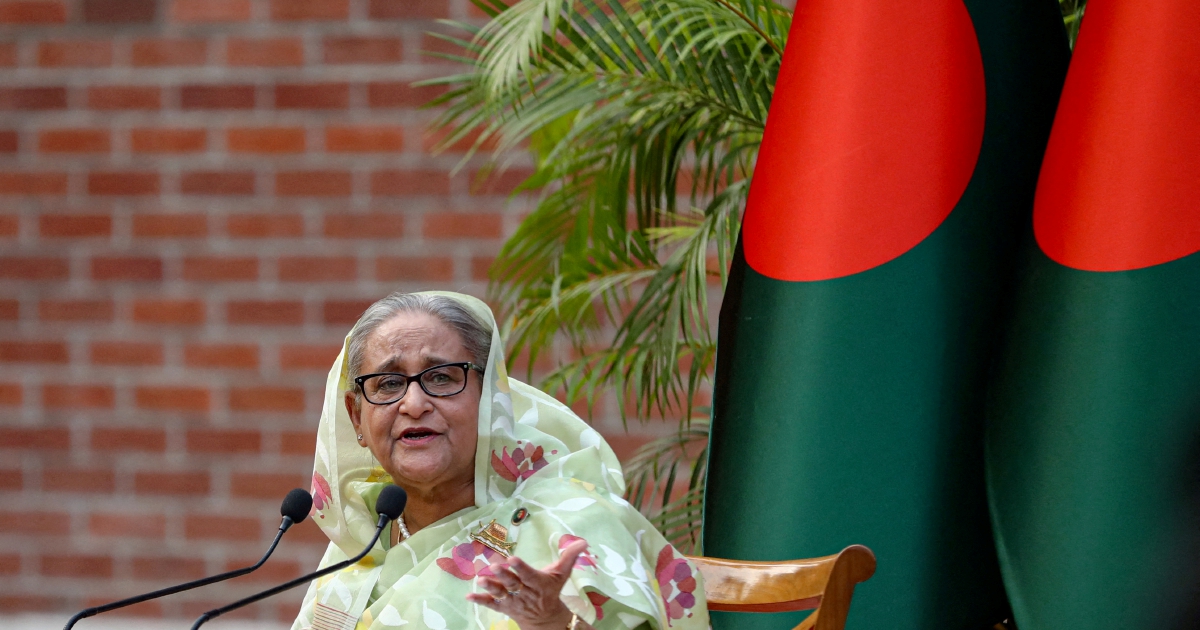
Bangladesh has moved to confiscate assets valued at 760 billion taka, equivalent to approximately US$6.2 billion, that authorities allege are connected to Sheikh Hasina, the former prime minister who fled the country during civil unrest earlier this year, along with her immediate family and a network of ten major business groups. The seizure represents one of the most substantial asset recovery efforts undertaken by the interim administration since the political transition, according to announcements made by government officials on Wednesday.
The scale of the asset recovery underscores the depth of allegations surrounding the accumulation of wealth during Hasina's tenure as premier. Her departure from Bangladesh followed weeks of mounting public discontent and demonstrations that escalated into broader civil disorder. The interim government that assumed control in her wake has prioritised investigating alleged financial irregularities and the concentration of economic power among politically connected individuals and corporations during her administration.
The seized assets extend beyond Hasina's personal holdings and those of her immediate family members, encompassing business interests held by ten separate corporate entities. These enterprises span multiple sectors of Bangladesh's economy, suggesting that the network of alleged wealth accumulation involved diverse investment portfolios rather than concentrating wealth in singular industries. The breadth of the seizure indicates that investigative authorities have traced financial connections across banking, manufacturing, real estate, and potentially other commercial domains.
For Malaysian and Southeast Asian observers, the asset seizure carries significant implications regarding governance standards and accountability mechanisms across the region. Bangladesh's experience reflects ongoing tensions within developing democracies between political elites and public expectations of transparent, equitable resource management. The interim government's aggressive pursuit of asset recovery demonstrates one approach to addressing public anger over perceived corruption and inequality, though questions remain about the effectiveness and fairness of such processes.
The confiscation represents a symbolic and material assertion by the transitional administration of its commitment to severing ties between political authority and concentrated private wealth accumulation. By targeting a former premier and her associated networks, the interim government signals its intention to reshape Bangladesh's political economy and potentially rebuild public trust in institutional governance. However, the scale of assets involved also raises questions about the efficiency of Bangladesh's legal frameworks in managing, auditing, and ultimately repurposing such wealth for public benefit.
Comparative analysis with asset recovery efforts in other South and Southeast Asian countries reveals that Bangladesh's approach follows patterns established elsewhere in the region. Nations including Malaysia, the Philippines, and Thailand have undertaken similar initiatives following political transitions, using freezing orders and confiscation as tools to recover state resources. The success of these operations depends significantly on the independence of judicial institutions and the transparency of subsequent asset management processes.
The interim government's focus on business groups connected to Hasina's circle reflects broader concerns about the entrenchment of economic power within political networks across South Asia. During her tenure, critics argued that certain corporate entities gained preferential access to state contracts, favourable regulatory treatment, and financial resources, creating asymmetries within Bangladesh's business environment. Addressing these structural imbalances constitutes a stated priority for transitional authorities attempting to establish more competitive and transparent economic governance.
Legal and practical challenges will inevitably accompany the implementation of these asset seizures. Tracing funds through complex corporate structures, international banking systems, and shell entities requires sophisticated investigative capacity and sustained institutional cooperation. Bangladesh's authorities will need to coordinate across multiple government agencies and potentially engage international partners to fully account for and secure assets that may have been relocated or concealed beyond national borders.
The confiscation also raises important questions about due process protections and the rights of individuals and entities under investigation. While public anger over alleged corruption creates political momentum for aggressive recovery action, establishing credible legal foundations for these seizures remains essential to maintaining the rule of law and preventing arbitrary asset appropriation. The interim government's ability to navigate this balance will significantly influence both domestic perceptions of its legitimacy and international assessments of Bangladesh's institutional stability.
For foreign investors and multinational corporations operating within Bangladesh, these developments signal heightened regulatory scrutiny and potential reassessment of political risks associated with operating in the country. The asset seizure campaign may encourage greater caution among international business entities considering expansion or continued investment in Bangladesh, particularly if uncertainty persists regarding the stability and predictability of governance frameworks.
Regional economic observers will monitor how Bangladesh deploys these recovered assets and whether proceeds flow toward public infrastructure development, social spending, or institutional strengthening. The transparency with which transitional authorities manage confiscated wealth will substantially influence the perceived legitimacy of the recovery process and the sustainability of Bangladesh's post-transition governance architecture.
The broader significance of Bangladesh's asset recovery effort extends beyond immediate financial considerations to encompass fundamental questions about state capacity, institutional legitimacy, and the political economy of South Asian governance. As the interim government works to consolidate its authority and establish credible foundations for subsequent democratic processes, effectively managing this unprecedented concentration of seized assets will test institutional capabilities and demonstrate commitment to public accountability principles that have long remained contested within Bangladesh's political system.

