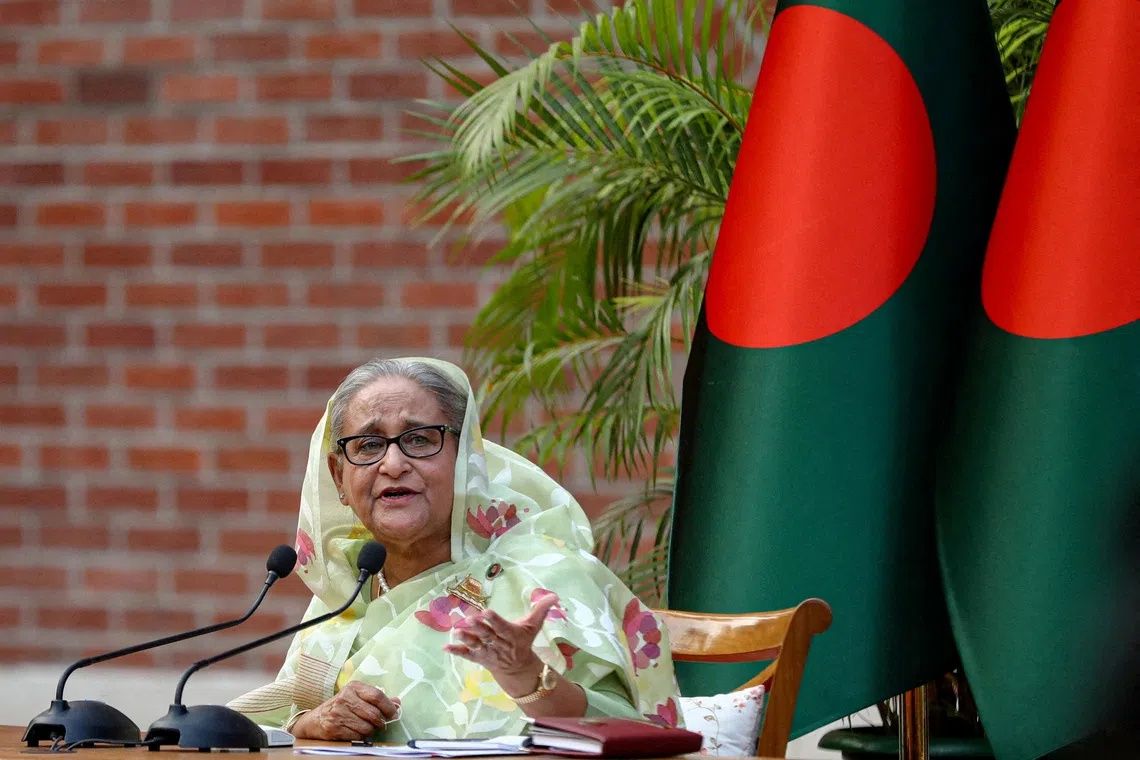
Bangladesh has formally requested clarification from India regarding exiled former prime minister Sheikh Hasina's intention to deliver a virtual address from New Delhi, signalling concern that hosting such political activities by a fugitive could undermine the substantial diplomatic progress both nations have made in recent months. The request marks the first official governmental response to Hasina's participation in an August 5 event organised by the Foreign Correspondents' Club of South Asia, which will commemorate the second anniversary of the mass student-led protests that ultimately toppled her administration in 2024.
State Minister for Foreign Affairs Shama Obaed Islam articulated Dhaka's position to reporters on Monday evening, emphasising that Bangladesh remains committed to advancing bilateral relations with India but requires explicit assurances from New Delhi that it will not permit or tacitly support political activities conducted by individuals facing serious criminal charges. Islam's carefully worded statement reflected the delicate balancing act Dhaka must perform—maintaining diplomatic cordiality while protecting national interests and the legitimacy of the current administration under Prime Minister Tarique Rahman, who took office following February's election.
The timing of this diplomatic friction is particularly sensitive given that both countries have consciously worked to restore relationship equilibrium following the turbulence of Hasina's exit. The deterioration in relations began immediately after her government fell in August 2024, but recent months have witnessed deliberate efforts from both capitals to engage constructively and rebuild institutional channels of communication. Any perceived Indian acquiescence to Hasina's political activities from Indian soil risks undermining these painstaking efforts at reconciliation.
Hasina, now 78 years old, will participate in the New Delhi event through video link alongside her son Sajeeb Wazed Joy and other speakers, according to organisers. The Foreign Correspondents' Club of South Asia characterised the gathering as a commemoration of the historic student uprising, though Islam pointedly noted that while the event itself is not organised by the Indian government, the participation of a fugitive in political activity from Indian territory raises fundamental questions about state responsibility and diplomatic protocol. Bangladesh has consistently raised concerns with New Delhi about Awami League leaders, including Hasina, issuing political statements from Indian soil—a practice Dhaka views as extraterritorial political interference that violates accepted norms between neighbouring nations.
The extradition issue remains unresolved, with Dhaka continuing to press India for Hasina's return to face multiple criminal cases. The situation became more complex when Bangladesh sentenced Hasina to death in absentia in 2025 for crimes against humanity, specifically relating to her government's response to the 2024 protests. According to United Nations assessments, the security forces' actions during that period resulted in up to 1,400 deaths. Hasina has categorically rejected the verdict as legally invalid and without standing, arguing that the proceedings lack legitimacy given her physical absence and the political nature of the charges. Her insistence on this position, coupled with her stated intention to return to Bangladesh in December despite the death sentence, suggests an ongoing deadlock unlikely to resolve through conventional diplomatic channels.
India's formal position remains unclear, with the Indian foreign ministry offering no immediate response to Bangladesh's representations on this matter. This silence itself carries diplomatic weight—neither confirming support for Hasina's activities nor explicitly disavowing them. India's historical relationship with Hasina and the Awami League party, combined with its strategic interests in regional stability, may complicate any straightforward response from New Delhi. Several analysts suggest India faces genuine pressure in navigating between respecting Bangladesh's sovereignty and maintaining its own diplomatic flexibility regarding prominent regional political figures who have sought refuge on Indian territory.
Islam emphasised that Bangladesh had previously communicated to India its expectation that New Delhi would discourage fugitives from engaging in political activities from Indian soil, suggesting a prior understanding between the two nations on this principle. If India had indeed previously acknowledged this position, then permitting Hasina's speech would constitute a reversal of stated policy, creating additional diplomatic friction. Islam indicated that should the matter not be satisfactorily resolved through existing diplomatic channels, Bangladesh would escalate the issue through formal diplomatic procedures, signalling that this remains an active concern rather than a passing grievance.
The broader context involves the dramatic transformation of Bangladeshi politics following Hasina's removal. The current government, led by Rahman, represents a fundamental political realignment and has sought to establish its own legitimacy by distancing itself from the previous regime's policies and personnel. For Rahman's administration, the presence of Hasina actively engaging in political commentary from abroad represents a potential rallying point for opposition elements and complicates the narrative of clean governance that the new regime is attempting to establish.
For Malaysian and Southeast Asian observers, this episode illuminates the complexities of managing relations between neighbouring states when high-profile political figures seek refuge abroad. The situation raises questions about the obligations of host nations regarding fugitives and the balance between providing humanitarian asylum and respecting the judicial processes of another state. Regional stability ultimately depends on all countries observing broad principles of non-interference and restraint, particularly when powerful political personalities are involved. The outcome of India-Bangladesh negotiations on this matter may set precedents affecting regional diplomatic practice for years to come.

