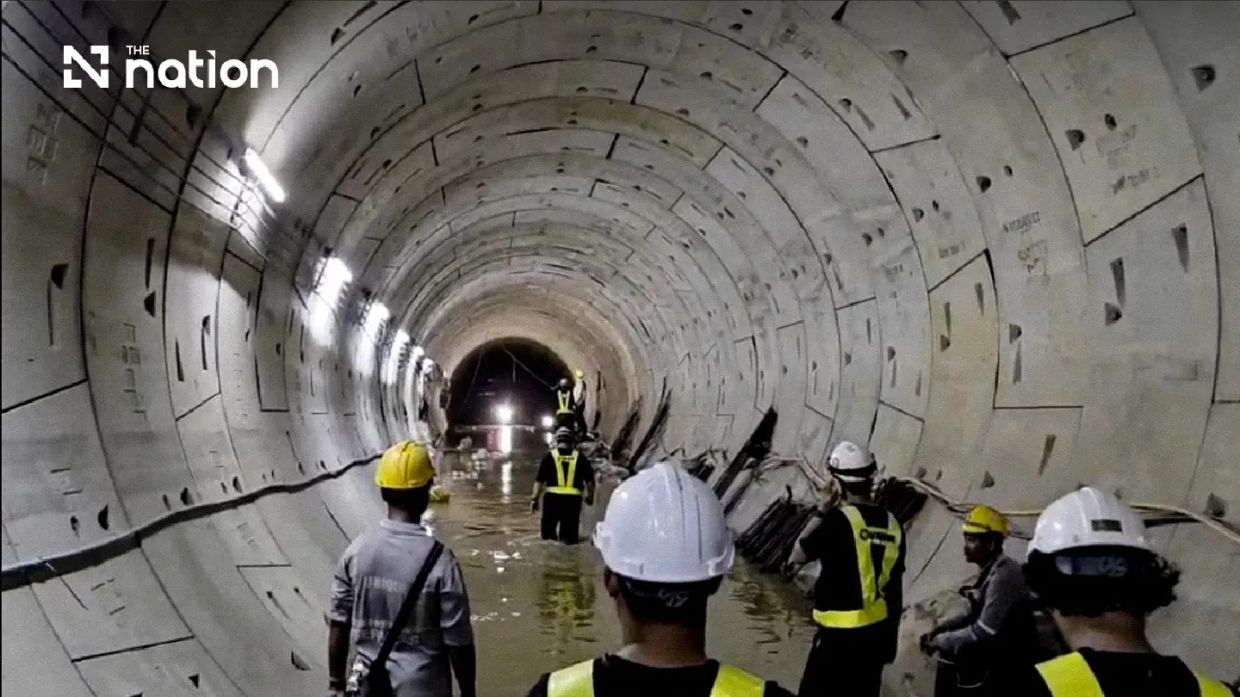
Bangkok's expanding rapid transit network faced a fresh test of its infrastructure resilience when heavy rainfall on July 8 forced water into a construction shaft beneath the southern Purple Line extension. The incident, occurring in the Tao Poon–Rat Burana section near Wongwian Yai, prompted an emergency response involving Transport Ministry officials and Prime Minister Anutin Charnvirakul, who arrived at the site around midnight to oversee the situation firsthand.
The breach occurred within a construction worksite serving the Saphan Phut–Dao Khanong section of the project, managed under Contract 4 by Unique Engineering and Construction Public Company Limited (UNIQ). The contract, valued at 14.982 billion baht (US$447.3 million), represents a significant portion of the capital-intensive Purple Line expansion. Work at the location involves substantial tunnel excavation and retaining wall construction, activities that expose underground areas to water infiltration during periods of intense precipitation—a recurring challenge in Bangkok's monsoon climate.
The rapid escalation of the situation reflects heightened sensitivity within Thailand's transport authorities to underground construction risks. Deputy Prime Minister Phiphat Ratchakitprakarn, Transport Minister by portfolio, coordinated the initial response alongside three deputy transport ministers and the deputy interior minister. This high-level turnout underscores the political salience of rail infrastructure projects in Bangkok, where public confidence in transit safety remains fragile following previous construction incidents. The Mass Rapid Transit Authority of Thailand (MRTA) governance structure also sent its top official, Gardphajon Udomdhammabhakdi, to assess the damage and oversee remedial protocols.
Initial assessments indicated the situation remained manageable, though officials ordered comprehensive technical investigations to identify the leak's precise source and assess whether structural integrity had been compromised. The inspection mandate included immediate corrective measures, sustained water level monitoring, and verification that engineering standards remained satisfied. This methodical approach contrasts with reactive crisis management, emphasizing the MRTA's determination to prevent escalation into the kind of catastrophic ground collapse that damaged infrastructure near Vajira Hospital during late September 2025—an incident that shook public confidence in Bangkok's underground construction practices.
The Vajira Hospital collapse serves as the essential context for understanding the urgency of the Purple Line response. That incident involved tunnel structure failure that pulled surface soil into the subsurface cavity, creating visible ground deformation and raising fundamental questions about excavation methodology, geotechnical assessment, and contractor accountability. The event triggered policy reviews, structural audits, and heightened ministerial oversight across similar projects. Anutin's late-night appearance at Wongwian Yai reflected lessons learned from that episode—demonstrating that early, visible intervention could signal competent crisis management and reassure a skeptical public.
Anutin emphasized during the site visit that water levels inside the tunnel remained under control, with no requirement for nearby road closures or mass evacuation. He noted that officials had identified the leak from the outset and were actively addressing it rather than discovering structural failure after-the-fact. The distinction carries weight in the context of Bangkok's infrastructure narrative: a responsive government recognizing and managing problems transparently differs markedly from authorities discovering damage retrospectively through public complaints or media investigation. The Prime Minister's framing positioned the response as proactive engineering-based problem-solving rather than crisis damage control.
The MRTA's installation of movement-monitoring equipment on nearby buildings and structures demonstrates the integrated surveillance approach now standard for Bangkok's critical infrastructure projects. Real-time deformation measurements allow engineers to detect subtle structural distress before visible damage manifests, theoretically enabling preventive intervention. Anutin confirmed that no abnormal movement signals had emerged during the initial monitoring period, though he stressed the necessity of continued close observation. This graduated assessment philosophy—initial evaluation, real-time monitoring, sustained surveillance—reflects international best practice in managing subsurface construction risks in urban environments.
The coordination mechanism that brought multiple ministers to the site carries implications beyond this single incident. When Anutin acknowledged that he had notified colleagues through a group chat before departing for Wongwian Yai, he revealed the informal channels through which Bangkok's high-level decision-making now flows during crises. The transparency of that disclosure—rather than presenting the ministerial turnout as pre-planned crisis response—suggests confidence in the coordination's appropriateness. Such horizontal communication among cabinet-level officials during emerging incidents represents evolving governance practice in Thailand's transport sector, potentially establishing precedent for future rapid-response protocols.
The financial and temporal implications of the leak remain substantial. Delay in completing the Saphan Phut–Dao Khanong section cascades across the entire Purple Line expansion timeline, affecting passenger projections, revenue forecasts, and Bangkok's broader transit development strategy. Contractors face financial pressure to complete remediation quickly without compromising safety or engineering standards—a tension that authorities must monitor carefully. The MRTA's instruction to accelerate repairs while maintaining regular reporting to the Transport Ministry establishes accountability mechanisms designed to prevent both reckless corner-cutting and indefinite delays.
For Malaysian and Southeast Asian observers, the Purple Line incident illustrates the infrastructure challenges facing rapidly urbanizing capitals with complex geology and intense monsoon climates. Bangkok's experience with tunnel construction complications—from the Vajira Hospital collapse through the Wongwian Yai flooding—provides instructive lessons for other regional cities planning major transit expansions. The Turkish and Italian contractors operating parts of Bangkok's rail network bring international expertise, yet subsurface work remains inherently site-specific, requiring deep understanding of local hydrogeology, soil conditions, and construction methods adapted to tropical monsoon environments.
Anutin's statement that the incident differed fundamentally from previous failures—because authorities detected the problem early rather than discovering it through structural collapse—encapsulates the policy learning curve visible in Bangkok's infrastructure management. The transparency of ministerial involvement, the emphasis on real-time monitoring, and the commitment to preventive measures all signal evolution in how Thailand's government approaches major infrastructure risks. Whether these protocols prove sufficient to prevent recurrence of serious construction incidents remains the critical question as the Purple Line expansion continues through Bangkok's congested urban landscape.

