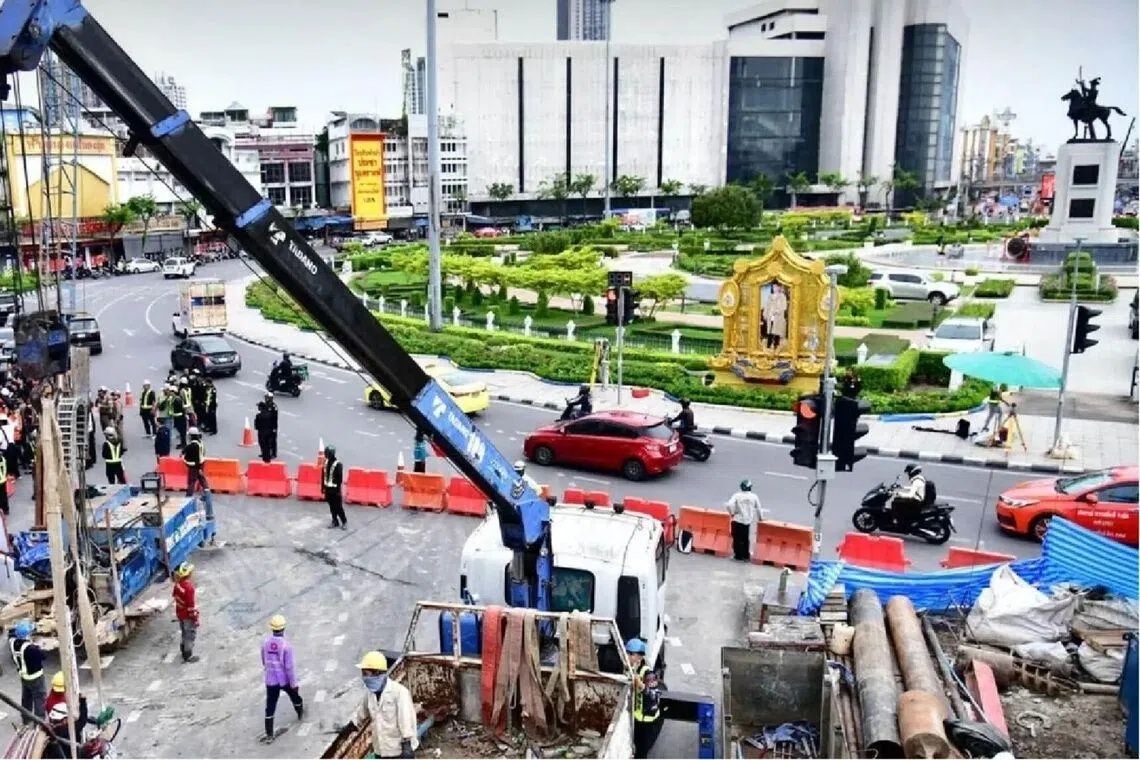
Bangkok has launched an emergency response to a potentially serious infrastructure crisis after water infiltration at a subway construction site caused the ground to subside near Wongwian Yai, forcing authorities to evacuate about 60 people from three commercial buildings within a 30-metre radius of the affected area. The incident underscores the substantial risks posed by large-scale underground construction projects in densely populated urban centres, particularly when engineering safeguards fail to contain water pressures in the subsurface environment.
The problem emerged when water began seeping into a drainage sump located at the lowest point of the Purple Line's southern extension tunnel. This seemingly contained breach allowed surrounding soil to migrate into the underground structure, destabilising the earth above and creating a visible subsidence depression across the road surface. The cascading effect from a single seepage point demonstrates how vulnerable the ground layer becomes when underground structures compromise the natural soil stability that has existed for decades or centuries.
Bangkok governor Chadchart Sittipunt personally visited the site on 9 July alongside deputy governor Wisanu Subsompon and deputy permanent secretary Kanokwan Iamlim, signalling the gravity with which city leadership is treating the emergency. Initial assessments indicated that water levels and the rate of subsidence had begun to stabilise by the time officials inspected the location, though this stabilisation does not eliminate the need for sustained vigilance and preventive action. Authorities have committed to round-the-clock monitoring to detect any resumption of movement or additional soil loss.
The evacuation affects residents of three commercial buildings positioned within the immediate danger zone. The Bangkok Metropolitan Administration and the Mass Rapid Transit Authority of Thailand's contractor have arranged temporary accommodation in hotels and will maintain residents in these facilities for approximately one week while structural assessments proceed. The project contractor will bear all costs associated with relocation, including accommodation, compensation and related expenses, a measure aimed at reducing public hardship during the emergency phase.
To enhance real-time surveillance of structural integrity, the Department of Disaster Prevention and Mitigation has installed two Rescue Guardian monitoring units on buildings positioned near the subsidence zone. These sophisticated sensors continuously measure tilting and structural deformation, transmitting data to a centralised monitoring system that immediately alerts officials if abnormal movement occurs. The system essentially converts passive buildings into active data-collection points, allowing engineers to detect danger signals with precision impossible through visual inspection alone.
Beyond the monitoring equipment, Thailand's national Urban Search and Rescue team engineers have deployed to evaluate nearby structures comprehensively, ensuring that the response adheres to both engineering standards and public safety protocols. The Department of Disaster Prevention and Mitigation has also supplied generators, lighting apparatus and specialised machinery to support continuous overnight operations. Rescue foundations and volunteer units remain on standby to provide emergency medical assistance or coordinate patient transfers if the situation deteriorates unexpectedly.
A forward command centre has been established adjacent to the subsidence point to coordinate activities across multiple agencies, including the BMA, the MRTA, the project contractor, district authorities, police and emergency responders. The immediate engineering priority focuses on sealing the water leak and preventing additional soil from being drawn into the tunnel, a technically demanding task that requires both precision and speed. Continuous monitoring of the road surface, soil movement patterns, water leakage volume and building conditions will inform every decision about restoration timelines.
The incident occurs along the same Purple Line southern alignment where an earlier road collapse took place near Vajira Hospital, though a different contractor manages the current project. This history of construction difficulties on the same corridor may prompt officials to re-examine contractor selection criteria and oversight mechanisms for future phases. The fact that the same rail extension has experienced multiple subsidence incidents suggests that geological conditions, soil composition or hydrology in this region may present challenges beyond standard engineering solutions.
Traffic management has become an immediate concern, with authorities closing all outbound lanes of Prajadhipok Road over roughly 200 metres between Ban Khaek intersection and the King Taksin the Great Monument at Wongwian Yai. This closure, intended to minimise vibrations from vehicle movement that could further destabilise weakened soil, forces two inbound lanes to accommodate outbound traffic temporarily. Motorists from Memorial Bridge or Phra Pok Klao Bridge have been directed to use alternative routes via Itsaraphap, Lat Ya or Somdet Chao Phraya roads, arrangements that will remain until engineers confirm structural safety.
The longer-term traffic implications are substantial given that the area represents a major urban bottleneck positioned near significant educational institutions including Suankularb Wittayalai School and Suksanari School. Governor Chadchart has indicated that Bangkok may implement measures similar to those deployed following the Vajira Hospital subsidence, potentially including dedicated school shuttle services designed to reduce parent vehicle volumes in the affected corridor. Such interventions require careful coordination with schools and families to ensure adequate alternative transport capacity.
Authorities have indicated that all restrictions will remain in place until engineers formally confirm that buildings, road infrastructure and surrounding structures meet safety standards. The process of stabilising the tunnel, sealing the leak, monitoring subsidence rates and assessing structural integrity will require time, precision and comprehensive testing. The rehabilitation period for Prajadhipok Road and the neighbouring commercial buildings represents not merely an inconvenience but a necessary precaution against the catastrophic consequences that could follow if proper engineering protocols are bypassed in pursuit of reopening deadlines.
For Southeast Asia more broadly, the Bangkok incident serves as a sobering reminder of the infrastructure challenges accompanying rapid urban expansion and underground transit development. Cities across the region undertaking comparable subway or light rail projects must ensure that contractor oversight, geological investigation and emergency protocols meet the highest engineering standards. The evacuation, monitoring systems and multi-agency coordination visible in Bangkok's response represent best practices that should become standard across the region's growing network of underground transit projects.

