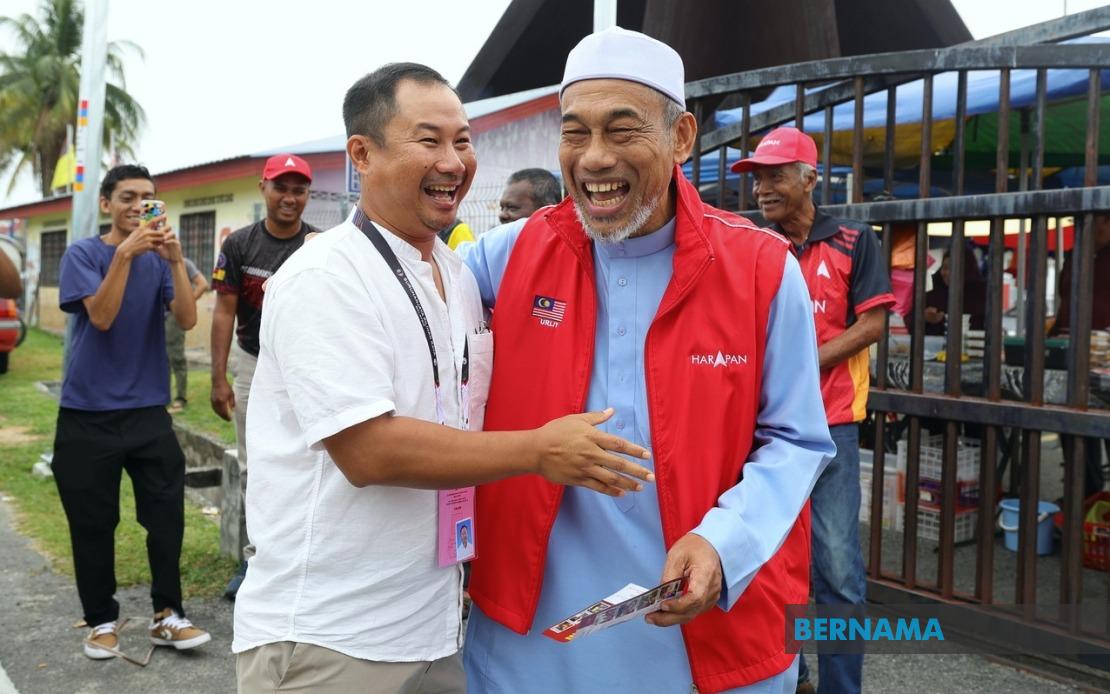
Datuk Bakri Sawir is banking on his established presence and hands-on approach as he seeks to retain the Klawang state assembly seat for a third consecutive term. The 67-year-old Pakatan Harapan candidate told campaigners and market-goers in Pekan Kuala Klawang that his effectiveness as an incumbent assemblyman, combined with his close ties to the electorate, forms the foundation of his re-election bid in the 16th Negeri Sembilan State Election.
Since first being elected in 2018, Bakri has built his political brand around direct engagement with constituents, deliberately moving away from the traditional model where voters are expected to seek assistance at service centres. His strategy reflects a deliberate choice to embed himself physically within the Klawang constituency, a calculation that he believes resonates in a constituency of fewer than 14,000 voters where personal relationships carry considerable weight. By visiting residents at their homes rather than awaiting their visits, Bakri has fashioned a political identity rooted in accessibility and persistent ground presence.
The Klawang assemblyman emphasizes that his residence within the constituency enables him to remain available to residents on a continuous basis, not merely during election campaigns or the symbolic visits that characterise some political representatives. This living arrangement, he argues, differentiates him from rivals who may appear distant from constituent concerns between electoral cycles. For a grassroots-oriented candidate in a rural-leaning constituency, such physical and social proximity to the community holds tangible electoral value.
Bakri frames his political work through a philosophical lens, describing politics as a path to service and spiritual fulfilment rather than purely transactional power-seeking. He explicitly acknowledges that not all voters will support him, demonstrating a measured approach that respects electoral diversity rather than demanding unanimous backing. This positioning may appeal to voters fatigued by aggressive partisan messaging, though it leaves room for opponents to question whether such philosophical abstraction translates into concrete material gains for constituents.
Looking forward, Bakri has outlined an ambition to establish a university campus in Jelebu, a proposal that he had previously championed but acknowledges remains financially constrained under current government circumstances. This long-term vision signals investment in human capital development and positioning Jelebu as an educational hub, though the vagueness surrounding timelines and funding mechanisms may raise questions about feasibility. More immediately, Bakri is promoting practical infrastructure projects designed to generate visible economic returns within his term.
Among the nearer-term priorities is the development of a Rest and Recreation Area facility in Tembun, Hulu Klawang, a project designed to enhance the constituency's appeal to transit and leisure traffic. Bakri frames this as a pathway to increased tourism spending and local entrepreneurial opportunities, connecting infrastructure development to grassroots economic empowerment. Such projects often resonate with rural voters who perceive limited economic diversification within their regions.
Bakri has also identified Bukit Tajali as a site for recreational park development encompassing leisure and adventure tourism activities. This initiative similarly aims to create economic opportunities within the constituency whilst positioning Klawang as a destination for day-trippers and tourists seeking nature-based experiences. The accumulation of these infrastructure proposals suggests a development vision centred on positioning Klawang as a destination constituency rather than merely a residential one.
The Klawang contest represents a three-way competition, with Bakri facing Danni Rais, 38, representing Perikatan Nasional, and Muhammad Adib Musa, 25, the Parti Pribumi Bersatu Malaysia candidate. The entrance of a Bersatu contestant introduces complexity to what might otherwise be a straightforward PH-PN contest, potentially fracturing anti-establishment votes and complicating the electoral mathematics. For Bakri, such fragmentation could prove advantageous if the opposition vote splits sufficiently to preserve his plurality.
The broader Negeri Sembilan state election involves 889,490 registered voters participating in voting scheduled for August 1, with early voting on July 28. Military and police personnel comprise approximately 22,000 early voters, reflecting the institutional composition of the state's electorate. The state assembly was dissolved on June 5, initiating a campaign period that has allowed candidates like Bakri extended time for ground-level engagement and constituency-level message reinforcement.
Bakri's strategic positioning emphasises continuity, accessibility, and incremental development rather than dramatic transformation. This approach aligns with the preferences of voters in smaller, less urbanised constituencies where disruption carries risks and proven competence in navigating local bureaucratic systems holds value. His emphasis on respecting political plurality, whilst simultaneously promoting his record, attempts to position him as a unifying figure rather than a partisan warrior—a potentially effective strategy in constituencies where social cohesion and cross-party civil engagement remain operationally important.
The Klawang assemblyman's campaign narrative ultimately rests on the proposition that sustained service, physical presence, and demonstrated delivery of local projects outweigh the appeal of alternative candidates. Whether voters will reward his two-term track record or prefer the fresh political energy offered by younger challengers remains uncertain, but Bakri's ground-level strategy and emphasis on localised economic development initiatives represent a coherent electoral philosophy tailored to his constituency's scale and needs.

