Bahrain's development minister has confirmed that the kingdom has resisted tapping a substantial currency swap facility with the United Arab Emirates, even as the country faces mounting economic pressures from escalating regional tensions. Speaking in London, Noor bint Ali Alkhulaif, who heads both the sustainable development ministry and the Bahrain Economic Development Board, disclosed that the $5.3 billion facility agreed with Abu Dhabi in April remains unexercised. This restraint comes despite renewed Iranian attacks on Bahrain over recent days and deepening concerns about the kingdom's foreign exchange position, which has contracted to around $3 billion—its lowest level since the COVID-19 crisis.
The revelation underscores Bahrain's delicate balancing act as the Gulf region navigates unprecedented instability. Located strategically at the heart of the Persian Gulf and hosting the United States Navy's Fifth Fleet headquarters, Bahrain has found itself caught directly in the crossfire of escalating hostilities between Washington and Tehran. The kingdom's vulnerability stems partly from structural economic challenges predating the current conflict. Credit rating agency S&P Global projects a 3% economic contraction this year alongside a fiscal deficit approaching 8.5% of gross domestic product—a stark deterioration from the growth trajectory Bahrain envisaged.
Alkhulaif acknowledged the frustration in the kingdom over how unforeseen circumstances have derailed development plans. "It was meant to be a year of building the new Bahrain," she told Reuters, expressing disappointment that geopolitical events beyond Riyadh's control have disrupted economic momentum. The conflict that erupted in March forced the cancellation of multiple regional events, including Saudi Arabia's Formula One race and Bahrain's own Grand Prix. For a country already burdened with one of the region's heaviest debt loads, such disruptions carry outsized consequences for tourism revenues and international investment confidence.
Yet Alkhulaif projected cautious optimism about recovery momentum already taking root across key economic sectors. Manufacturing and logistics companies have pivoted strategies to bypass the Strait of Hormuz, identifying alternative supply chain routes that circumvent direct exposure to military escalation. Tourism flows from neighbouring Gulf states, which typically comprise roughly 90 percent of Bahrain's annual visitor base totalling 15 million arrivals last year, have rebounded to pre-conflict levels. These indicators suggest that despite headline economic contraction estimates, underlying business resilience is functioning better than worst-case scenarios might suggest.
The decision to preserve the UAE currency swap rather than activate it signals confidence—or perhaps necessity—in Bahrain's approach to managing liquidity. As a board member of Bahrain's central bank, Alkhulaif confirmed that the facility remains available as a backstop but has not been called upon. The central bank's decision to maintain this financial firewall suggests policymakers believe the current foreign exchange position, while reduced, remains manageable without resort to emergency liquidity arrangements. However, this strategy carries implicit risk if regional tensions deteriorate further or domestic pressures intensify.
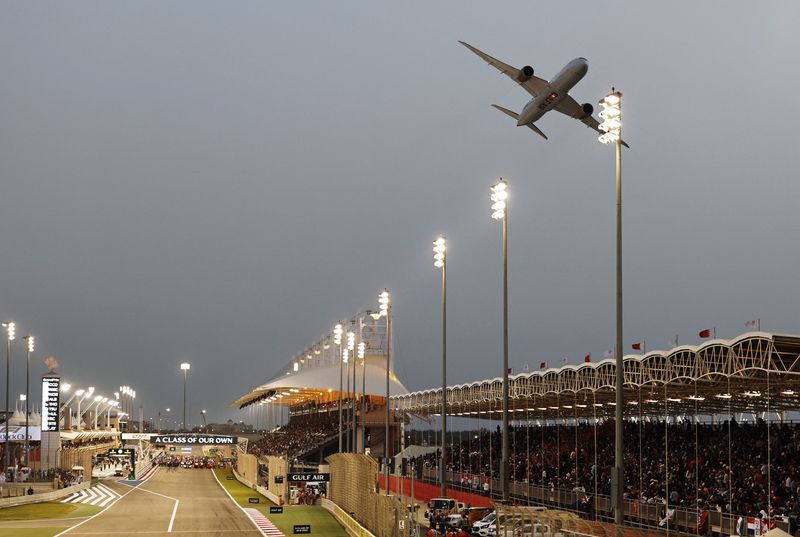
Parallel to managing immediate economic challenges, Bahrain has engaged in discussions regarding the reinstatement of its Formula One Grand Prix on the 2024 calendar. The prestigious motorsport event represents far more than entertainment for the kingdom—it functions as a major economic engine and international prestige project. The race typically draws approximately 105,000 spectators, with higher-spending international visitors accounting for 10 to 15 percent of attendance. Beyond gate receipts, the event generates substantial hospitality, retail, and ancillary service revenues that ripple through the economy.
Formula One sources indicate that if political and security conditions stabilise sufficiently, the most feasible window for reinstating Bahrain's race would be the weekend of October 3-4, positioned strategically between the Azerbaijan Grand Prix in Baku and the Singapore Grand Prix on October 11. This scheduling slot would maintain the existing calendar structure while accommodating the delayed Bahrain race without requiring wholesale reorganisation. However, such a move hinges on tangible de-escalation of US-Iran hostilities, a condition Alkhulaif acknowledged as prerequisite. She stated the government is exploring whether cancelled races might be "plugged back into the calendar," though she emphasised that no confirmations have been finalised.
Timing considerations loom large in the decision-making calculus. Formula One teams and organisers require adequate lead time to mobilise personnel, equipment, and logistical support for each venue. The industry consensus holds that any final determination on Bahrain's 2024 reinstatement must materialise within weeks rather than months. Delaying beyond a certain threshold makes late-season fixture swaps operationally untenable, effectively pushing any potential return to the 2025 calendar or beyond. This compressed timeline concentrates pressure on both Bahraini officials and international organisers to assess whether security conditions have sufficiently normalised.
Beyond the immediate 2024 scenario, Bahrain's longer-term motorsport prospects appear promising relative to near-term uncertainties. The kingdom is positioned to reclaim the opening race slot of the 2026-2027 Formula One season, a particularly prestigious position in the annual calendar. Additionally, Bahrain hosts critical pre-season testing operations that prepare teams for championship competition. These fixtures promise sustained economic benefits and international visibility across multiple years. The earlier scheduling of Ramadan in coming years, Alkhulaif noted, actually favours Bahrain's hosting capacity by allowing race operations to occur outside the holy month's constraints.
The convergence of these dynamics—unused currency swap reserves, recovering tourism and logistics sectors, and negotiations over sporting marquee events—reveals Bahrain's broader strategic positioning. The kingdom appears determined to demonstrate economic resilience without resorting to emergency financial measures, while simultaneously leveraging international engagement through high-profile events to maintain investor confidence and geopolitical relevance. Whether this calculus proves sustainable depends substantially on trajectories in the broader Iran-US confrontation, which fundamentally shapes the security perimeter and risk premium affecting the entire Gulf region.
For Malaysian readers and Southeast Asian observers, Bahrain's situation illustrates broader vulnerabilities affecting smaller Gulf economies exposed to great power competition. Many Southeast Asian nations maintain comparable dependencies on international tourism, global supply chains, and foreign direct investment while navigating geopolitical complexities beyond their direct control. Bahrain's approach—preserving financial tools rather than immediately deploying them, sustaining investor engagement despite headline risks, and pursuing prestige projects that signal confidence—offers instructive lessons about crisis management strategies. The kingdom's success or failure in navigating the current period may offer regional peers valuable insights into economic resilience and policy sequencing during extended periods of heightened instability.

