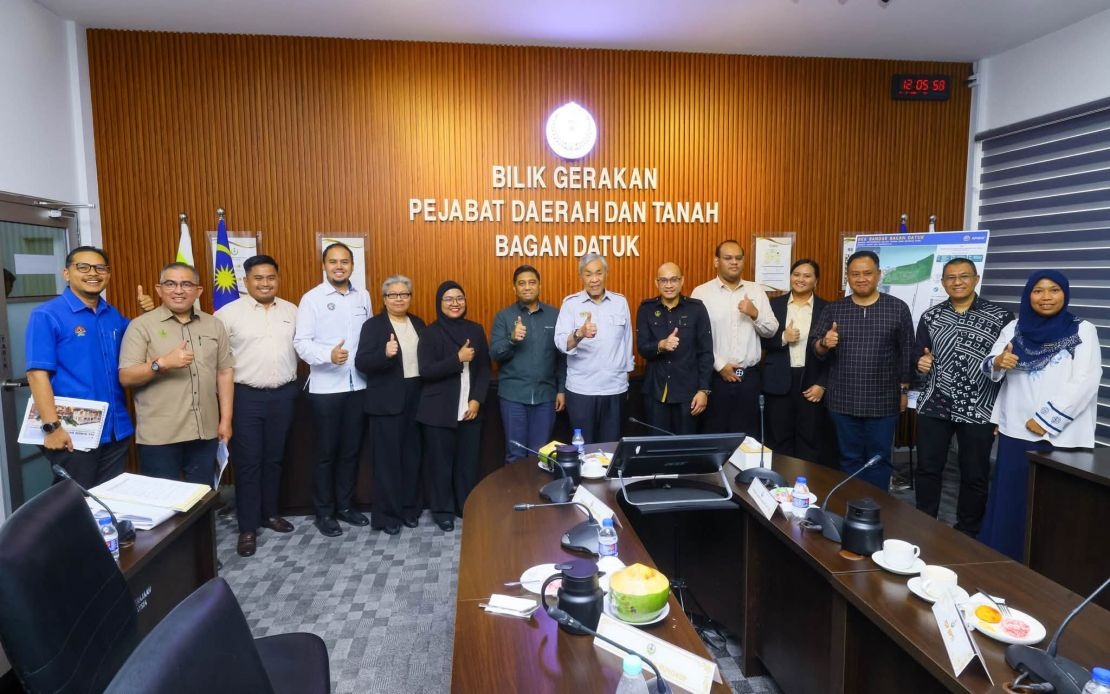
Deputy Prime Minister Datuk Seri Dr Ahmad Zahid Hamidi has articulated an ambitious vision for Bagan Datuk, envisioning the district as a model administrative centre that combines livability with competitive advantage. Speaking in Ipoh on August 14, Zahid—who represents the Bagan Datuk parliamentary seat—stressed that the constituency possesses significant untapped potential that must be systematically converted into tangible development benefiting residents.
The transformation would centre on creating what officials describe as an administrative town within a park setting, incorporating modern facilities, comprehensive infrastructure, expanded economic opportunities, and a comfortable living environment. This concept reflects growing recognition across Southeast Asia that administrative centres need not be purely utilitarian spaces but can integrate environmental planning with functional governance infrastructure.
Zahid's remarks followed a detailed presentation on the Bagan Datuk special area plan, known locally as the RKK (Rancangan Khas Kawasan). The Deputy Prime Minister conducted a working session with the Teluk Intan Municipal Council, Bagan Datuk District authorities, the Land Office, and consulting firms involved in developing the comprehensive strategy. This multi-stakeholder engagement signals that the initiative extends beyond political rhetoric into substantive planning coordination.
For Malaysian observers, the timing and scope of this announcement hold particular significance. Bagan Datuk represents a constituency in Perak with genuine development challenges typical of many interior Malaysian districts—balancing heritage preservation with modernisation, retaining local character whilst attracting investment and talent. The special area plan framework suggests authorities are moving beyond ad-hoc projects toward integrated, long-term spatial planning that considers social, economic, and environmental dimensions simultaneously.
Zahid's personal investment in the project reflects his dual role as sitting Member of Parliament and national deputy leader. He emphasised his native roots in Bagan Datuk, framing the development vision as driven partly by local attachment and partly by administrative responsibility. This positioning is strategically significant in Malaysian politics, where credible local development advocacy often distinguishes parliamentary representatives from purely national-level figures.
The administrative town concept being pursued represents a broader policy trend across Malaysia and the region. Rather than allowing constituencies to develop organically or haphazardly, state governments increasingly employ strategic spatial planning to guide growth. Such plans typically designate mixed-use zones, establish economic clusters, create recreational spaces, and improve connectivity—elements that the Bagan Datuk initiative reportedly encompasses.
Central to the development strategy is infrastructure enhancement. Without specifying exact projects, Zahid's vision encompasses improved facilities and connectivity that would make Bagan Datuk attractive to businesses, professionals, and families considering relocation. For a district competing with larger urban centres in Perak and neighbouring states, such infrastructure investments become essential to retention and recruitment.
Economic diversification represents another pillar of the plan. The mention of broader economic opportunities suggests stakeholders recognise that Bagan Datuk cannot remain dependent on traditional sectors alone. Whether through tourism initiatives, small-medium enterprise clusters, light manufacturing zones, or service sector development, the strategy appears aimed at creating multiple employment pathways beyond historical economic bases.
The engagement with the Teluk Intan Municipal Council and Land Office underscores that successful district development requires coordination across administrative entities. Municipal councils manage local services and urban planning, whilst land offices handle property administration and development approvals. Aligning these bodies around a unified vision, as appears to be occurring, can accelerate project implementation and reduce bureaucratic friction.
For property investors and businesses, the announcement signals potential opportunities within a coordinated development framework. When administrative leadership publicly commits to infrastructure and facility improvements whilst simultaneously undertaking formal spatial planning, private sector actors often perceive reduced uncertainty and increased likelihood of project viability. This can attract both local entrepreneurs and external investors.
The Bagan Datuk initiative also carries implications for understanding how Malaysian political leaders approach constituent development. By emphasising planning rigour, stakeholder consultation, and long-term vision alongside immediate improvements, Zahid's framing suggests a governance approach that seeks legitimacy through systematic competence rather than patronage distribution alone. Whether implementation matches these aspirations remains a crucial test.
For Southeast Asian readers, Bagan Datuk's transformation endeavour reflects challenges faced across the region: how interior districts maintain relevance and competitiveness in an era of urbanisation, how governance authorities balance development with livability, and how administrative leadership can catalyse change through coordinated planning and investment. The district's trajectory will merit observation as a case study in contemporary Malaysian development strategy.

