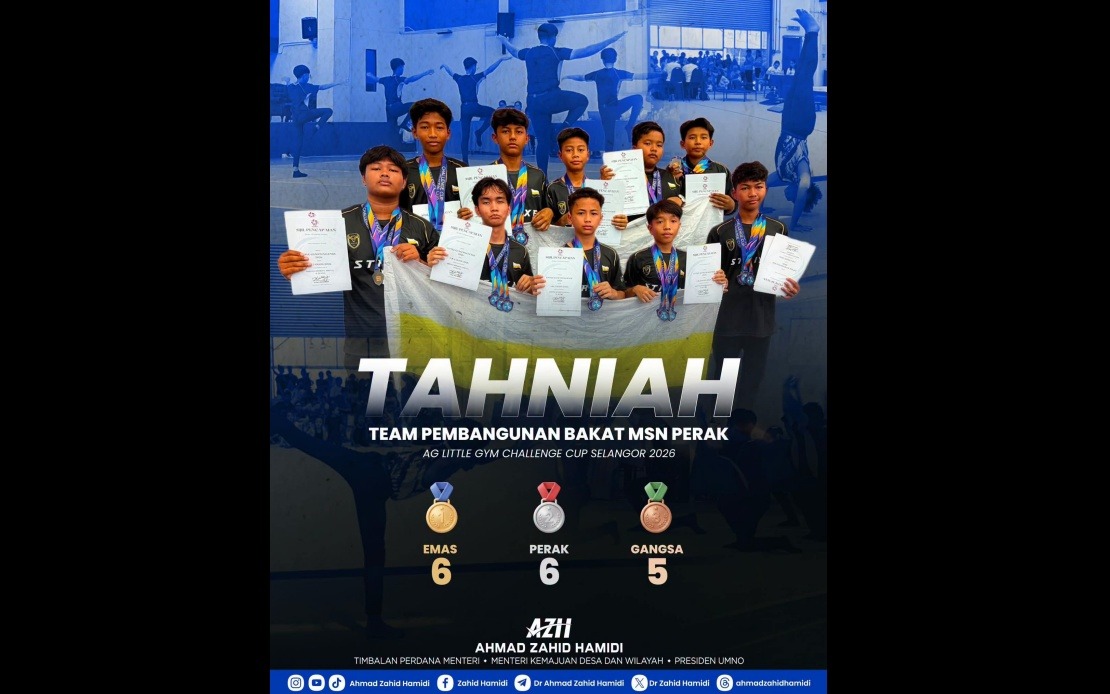
Young gymnasts from the district of Bagan Datuk have secured a remarkable medal tally at the AG Little Gym Challenge Cup Selangor 2026, capturing six gold medals alongside six silver and five bronze medals in a competition held in Kajang on August 1. The performance has drawn recognition from prominent political figures and local sports organizations, underlining the growing presence of competitive gymnastics talent in Perak's parliamentary constituencies.
Deputy Prime Minister Datuk Seri Dr Ahmad Zahid Hamidi, who represents Bagan Datuk in Parliament, highlighted the achievement through his social media channels, framing the medal haul as evidence of the district's capacity to nurture sporting excellence. His public endorsement carries particular significance as it reflects how local achievement in sports has become intertwined with constituency representation and regional pride across Malaysia. The acknowledgment from a senior government figure demonstrates the broader institutional recognition accorded to youth sporting accomplishments in the country's political landscape.
In his statement, Ahmad Zahid emphasized that the Bagan Datuk contingent's success extended beyond individual athletic prowess, suggesting a deeper narrative about balanced human development among young Malaysians. He specifically noted that gymnasts from the district had demonstrated academic competence alongside sporting ability, a positioning that aligns with national educational philosophy emphasizing holistic student achievement. This framing reflects ongoing policy conversations in Malaysia about nurturing youth who excel across multiple domains rather than specializing narrowly in single disciplines.
The Deputy Prime Minister directed his commendations toward the entire ecosystem supporting the young athletes, deliberately acknowledging coaches, parents, and supporting staff rather than focusing solely on individual medal winners. This inclusive approach mirrors contemporary thinking in Malaysian sports development, which increasingly emphasizes the role of family support structures and coaching quality in determining competitive outcomes. The recognition of collective effort underscores how grassroots sporting achievement depends on institutional infrastructure and parental commitment extending beyond the athletes themselves.
The Bagan Datuk Generasi Muda Gymnastics Club, the organization directly overseeing these young competitors, issued its own statement celebrating the Kajang competition results. Their public communication adopted motivational language emphasizing the relationship between physical achievement and personal character development, specifically highlighting discipline and determination as underlying virtues. This messaging strategy, common among Malaysian youth sports organizations, positions competitive medals as tangible evidence of intangible qualities considered socially valuable, particularly in the context of youth development narratives.
The club's statement notably reframed the Selangor competition results as a staging point rather than a culmination, explicitly articulating plans for intensified training regimens moving forward. This forward-looking perspective reflects ambitious competitive horizons within Bagan Datuk's gymnastics program, suggesting that organizers view the August 1 medal count as establishing baseline expectations for subsequent competitions rather than representing peak performance. Such positioning indicates institutional confidence in the talent pipeline and resources available to the gymnastics program.
Gymnastics has historically occupied a niche position within Malaysia's youth sports ecosystem, with fewer participants than team sports such as badminton, football, or netball, yet increasingly recognized as developing flexibility, balance, and spatial awareness valuable across multiple athletic domains. The emergence of competitive gymnastics programs in constituencies like Bagan Datuk reflects broader regional diversification of youth sporting opportunities beyond traditional school-centered activities. This expansion potentially opens pathways for young athletes who might not fit conventional sporting templates but possess the physical capabilities and temperament suited to gymnastics competition.
The success at the Selangor Challenge Cup carries particular relevance for Perak's sporting infrastructure, as gymnastics development requires specialized facilities, equipment, and coaching expertise that have historically concentrated in more urbanized Malaysian states. Bagan Datuk's competitive performance therefore suggests that gymnastics expertise and competitive culture have begun extending into smaller urban centers and secondary metropolitan areas, potentially indicating improvements in sports facility distribution and coaching professionalization across the country's regions.
For Malaysian observers tracking youth sports development more broadly, the Bagan Datuk achievement exemplifies how local sporting clubs increasingly function as community institutions extending beyond pure athletic competition. These organizations serve functions including social engagement, character development messaging, and constituency-level pride, embedding sporting success within broader narratives about community wellbeing and regional capability. The involvement of constituency-level political figures in celebrating sporting achievements reinforces this positioning of youth sports within community and governance frameworks.
The six-gold medal achievement also reflects contemporary trends in Malaysian gymnastics toward developing competitive depth rather than relying on individual champions. A gymnast winning multiple gold medals might indicate specialist excellence in specific apparatus, while a broader medal distribution across the contingent suggests systematic development of well-rounded gymnasts capable of competing across multiple events and categories. This portfolio approach to talent development aligns with international best practices in gymnastics coaching, suggesting that Malaysian programs increasingly draw on global coaching methodologies and competitive frameworks.

