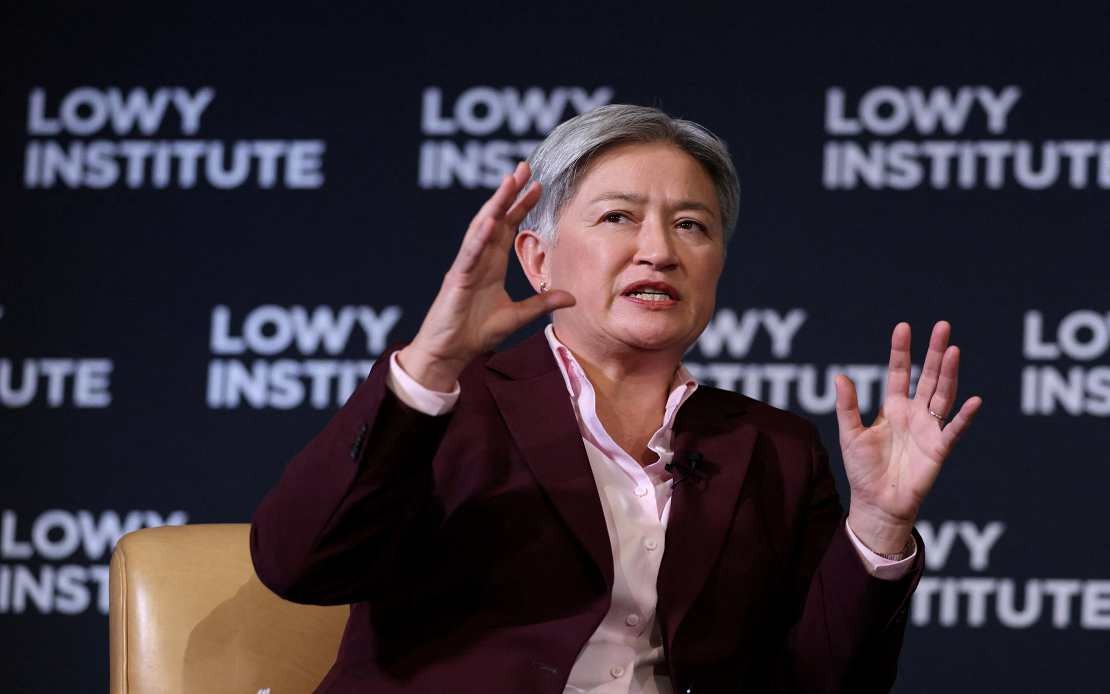
Australia's Foreign Affairs Minister Penny Wong has issued a stark warning about the risks of abandoning the nation's multicultural foundations, arguing in a Friday address at the Lowy Institute in Sydney that moves toward cultural homogeneity would cripple the country's economic and diplomatic standing. Her intervention represents a direct challenge to rising populist sentiments that have gained significant electoral traction, particularly among voters attracted to Senator Pauline Hanson's One Nation party, which has made restrictive immigration and nationalist themes central to its political platform.
Wong characterised calls for monoculturalism as a "melancholic fantasy" that would trap Australia in a posture of defensive inwardness. She articulated the interconnected nature of modern statehood, arguing that Australia's prosperity and security depend fundamentally on maintaining international relationships, partnerships, and cultural openness. By embracing homogeneity, Wong suggested, Australia would voluntarily excise the very attributes that have enabled its regional influence and economic dynamism. The minister's framing transforms what might otherwise appear as a cultural debate into a strategic question about national competitiveness and geopolitical positioning.
The context for Wong's remarks is a dramatic shift in Australian public opinion and electoral dynamics over recent years. One Nation, a right-wing populist party that has historically occupied the margins of Australian politics, has seen its support surge according to successive opinion polls through 2026. The party has articulated a platform centred on drastically curtailing immigration flows, withdrawing development aid, and extracting Australia from multilateral institutional arrangements that have shaped the country's diplomatic architecture for decades. Should One Nation secure power at the 2028 general election, these positions would likely translate into substantive policy shifts with profound regional implications.
Polling data reveal the magnitude of the shift occurring in Australian electoral preferences. A YouGov Australia survey conducted in July showed that 26 percent of respondents indicated an intention to vote for One Nation at the next election, representing a dramatic four-fold increase from the 6.4 percent support the party received in the 2025 general election. This trajectory reflects not merely marginal movement but a fundamental realignment of voter sentiment, particularly regarding immigration and national identity. The same polling indicated that the governing Labour Party's support has contracted to 28 percent from 34.5 percent at the prior election, while the conservative Coalition's backing has collapsed to 20 percent from 31.8 percent, suggesting that established parties are losing ground to the populist insurgent.
Public attitudes toward immigration itself have hardened markedly over the past two years. The Lowy Institute's annual polling, released in June 2026, documented that 55 percent of Australians now believe immigration intake is excessive, representing an increase from 53 percent the previous year and 48 percent in 2024. This consecutive year-on-year deterioration in public sentiment toward immigration provides the electoral tailwind propelling One Nation's ascent. The trend suggests that immigration concerns have moved from niche grievance to mainstream political preoccupation, creating opportunities for parties willing to articulate restrictive positions and leverage anxieties about cultural change, employment competition, and social cohesion.
Pauline Hanson's explicit advocacy for monoculturalism, articulated in June, provided the immediate catalyst for Wong's intervention. Hanson's statement represented an unusually forthright and ideologically pure articulation of cultural nationalism, abandoning the coded language through which such sentiments are sometimes expressed. By declaring that Australia must transition toward monoculturalism, Hanson was essentially arguing for the reversal of immigration and multiculturalism policies that have defined Australian governance for roughly half a century. Wong's response suggests that the government perceives this challenge as sufficiently significant to warrant direct rebuttal from senior Cabinet figures.
Wong's strategic argument deserves examination, particularly given its salience for Southeast Asian observers. She contended that pursuing monoculturalism would necessarily entail curtailing Australia's international options and partnerships. In Wong's formulation, cultural diversity and international engagement are not incidental virtues but functional necessities for a mid-sized power navigating a complex regional environment. This perspective implicitly positions Australia's multicultural character not primarily as an end in itself but as instrumental to strategic objectives including trade expansion, alliance formation, and technological innovation. For Malaysian observers particularly, this framing resonates with the reality that Australia's regional standing depends substantially on relationships with neighbours of vastly different cultural and religious compositions.
The political economy underlying Wong's argument reflects Australia's material interests in an integrated regional system. Australia's prosperity depends extensively on trade relationships, particularly with Asia, and on the free movement of capital, talent, and goods that characterize contemporary globalised commerce. Restricting immigration and withdrawing from multilateral institutions, as One Nation proposes, would likely damage Australia's competitive positioning in these domains. Wong's emphasis on "partners to trade with" and "opportunities to grow from" encapsulates how Australian economic strategy has increasingly become tied to engagement with Asia-Pacific neighbours, a relationship that depends partly on cultural and human connections that migration fosters.
The electoral dynamics at play in Australia carry lessons and warnings for other developed democracies grappling with populist challenges. One Nation's surge demonstrates how immigration and cultural identity concerns can rapidly mobilize electoral majorities if incumbent parties fail to address underlying anxieties with persuasive narratives of their own. The doubling of support over a single electoral cycle suggests not merely incremental opinion shift but potential for cascading realignment as voters identify a vehicle for expressing previously suppressed preferences. Wong's decision to engage directly with these themes suggests the government recognises the electoral threat as sufficiently acute to warrant Cabinet-level response.
For Southeast Asian countries with substantial stakes in Australia's regional orientation, the One Nation surge carries obvious implications. An Australian government committed to reducing immigration, withdrawing foreign aid, and extracting itself from multilateral institutions would represent a marked departure from decades of regional engagement. Many Southeast Asian nations depend on Australian development assistance and value the country's role in regional institutional architecture. A One Nation-led government might pursue more transactional bilateral relationships rather than multilateral engagement, potentially reducing the complexity and interdependence that characterise contemporary regional dynamics. Wong's intervention can be understood partly as an attempt to defend institutional arrangements and openness that benefit Australia's neighbours and partners.
The divergence between elite and public opinion on immigration evident in Australian polling also mirrors patterns documented across developed democracies. Wong's arguments, delivered at an elite think tank and directed toward sophisticated audiences concerned with strategic positioning, address a different audience than the voters migrating toward One Nation. One Nation's appeal appears rooted partly in concerns about rapid demographic change, labour market competition, and cultural transformation that elite narratives emphasising economic benefits and strategic necessity do not readily address. This gap between expert consensus on immigration's benefits and public anxiety about immigration's pace suggests that technical economic arguments alone may prove insufficient to arrest populist momentum.
The Australian debate unfolds against a backdrop of regional tensions and great-power competition that shape how nations calculate their strategic interests. Australia's continued engagement with multilateral institutions, its alliance relationships, and its openness to international partnerships have provided it with capacity to balance between competing powers and maintain agency in an increasingly contested region. A withdrawal toward monoculturalism and isolationism would likely constrain these options precisely when geopolitical pressures in the region appear to be intensifying. Wong's framing thus situates cultural and immigration policy within broader strategic considerations that extend beyond Australia's borders and that are directly relevant to regional stability and prosperity.
The trajectory of Australian politics toward the 2028 election will substantially shape the region's future orientation and Australia's role within it. Should One Nation continue accumulating support and carry this momentum into government, the consequences for regional engagement, multilateral institutions, and immigration policy would likely be substantial. Wong's intervention represents an effort to contest the narrative that monoculturalism strengthens nations, but whether rhetorical engagement from senior government figures can reverse or arrest the populist surge remains an open question with implications extending well beyond Australia's borders.

