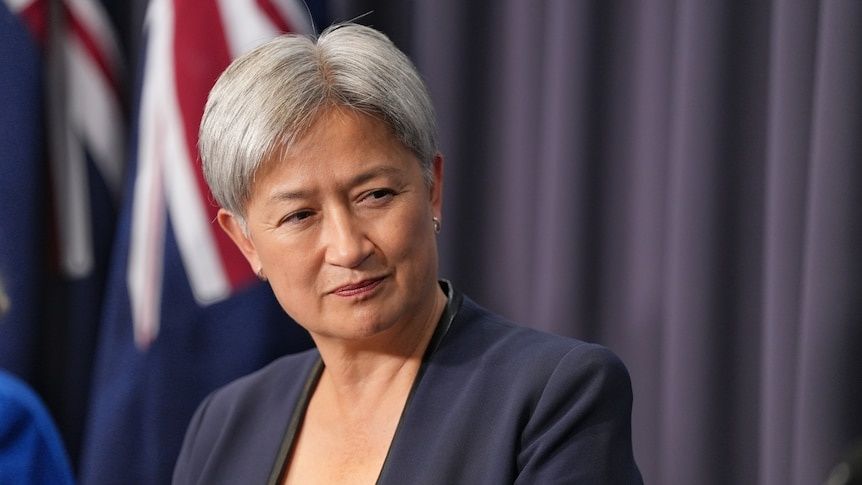
Australia's Foreign Minister Penny Wong will deliver a forceful endorsement of multiculturalism on Friday, explicitly rejecting calls for cultural homogeneity that have gained traction through the rising far-right One Nation party. In her address to the Lowy Institute in Sydney, Wong—herself born in Malaysia and the first Asian-Australian to serve as a federal minister—will frame multicultural society not merely as an aspirational ideal but as the historical foundation upon which modern Australia has been built, arguing that "multicultural Australia is the only Australia that has ever existed."
The timing of Wong's intervention reflects growing political anxiety within the Labor government about One Nation's dramatic ascendancy. Recent polling has elevated the party, led by Pauline Hanson, to become Australia's most popular political force, positioning it to potentially wield kingmaker influence in the 2028 federal election. Hanson, frequently compared internationally to figures such as US President Donald Trump and French politician Marine Le Pen, has become an increasingly vocal advocate for what she terms a "monoculture" Australia, fundamentally at odds with the nation's demographic reality and Wong's political worldview.
Wong's rhetoric will emphasise the practical dangers of pursuing cultural retrenchment, particularly for a middle power like Australia navigating an increasingly complex global environment. She will argue that abandoning multiculturalism represents not merely a retreat from progressive values but a strategic vulnerability that would diminish Australia's international leverage. The "melancholic fantasy of a monoculture," as Wong characterises it in her prepared remarks, would actively damage Australia's capacity to maintain crucial trade partnerships and security relationships that depend on cultural and diplomatic fluidity.
The demographic foundation for Wong's argument rests on compelling census data: fully half of all Australians were either born outside the country or have at least one parent born overseas. This statistic underscores how deeply embedded diversity is in contemporary Australian society, making any genuine pivot toward homogeneity not merely ideologically fraught but practically implausible. Wong plans to highlight the contributions of refugee communities to Australia's economic and sporting achievements, offering concrete examples of how migrants have enriched the nation across multiple domains.
One Nation's political resurgence has been particularly energised by Hanson's willingness to invoke historical exclusionary policies. This year, she sparked substantial controversy by referencing the "White Australia" policy framework of the 1970s—a restrictive immigration regime explicitly designed to limit non-white immigration. Such rhetoric represents a direct challenge to the multicultural consensus that has dominated Australian political discourse since the 1970s, signalling that historical grievances around immigration and cultural identity remain potent electoral territory.
Wong's message to political actors exploiting these divisions is unambiguous: such tactics ultimately diminish Australia's strength both domestically and internationally. She will state that "those who seek to divide us for clicks and votes should know that they make us weaker at home and more vulnerable in the world," a formulation that frames divisive politics not as mere rhetoric but as a genuine security liability. This framing attempts to elevate the multiculturalism debate beyond cultural identity disputes into questions of national interest and strategic positioning.
The geopolitical context animating Wong's concerns reflects Australia's particular vulnerabilities as a middle power in an era of intensifying great-power competition. She will warn that Australia faces systematic challenges in maintaining its "strategic space" as larger powers deploy military coercion, economic pressure, and control over critical technologies to constrain smaller nations' choices. In this environment, she will argue, cultural insularity and the abandonment of international engagement represented by One Nation's isolationist platform would leave Australia dangerously exposed and diminished.
Prime Minister Anthony Albanese has offered complementary messaging, emphasising that the Labor government recognises legitimate community concerns about economic pressures and housing affordability without conceding ground to the far-right framing. Albanese acknowledged on Friday that immigration levels had peaked and would be moderated, though he was emphatic that any policy adjustments would occur "without vilifying people, without trying to divide the community, but bringing people together in the national interest." The distinction Albanese draws between managing immigration levels pragmatically and embracing divisive cultural nationalism represents the government's attempted middle path.
The government's positioning carries particular significance for Southeast Asian engagement with Australia. Wong, as the first senior Australian political figure of Asian heritage to hold such prominence, carries symbolic weight in reassuring regional partners that Australia remains genuinely committed to the Indo-Pacific as a community of diverse nations. One Nation's monoculture vision, by contrast, signals retreat from regional integration and partnership frameworks that have become central to Australian foreign policy since the end of the Cold War.
The immigration policy changes the Labor government plans to announce will operate against this ideological backdrop. Rather than yielding to One Nation's cultural nationalism, the government seeks to demonstrate that immigration management and multicultural commitment can coexist—that concerns about housing and economic strain need not translate into wholesale rejection of diversity. This represents a calculated political gambit to neutralise One Nation's electoral appeal by conceding ground on policy technicalities while defending the broader multicultural framework.
Wong's framing of multiculturalism as both historically accurate and strategically essential represents an attempt to redefine the political terrain around immigration and identity. By insisting that diversity is not an imported ideology requiring justification but rather the authentic expression of Australian history and the necessary precondition for Australian strength, she seeks to flip the narrative from defence to assertion. Whether this messaging proves sufficient to arrest One Nation's momentum ahead of 2028 remains uncertain, but it signals that Australia's major parties will contest fundamentally different visions of national identity.

