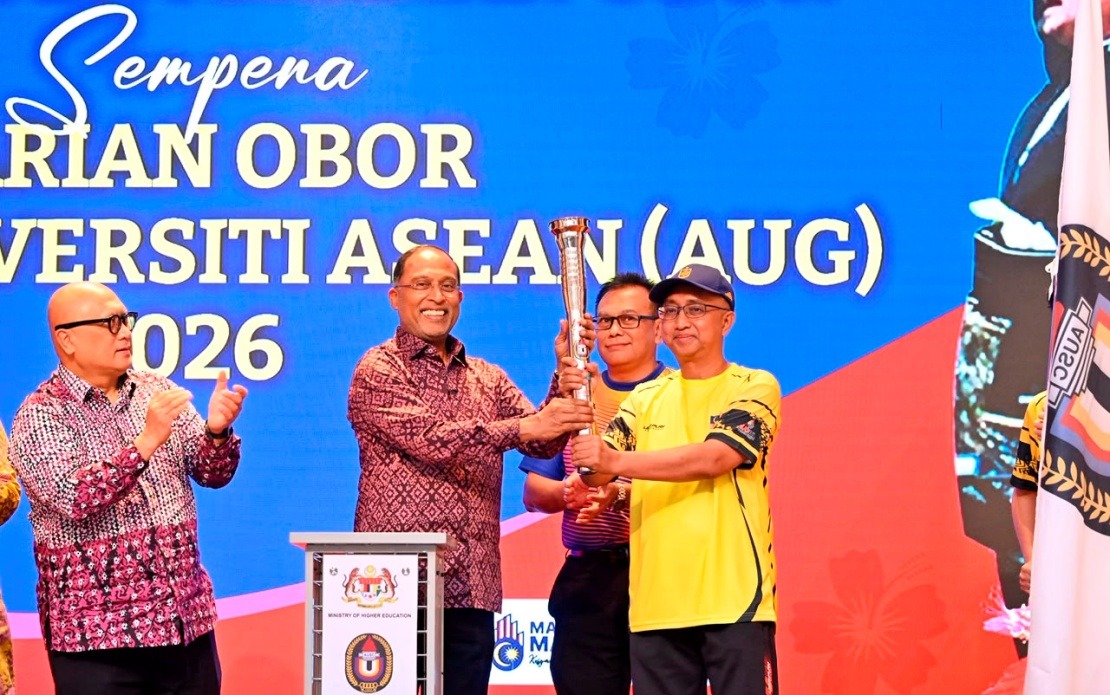
Malaysia's commitment to hosting a landmark regional university sporting event moved into its symbolic phase today with the lighting of the ASEAN University Games torch at the Ministry of Higher Education headquarters in Putrajaya. The ceremonial handover, conducted during the ministry's monthly assembly, represents more than a logistical milestone—it signals the nation's readiness to showcase both athletic excellence and institutional pride on the Southeast Asian stage.
Higher Education Minister Datuk Seri Dr Zambry Abd Kadir conveyed the torch to Prof Dr Mohammad Ismail, Deputy Vice-Chancellor for Student and Alumni Affairs at Universiti Malaysia Kelantan, who will guide Malaysia's contingent through the competition. Zambry's message to the athletes transcended the ceremonial nature of the event, emphasizing that each participant carries a dual responsibility: to pursue victory while representing Malaysia's standing among regional peers. His call to "carry the Malaysian torch and the torch of victory" underscored the government's expectation that university athletes function as ambassadors during international competition.
The opening relay featured four accomplished national competitors who embody Malaysia's sporting diversity. Long jumper Andre Anura Anuar and shot putter Nani Sahirah Maryata, both from Universiti Putra Malaysia, demonstrated Malaysia's strength in track and field disciplines. Karate competitor Thevendran Kaliana Sundram from Universiti Pertahanan Nasional Malaysia and taekwondo athlete Lee Hui Yee, representing Sultan Salahuddin Abdul Aziz Shah Polytechnic, illustrated the breadth of martial arts talent within Malaysian tertiary institutions. Their presence transformed an administrative ceremony into a public validation of student-athlete achievement.
The torch's journey extends well beyond Putrajaya's government precinct, tracing a symbolic map across Malaysia's leading universities. After departing from the Ministry of Higher Education and passing through the Ministry of Tourism, Arts and Culture, the relay will continue through Universiti Kebangsaan Malaysia, Universiti Putra Malaysia, Universiti Pertahanan Nasional Malaysia, Universiti Malaya, and Universiti Teknologi MARA. This geographically distributed torch run ensures institutional inclusion and builds anticipation across campuses that will provide both competitors and supporting infrastructure for the games.
The scale of the December competition underscores Malaysia's significant organizational undertaking. Nearly 4,700 participants will converge on Malaysian venues, comprising 2,849 athletes and officials drawn from all eleven ASEAN member nations. The supporting ecosystem includes 700 referees and competition officials alongside 920 volunteers—a human infrastructure demonstrating how regional sporting events mobilize broader community engagement beyond the competitive arena. Such numbers reflect not merely sporting interest but the deepening integration of tertiary education systems across Southeast Asia.
Nineteen sporting disciplines will compete under the unifying theme "HOLISTIC.EXCELLENCE," a philosophical framework suggesting that university games should develop well-rounded competitors and institutions. The competition venues spread across the Klang Valley region—Shah Alam, Kuala Lumpur, Serdang, and Bangi—will showcase Malaysia's capacity to manage simultaneous multi-sport events across dispersed facilities. This distribution also distributes economic benefits and visibility beyond the capital city.
The December 10-19 window positions the games as a critical year-end sporting calendar fixture for Southeast Asian universities. For Malaysian institutions, hosting provides competitive home advantages while demonstrating educational institutions' role in developing athletic talent alongside academic excellence. The torch run crystallizes this dual commitment, transforming abstract preparation into visible celebration.
For Malaysia's regional standing, the games represent an opportunity to affirm soft power through sporting hospitality and organizational competence. ASEAN university competition serves as a pipeline for national teams and an incubator for sports talent development. By successfully executing the AUG 2026, Malaysia reinforces its position as a capable regional host and affirms that Southeast Asian tertiary institutions maintain world-class competitive standards.
The torch relay's symbolism carries particular weight in the Malaysian context, where universities have historically served as wellsprings of national talent across multiple domains. That the Ministry of Higher Education formally inaugurates the torch run—rather than leaving it to sports bureaucracies—signals government recognition that university competition represents more than recreational activity. It constitutes a strategic investment in human capital development and regional standing.
For participating athletes and supporting institutions, the torch moment marks the transition from preparation to competitive readiness. The symbolic passing of responsibility from political leadership to university contingent chief signals that the moment for results has arrived. In the weeks remaining before December, that torch will illuminate training regimens, institutional ambitions, and Malaysia's determination to excel when the region's university sports community assembles on Malaysian soil.

