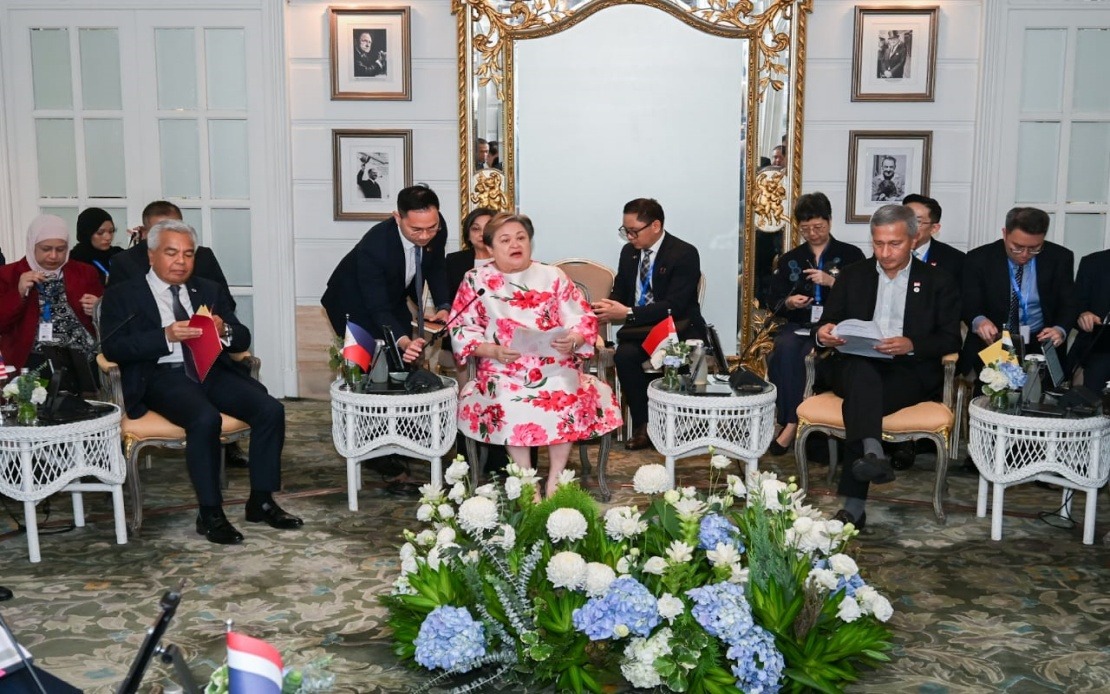
ASEAN is holding firm to its Five-Point Consensus as the cornerstone of its approach to Myanmar's political crisis, even as the junta-controlled parliament recently voted to reject the regional roadmap. At meetings held in Bangkok this week, ASEAN foreign ministers reinforced their commitment to the framework, which was originally adopted in April 2021 and calls for an immediate halt to violence, inclusive political dialogue, humanitarian assistance, and mediation through an ASEAN Special Envoy. The reaffirmation comes amid mounting frustration within the bloc over Myanmar's apparent intransigence and the deteriorating humanitarian situation on the ground.
Philippine Foreign Secretary Maria Theresa Lazaro, serving as the ASEAN Chair's Special Envoy on Myanmar, made clear that the regional organisation will not abandon its consensus-based approach despite rejection from Naypyidaw. Speaking at a joint press conference in Bangkok with Thailand's Foreign Minister Sihasak Phuangketkeow, Lazaro underscored that the Five-Point Consensus remains the foundational document guiding all of ASEAN's interactions with Myanmar's government and other stakeholders. Her remarks effectively signalled that ASEAN would not be swayed by the Myanmar parliament's recent motion against the plan, and that the bloc would continue to use the framework as its basis for engagement.
The meetings, which included the Informal Meeting of ASEAN Foreign Ministers and an Extended Informal Consultation on Myanmar, marked a significant moment in regional diplomacy. This was the first in-person gathering between ASEAN foreign ministers and Myanmar's Foreign Minister since the military coup in February 2021 triggered the current political crisis. The fact that such a meeting could be arranged at all, given the deep divisions within ASEAN over how to handle Myanmar, suggests careful diplomatic preparation and a shared desire among member states to maintain dialogue even under strained circumstances. Malaysia was represented by Foreign Ministry Secretary-General Tan Sri Amran Mohamed Zin, while Cambodia notably did not send a representative.
During the meetings, ASEAN conveyed three specific expectations to Myanmar's government. The first centres on expanding humanitarian assistance to the Myanmar population, which has suffered immensely under military rule and the ongoing civil conflict. ASEAN indicated plans for a humanitarian mission led by the Chair to explore concrete ways of increasing aid delivery to affected communities. This focus reflects growing concern within the bloc about the humanitarian toll of Myanmar's instability, including food insecurity, displacement, and limited access to healthcare and education across large parts of the country.
The second expectation concerns a reduction in violence, particularly targeting of civilians. Since the coup, Myanmar has witnessed escalating armed conflict between the military and various opposition forces, with civilian populations caught in the crossfire. ASEAN's emphasis on this point reflects international pressure and the bloc's own internal concerns about regional stability and refugee flows that could affect neighbouring countries, particularly Thailand which shares a long border with Myanmar.
Third on ASEAN's agenda is the promotion of more inclusive political dialogue aimed at achieving national reconciliation. This dimension encompasses efforts to foster a political environment conducive to negotiations between the junta, opposition groups, and ethnic minority forces. ASEAN has also specifically called for the release of political prisoners held by the Myanmar military, recognising that the absence of dialogue partners outside detention makes meaningful negotiations virtually impossible. The emphasis on inclusivity reflects ASEAN's longstanding commitment to consensus-building and the belief that sustainable solutions require the participation of all significant political actors.
Thailand's Foreign Minister offered a nuanced perspective on ASEAN's strategy, characterising the bloc's approach as "calibrated engagement"—a diplomatic formulation that attempts to balance pressure with dialogue. Sihasak emphasised that this engagement is fundamentally a two-way proposition, requiring Myanmar to reciprocate by demonstrating willingness to address ASEAN's concerns and broader international expectations. He acknowledged that while ASEAN remains united behind the Five-Point Consensus, the real challenge lies not in the framework itself but in devising and executing a coherent implementation strategy that can move the consensus from rhetoric to tangible results.
For Malaysian readers and the broader Southeast Asian audience, the significance of ASEAN's stance extends beyond sympathy for Myanmar's people. Myanmar's instability poses direct consequences for the region: refugee pressures on Thailand and potentially on Malaysia, cross-border armed conflicts, disrupted trade routes, and the risk of greater external powers exploiting regional divisions. Malaysia, as a significant player within ASEAN, has stakes in both maintaining regional cohesion and demonstrating that the bloc can exercise meaningful influence over one of its members. The presence of Malaysia's representative at these meetings signals continued engagement despite the complexity of the Myanmar situation.
The rejection of the Five-Point Consensus by Myanmar's parliament, announced just days before these meetings, appeared designed to undermine ASEAN's position. However, the bloc's response suggests it will not be easily deterred. ASEAN's insistence on the framework reflects both pragmatism—the consensus represents the broadest point of agreement within the bloc—and a determination to maintain its primacy as the institutional guardian of regional affairs. By reaffirming the Five-Point Consensus, ASEAN is also signalling to the international community that it has not abandoned Myanmar to chaos or external intervention.
The question of timelines and accountability remains unresolved. When asked whether Myanmar had been given a specific deadline to address ASEAN's concerns, Sihasak indicated that the bloc would assess progress at the ASEAN Summit scheduled for later in the year. This approach preserves ASEAN's consensus-building style while creating space for negotiations, though it also risks allowing the Myanmar situation to drift without concrete pressure for change. The summit will likely become a focal point for evaluating whether the calibrated engagement strategy is yielding meaningful progress or simply providing cover for continued military entrenchment.
The path forward for ASEAN remains challenging. The bloc faces pressure from within its own ranks—Vietnam and some other members favour stronger positions on Myanmar, while Laos maintains closer ties with the junta. Externally, the United States, European Union, and other Western powers are watching to see whether ASEAN can translate diplomatic engagement into tangible improvements in Myanmar's governance and human rights record. For Malaysia and other ASEAN members, the Five-Point Consensus represents a delicate balance: it acknowledges ASEAN's commitment to engagement and non-interference in member states' internal affairs while simultaneously asserting that such non-interference has limits when regional stability is threatened.
Looking ahead, the success of ASEAN's approach will depend on whether Myanmar's military leadership shows any genuine inclination to move toward the political dialogue and inclusive governance that the Five-Point Consensus envisions. Without such willingness, even the most carefully calibrated engagement may prove insufficient to alter the trajectory of Myanmar's crisis. For now, ASEAN appears determined to persist with diplomacy, recognising that abandoning the framework would represent a defeat for regional institutional authority and might open the door to competing external influences in Myanmar's future.

