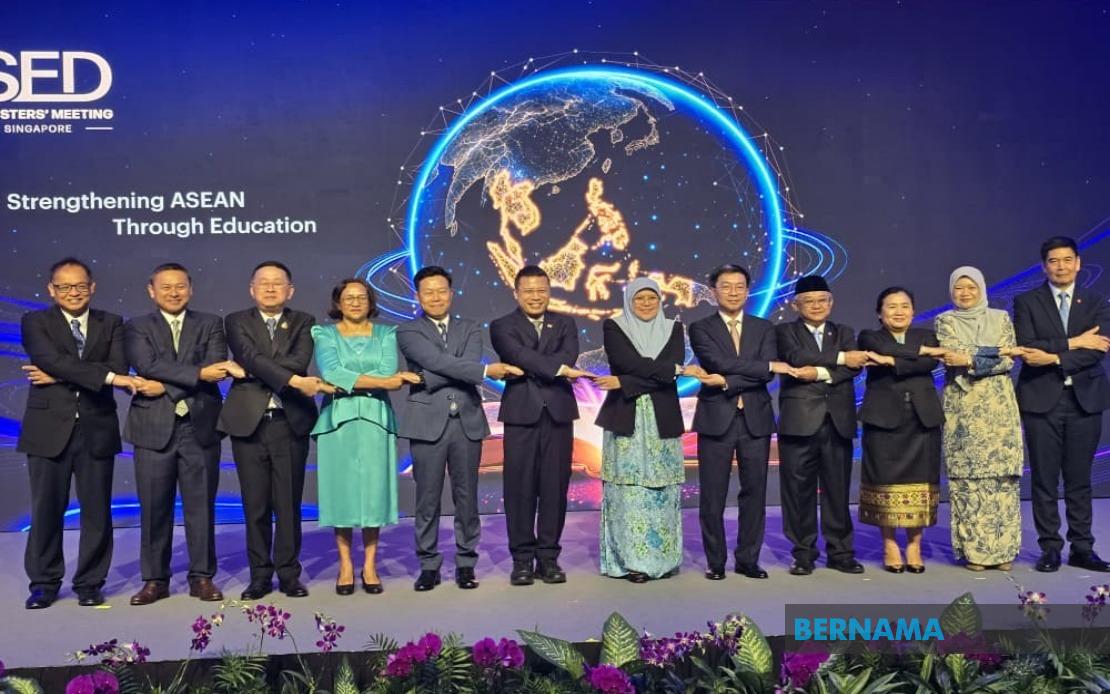
Southeast Asia's education landscape is undergoing significant transformation following the launch of ASEAN's Five-Year Work Plan on Education 2026-2030 at the 14th ASEAN Education Ministers Meeting in Singapore on Wednesday. The comprehensive framework represents a coordinated regional commitment to overhauling education systems across all member states, with particular emphasis on equipping citizens with skills demanded by rapidly evolving global markets while preserving ASEAN's distinctive cultural values and fostering closer integration among member nations.
The strategic plan emerged from deliberations among education ministers from across the region, including Malaysia's Minister of Education Fadhlina Sidek and other senior officials representing ASEAN's diverse educational contexts. Rather than imposing uniform standards, the initiative acknowledges the varied development stages and priorities of member states while establishing common ground around key strategic themes. This collaborative approach recognises that educational excellence in the 21st century requires balancing technological innovation with foundational learning, preparing graduates who can navigate complex global challenges while maintaining rootedness in their own communities.
Singapore, assuming the 2026-2027 chairmanship of the ASEAN Education Sector, framed the initiative under the overarching theme "Strengthening ASEAN through Education." Education Minister Desmond Lee emphasised that the work plan directly addresses how education systems must adapt to technological disruption and shifting economic demands. His articulation of three priority pillars—artificial intelligence integration, STEM enhancement, and comprehensive student development—reflects growing regional anxiety about maintaining competitive advantage amid intensifying global competition for talent and investment. The emphasis on AI in educational contexts is particularly telling, signalling recognition that digital literacy and algorithmic understanding will become foundational skills rather than specialisations.
The STEM focus within the five-year framework addresses a persistent regional challenge: the skills gap between educational outputs and employer demands. Malaysian educators and policymakers have long grappled with this disconnect, where graduates possess theoretical knowledge but lack practical, problem-solving capabilities in high-demand sectors. By elevating STEM across ASEAN, the work plan encourages member states to invest in laboratory infrastructure, teacher professional development, and curriculum redesign to embed scientific and mathematical thinking into pedagogical practice rather than treating these subjects as isolated disciplines.
Beyond technical skills development, the plan explicitly prioritises holistic student growth, acknowledging that employability extends beyond academic credentials. This philosophy embraces development of resilience, creativity, collaboration, and ethical reasoning—capacities increasingly recognised as essential for navigating volatility and disruption. For Malaysia particularly, where education has historically emphasised examination performance and rote learning, this reframing towards well-rounded development represents potential pedagogical shift with implications for curriculum design, teacher training, and assessment methodologies across schools and universities.
Central to the initiative is Singapore's commitment to establish a regional research network through its Centre for Character and Citizenship Education, designed to harmonise values education approaches across ASEAN member states. This institutional mechanism addresses a subtle but significant challenge in regional education cooperation: how to promote shared values—respect for diversity, regional solidarity, commitment to democratic principles—without imposing cultural homogeneity or undermining national sovereignty. By creating space for comparative analysis of how different countries embed values education within their curricula, the network allows knowledge transfer while respecting contextual differences.
The values education platform carries particular relevance for Malaysia, where education has traditionally served nation-building functions and where balancing religious, ethnic, and cultural considerations within curricula remains nuanced. By participating in ASEAN-level dialogue about values pedagogy, Malaysian educators gain exposure to innovative approaches while contributing their own experience to regional learning. Such exchanges strengthen professional networks and potentially reduce the sense of educational isolation that smaller member states might otherwise experience.
Inclusive access to quality education represents another foundational commitment embedded within the five-year work plan. This principle acknowledges that educational inequality persists across the region, with significant disparities between urban and rural areas, across socioeconomic strata, and between different demographic groups. For Malaysia, where disparities in educational quality correlate with geographic location and family income, renewed regional focus on equitable access creates policy pressure and provides comparative benchmarks for evaluating domestic progress. International frameworks can legitimise domestic reform efforts and demonstrate that addressing educational inequality constitutes shared regional priority rather than isolated national concern.
The timing of this five-year framework reflects broader Southeast Asian positioning amid great power competition and technological disruption. As China advances in education quality and as Western nations continue attracting regional talent, ASEAN's collective strategy implicitly asserts the region's capability to develop world-class education systems internally. By establishing shared aspirations and collaborative mechanisms, ASEAN members signal commitment to regional self-reliance in human capital development rather than defaulting to overseas education as primary path to competitive advantage.
Student well-being, explicitly mentioned as a priority, acknowledges accumulating evidence about mental health challenges afflicting young people across the region. Malaysian educators have increasingly confronted rising anxiety and depression rates among students, correlating with examination pressure and social media intensity. The work plan's emphasis on well-being suggests recognition that academic achievement divorced from psychological health produces fragile, ultimately unproductive outcomes. This signals potential policy evolution toward examination reform and greater investment in school counselling and mental health services across ASEAN.
Implementing such an ambitious regional education agenda presents substantial challenges. Member states operate under varying fiscal constraints, possess different institutional capacities, and face competing domestic priorities. Translation of aspirational frameworks into ground-level change requires sustained political commitment, adequate budgeting, teacher training at scale, and curriculum redesign—undertakings that routinely overwhelm even wealthy nations. For Malaysia and other developing economies, balancing rhetorical commitment with realistic resource allocation will determine whether this five-year plan produces transformative outcomes or remains primarily symbolic.
The work plan also implicitly acknowledges that education constitutes strategic infrastructure for regional integration. When ASEAN citizens possess comparable foundational competencies and shared understanding of regional values, cross-border mobility, collaboration, and integration accelerate. Educational harmonisation creates the human foundations for ASEAN Economic Community aspirations and regional political stability. From this perspective, investment in education represents not merely welfare provision but essential infrastructure for regional prosperity and political cohesion.
Looking forward, the five-year framework's success will depend substantially on mechanisms for monitoring, accountability, and adaptive implementation. ASEAN's historical challenge involves translating ministerial commitments into consistent member-state action, particularly when implementation requires resources or involves sensitive domestic issues. Regular review of progress, sharing of successful innovations, and peer accountability mechanisms will prove essential for translating this ambitious plan from policy document into lived educational transformation across the region's classrooms and universities.

