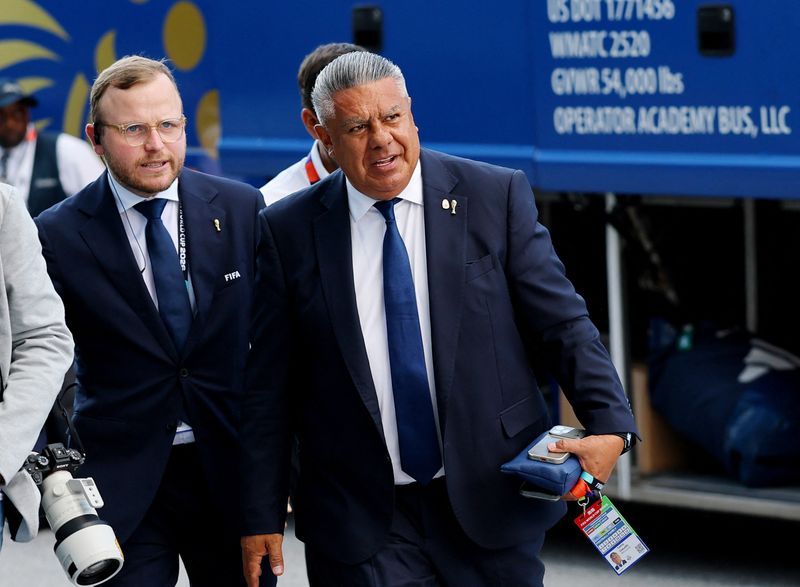
Argentina's football association moved swiftly to quash reports suggesting its president had come under formal legal scrutiny from American authorities, issuing a categorical denial on Wednesday that Claudio Tapia or treasurer Pablo Toviggino had been summoned to provide testimony in United States courts. The statement represented an attempt to contain fallout from earlier media accounts suggesting both senior officials had encountered federal agents at New York's JFK Airport, though the precise circumstances and legal implications remained contested between the AFA and various news outlets.
The association's denial came with a significant caveat: while insisting that Tapia and Toviggino faced no direct legal orders, the AFA acknowledged that someone else entirely had received a court subpoena to appear before a grand jury. That unnamed third party, according to the official statement, might be called upon to provide evidence regarding several individuals connected to the organisation, though the AFA did not elaborate on the scope or substance of what such testimony might address. This acknowledgment suggested that American legal authorities were indeed pursuing an investigative line touching on AFA operations and personnel, even if the headline officials were not, technically, personally summoned.
Media reports, particularly from the Argentine outlet Infobae, had painted a more dramatic picture of events at JFK Airport on Monday morning as Argentina's squad prepared to depart following the World Cup final. According to eyewitness accounts relayed through news organisations, federal agents had detained both Tapia and Toviggino on the tarmac itself, conducting questioning that lasted approximately thirty minutes while the two men sat aboard a bus parked adjacent to the aircraft. The same reports indicated that agents had sought access to Tapia's electronic devices, a detail that would normally suggest investigative interest in communications, financial records, or other digital evidence connected to the individual in question.
The US investigation touches on substantial sums and raises questions about governance in one of global football's most influential confederations. American authorities are reportedly examining contracts valued at more than $300 million that carry AFA linkages, suggesting that the scope extends beyond routine commercial arrangements into territory that warrants federal scrutiny. The investigation appears to sit within a broader framework of concern about Argentine football finances that has intensified since December raids conducted by local authorities investigating potential money laundering connected to the sport.
For Malaysian and Southeast Asian observers, the situation illustrates how international football governance intersects with complex jurisdictional and law enforcement landscapes. While FIFA and continental federations like CONMEBOL maintain substantial autonomy, the involvement of US courts and federal agents demonstrates how investigations into sports organisations can cross borders when contracts, commercial interests, or financial flows involve American parties or institutions. Similar dynamics could theoretically apply to football arrangements involving Asian nations and entities with ties to the United States.
The AFA's carefully worded statement appeared designed to draw a sharp distinction between formal legal orders and the airport encounter. The association explicitly rejected claims that devices had been confiscated, and emphasised that neither Tapia nor Toviggino faced personal procedural obligations or court-imposed measures arising from the document in question. However, the statement stopped short of addressing what precisely occurred at the airport or explaining the nature of the questions posed by federal agents, leaving open the possibility that informal investigative interviews had taken place outside the formal legal framework of a summons or subpoena.
The timing added a layer of diplomatic sensitivity. The incident occurred immediately after Argentina's World Cup victory, a moment of maximum national celebration and international visibility for the country's football authorities. Federal agents conducting such an encounter at that precise moment, regardless of technical legal classifications, carried symbolic weight and generated headlines that proved difficult to fully contain through subsequent denials. The optics of detaining the leader of a world championship team before departure created a narrative momentum that official statements alone could struggle to reverse.
The distinction between a formal summons and an investigative interview, while legally significant, carries limited persuasive power in public discourse. Media outlets and observers who had already reported the airport encounter found little incentive to substantially revise their coverage based on technical legal reframings. The question of why federal agents would seek to speak with Tapia at such length and in such circumstances remained the central enigma that the AFA's statement did not address, leaving room for speculation about the investigation's direction and intensity.
The broader investigation into AFA finances reflects international law enforcement attention to sports governance as a potential vector for financial crime. The December raids in Argentina had already indicated domestic concerns about money laundering in football, and the apparent parallel investigation by American authorities suggests those concerns resonate across jurisdictions. Whether the inquiry centres on contract irregularities, unexplained financial flows, or relationships between officials and commercial entities remains unclear from public statements, but the scale of the investigation—involving federal agents, grand juries, and international travel—indicates authorities consider the matter significant.
For Argentine football and the AFA's standing internationally, the investigation poses longer-term questions about institutional credibility and governance. Even if Tapia and other senior figures ultimately face no formal charges or sanctions, the process of investigation itself generates reputational damage and uncertainty. Continental and international football bodies may face pressure to address governance questions that investigations like this bring to light, potentially affecting how the AFA navigates future commercial arrangements, eligibility for tournaments, or relationships with FIFA and CONMEBOL.
The unresolved question is whether the investigation will expand to encompass Tapia and Toviggino directly, or whether the focus remains on the unnamed third party and whatever evidence they might provide about AFA operations. Should the investigation broaden, the carefully calibrated denials issued this week may come to look like early positioning rather than final resolution. For now, the AFA has attempted to contain the narrative, but the substance of the American authorities' inquiry continues independently of the association's public statements.

