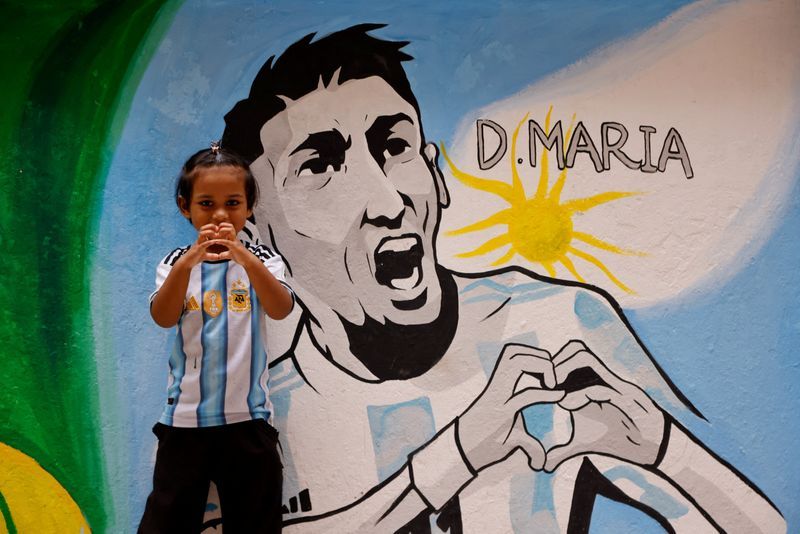
Argentina and Switzerland will collide in the World Cup knockout stage once more, carrying with them the weight of history from their dramatic encounter over a decade ago. The two nations last met at this tournament in 2014 in Brazil, when Angel Di Maria's extra-time goal finally broke through Swiss defensive resolve and propelled Lionel Messi's Argentina forward. Now, in what promises to be an equally compelling contest, the pair meet again with vastly different circumstances and expectations shaping their preparations.
The landscape of international football has shifted dramatically in the intervening years. When these teams first faced off in the round-of-16 in Sao Paulo, Argentina carried the burden of a nearly 30-year World Cup drought, their entire campaign seemingly dependent on extracting maximum value from Messi's extraordinary talents during his physical prime. Switzerland, meanwhile, remained aspirational visitors to the tournament, consistent qualifiers but perpetual frustration cases when knockout football beckoned. They had not advanced beyond the quarter-finals in over seven decades, since 1954, making each tournament campaign feel like another missed opportunity.
Argentina's position has transformed entirely. They arrive in the knockout stages as defending world champions, having claimed football's greatest prize at Qatar 2022 after finishing as runners-up eight years earlier in Russia. This silverware has reframed their entire narrative around the sport's biggest event. Yet paradoxically, their path to the quarter-finals has been anything but smooth. Against Egypt in the previous round, Argentina found themselves trailing 2-0 with just 11 minutes remaining before engineering a stunning 3-2 comeback, with Messi orchestrating the revival that has become the hallmark of this tournament's most compelling storyline. The captain himself acknowledged the pattern emerging in their campaign, describing the constant drama as an inevitable feature of World Cup football where momentum can shift in devastating fashion.
Messi, now 39 years old, has become an unexpected focal point once again despite the physical realities of age. No longer possessing the explosive athleticism that terrorized defenders throughout his career, the Argentina captain has nonetheless maintained a magnetic quality around which his team's entire tactical framework seems to revolve. His influence extends beyond statistics, encompassing the psychological dimension of facing a competitor whose name alone carries historical weight. Switzerland's players speak of him with genuine reverence, understanding that confronting his intelligence and experience represents a fundamentally different proposition than conventional opposition.
Switzerland's own narrative has undergone considerable evolution. Manager Murat Yakin's team has achieved what their predecessors could not, reaching the quarter-finals for the first time in 72 years through a penalty shootout victory over Colombia that followed a goalless stalemate. This achievement represents a watershed moment for Swiss football at the World Cup, suggesting that genuine progress has been made beyond the customary first-round exits and group-stage eliminations that have plagued their recent tournament history. The penalty victory demonstrated both mental fortitude and tactical acuity, qualities that Switzerland's football culture has long prided itself upon, yet qualities that have historically proven insufficient against the tournament's elite when knockout pressure intensifies.
Only three players remain from the 2014 meeting, a reflection of how thoroughly international football generations turn over and how exceptional it is for players to maintain peak performance across multiple tournament cycles. Messi represents one inevitable constant, his career spanning eras and redefining what longevity at the highest level means. Granit Xhaka, Switzerland's captain at age 33, and defender Ricardo Rodriguez, equally aged, provide continuity for the Swiss side. Xhaka has articulated the privilege of competing against Messi within this particular cycle, framing the experience as a culmination of his international career rather than another obstacle. Rodriguez similarly emphasized the respect demanded by Argentina's overall quality, not merely the individual brilliance their captain provides but the cohesive team structure that has enabled them to defend their crown.
Swiss football has evolved beyond the purely defensive paradigm that once defined their identity. Midfielder Johan Manzambi's creativity in advancing through the competition has proven instrumental, though a knee injury threatens his availability for this crucial encounter. Yakin clearly believes that Switzerland can exploit specific vulnerabilities exposed when Argentina faced Cape Verde and Egypt, suggesting that the defending champions' recent matches have revealed tactical patterns susceptible to precise counter-pressing and transition play. This analysis reflects sophisticated preparation rather than mere hope, indicating that Switzerland approaches this match with genuine tactical conviction rather than resigned acceptance of their underdog status.
Argentina's coaching staff, led by Lionel Scaloni, has indicated that they will largely retain the XI that defeated Egypt, signaling confidence in the unit that has demonstrated remarkable resilience under extreme pressure. Scaloni has characterized Switzerland as representatives of "an incredible World Cup tradition" and acknowledged their "outstanding players," language that reflects appropriate respect without conceding psychological ground. The Argentina manager understands that Switzerland's journey to the quarter-finals represents genuine achievement, not fortunate circumstance, and that complacency could prove catastrophic against opponents who have never accepted limitations imposed by historical precedent.
The narrative symmetry of this rematch extends beyond mere statistics. Switzerland finally possess the quarter-final berth they have sought for generations, yet their pathway to progression once again passes through Argentina and Messi. The intervening 12 years have elevated both teams' respective tournaments—Argentina from aspirants to defending champions, Switzerland from consistent disappointments to serious contenders—yet their fundamental opposition remains unchanged. This contest will determine whether Switzerland can finally overcome the mountain that blocked their passage over a decade ago, or whether Argentina's experience and championship pedigree will prove decisive once more. The match carries weight beyond mere sporting competition, embodying questions about generational evolution, sustained excellence, and whether historical patterns can be broken through determination and tactical insight. For Malaysian readers and broader Southeast Asian audiences, this encounter epitomizes how elite football transcends geography and unites global attention around questions of human achievement, team dynamics, and whether experience or fresh ambition ultimately prevails when titans clash.

